
About
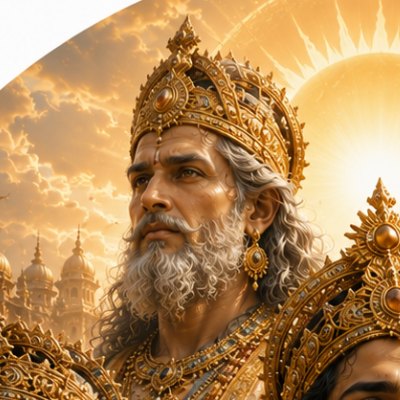
Maru — Immortal King of the Ikshvaku Solar Dynasty, Preserver of the Solar Line
Maru · Maru Aikshvaka · Maru of Kalagrama · Maru of Kalapagrama
Maru is a king of the Ikshvaku Solar Dynasty, recorded in the Bhagavata Purana as the son of Shighra and the father of Prashruta. He is one of the most theologically singular figures in the entire post-Rama Ikshvaku genealogy, distinguished not by martial achievement or philosophical teaching but by a quality that transcends the ordinary arc of royal succession: he is alive still. The Bhagavata Purana states explicitly that Maru, through mastery of yoga, continues to reside in the village of Kalagrama — a sacred settlement located beyond the Himalayan ranges — and that at the end of the Kali Yuga he will revive the extinct Solar Dynasty. The Bhagavata Purana's twelfth skandha corroborates this, identifying Maru alongside Devapi — an immortal of the Lunar Dynasty — as one of two living witnesses to the ancient royal lineages who will, at the instruction of Vasudeva, return to human society and re-establish the eternal order of dharma. He appears in the Bhagavata Purana, the Vishnu Purana, the Vayu Purana, the Brahmanda Purana, and is referenced in the Kalki Purana.
✦ The Name
The name Maru in Sanskrit means desert, wilderness, or arid land. As a name for a king of the Solar Dynasty, the term does not carry an obvious regal connotation, and its relationship to the king's nature or role is not explained in the primary sources consulted. The Kalki Purana, an Upapurana of relatively late composition, additionally refers to Maru by the names Budha and Sumitra in one narrative passage, though these alternate designations do not appear in the primary Mahapurana sources and should be treated as specific to that text's tradition.
✦ Lineage
- Dynasty: Ikshvaku Solar Dynasty (Suryavamsha), Kosala branch — descending from Surya through Manu Vaivasvata, Ikshvaku, and the long Ayodhya line through Rama and his son Kusha.
- Father: Shighra — an Ikshvaku king of Kosala, son of Agnivarna. Agnivarna is the king depicted in the nineteenth canto of Kalidasa's Raghuvamsha as a pleasure-seeking ruler who died young, leaving a pregnant queen to hold the throne; Shighra is the son born of that succession.
- Son: Prashruta (also called Prasushruta in some Puranic variants) — the next king in the Ikshvaku succession after Maru, who continues the dynasty's line through the Kali Yuga kings toward Brihadbala.
- Companion in Kalagrama: Devapi — a chiranjivin of the Lunar Dynasty (Chandravamsha), identified in the Bhagavata Purana as the brother of King Shantanu of the Kuru lineage. Devapi and Maru are described together in the Bhagavata Purana's twelfth skandha as the two immortal kings who await the end of the Kali Yuga side by side in the village of Kalagrama.
✦ Residence in Kalagrama and the Power of Yoga
The Bhagavata Purana's ninth skandha, chapter twelve, contains a remarkable statement about Maru that sets him apart from every other king in the post-Kusha Ikshvaku succession: it declares that Maru, having mastered yoga completely, is still residing in the village of Kalagrama at the time the text is being narrated. He has not died; he has not been succeeded by a son in any ordinary sense of succession during his own lifetime. Instead, through the power of yoga, he has maintained his existence across the span of ages, holding himself in readiness for a cosmic role that lies at the close of the current epoch.
Kalagrama — also referred to in the Puranic literature as Kalapagrama — is described in the Bhagavata Purana's tenth skandha as a village situated near Badarikashrama, the celebrated Himalayan shrine sacred to Vishnu. The Vayu Purana associates Kalapa with the Himalayan realm beyond the mountains. The Tagare translation of the Bhagavata Purana footnotes Kalagrama as located on or near the source of the Sarasvati tributary of the Alakananda in the Garhwal region. The village is thus identified with the high Himalayan zone, removed from the ordinary human world and associated with the concentrated spiritual power of the region surrounding Badrinath.
✦ The Prophecy: Restoration of the Solar Dynasty at the End of the Kali Yuga
The Bhagavata Purana's twelfth skandha, chapter two, verses 37 and 38, provides the fullest statement of Maru's eschatological role. The passage, narrated by the sage Shuka to King Parikshit, describes Maru and Devapi as two great kings of mystic strength who reside in the village of Kalapa at the time of narration. Maru is identified as a descendant of Ikshvaku and Devapi as the brother of Shantanu. At the close of the Kali Yuga, the text states, these two kings — having received direct instruction from the Supreme Personality Vasudeva — will return to human society. Their mission upon returning will be to re-establish the eternal order of dharma, characterised by the proper functioning of the divisions of varna and ashrama, as it existed before the degradation of the Kali Yuga.
The Vishnu Purana (IV.24) corroborates this prophecy, stating that Maru will be the future restorer of the Kshatriya race in the Solar Dynasty. The Vayu Purana's account, referenced in secondary scholarship, similarly declares that Maru will re-establish the Kshatriyas in a future cosmic cycle. The Kalki Purana, an Upapurana of later date, elaborates the narrative by depicting Maru meeting Kalki — the tenth avatar of Vishnu — in the Himalayas, and subsequently accompanying him in his campaigns before being placed by Kalki on the throne of Ayodhya to restore Solar Dynasty kingship after the purification of the earth.
✦ Maru Among the Long-Lived Beings of the Tradition
The tradition of Chiranjivis — beings granted extraordinary longevity or effective immortality through devotion, curse, boon, or yogic mastery — is well established in Puranic literature. The classical enumeration of seven Chiranjivis includes Ashvatthama, Mahabali, Vyasa, Hanuman, Vibhishana, Kripacharya, and Parashurama, with some lists extending to eight by including Markandeya. Maru is not consistently included in all canonical enumerations of the Chiranjivis, but the Bhagavata Purana and the Vishnu Purana both unambiguously describe him as a living being sustained by yoga across vast stretches of time — a condition functionally equivalent to that of the recognised Chiranjivis even if his name does not appear in every enumerated list. His situation, and that of his companion Devapi, represents a distinct Puranic category: not those made immortal by divine boon alone, but those sustained in existence by the perfected practice of yoga in service of a cosmic purpose yet to be fulfilled.
✦ Textual Variants
The Bhagavata Purana (IX.12.6) and the Vishnu Purana (IV.4) agree on Maru as the son of Shighra and place him in the same position in the Ikshvaku succession. The Vayu Purana and Brahmanda Purana contain parallel succession lists that are broadly consistent at this position. The name of Maru's son varies across texts: the Bhagavata Purana gives Prashruta, while other Puranic lists give Prasushruta or Suśruta at this position, a variant reflecting the common Puranic pattern of modest name-divergence across manuscript traditions. The Kalki Purana's identification of Maru additionally by the names Budha and Sumitra is specific to that Upapurana and does not appear in the Mahapurana sources.
✦ Theological Significance
Maru's theological significance within the Ikshvaku genealogy is profound and unique. Every other king in the succession from Kusha to Brihadbala is a historical figure in the Puranic sense — born, reigning, and dying within the normal arc of human kingship. Maru alone transcends this arc. His continued existence is presented not as a curiosity or an accident but as a purposive state: he is being preserved by yoga for a specific eschatological task, namely the renewal of righteous kingship at the moment of the universe's worst degradation. This makes him the dynastic guarantee of the Solar line's continuity — the living thread connecting the age of Rama through the Kali Yuga to the forthcoming Satya Yuga.
The pairing of Maru with Devapi in the Bhagavata Purana's twelfth skandha is also theologically rich. Devapi represents the Lunar Dynasty's living continuity; Maru represents the Solar Dynasty's. Their parallel vigil in Kalagrama mirrors the Puranic structure of cosmic balance between the two great royal lineages of human civilisation. Their return at Kalki's instruction will thus be simultaneously a renewal of both the Solar and Lunar dynasties — a complete restoration of the ancient Kshatriya order that dharma requires.
✦ Connection to the Wider Genealogy
Maru stands at the precise pivot between the dynastic past and the eschatological future of the Ikshvaku line. Ascending above him through Shighra, Agnivarna, Sudarshana, Dhruvasandhi, Pushya, and Hiranyanabha — the yoga master who taught Yajnavalkya — the chain reaches the thirteen unnarrated kings back to Atithi, son of Kusha, son of Rama. Descending below him through Prashruta, Sandhi, Amarshana, Mahasvan, Vishvasahva, Prasenajit, Takshaka, and finally Brihadbala, the succession reaches the last great warrior-king of the dynasty who died in the Padmavyuha at Abhimanyu's hands during the Kurukshetra war. Maru, though genealogically in the middle of this chain, is its theological anchor: the point at which the dynasty's mortal succession gives way to something altogether different — a king preserved alive through yoga, carrying within himself the seed of the Solar Dynasty's cosmic renewal.
✦ References
- Bhagavata Purana, Skandha IX, Chapter 12, Verse 6: Primary source. Records Maru as the son of Shighra; states explicitly that Maru, having mastered yoga perfectly, still resides in the village of Kalagrama; names his son as Prashruta.
- Bhagavata Purana, Skandha XII, Chapter 2, Verses 37–38: Primary source. The fullest prophetic statement of Maru's eschatological role: identifies him alongside Devapi as a living being of great mystic strength residing in Kalapa village; states that at the end of the Kali Yuga both will receive instruction from Vasudeva and return to re-establish the eternal dharmic order of varna and ashrama.
- Bhagavata Purana, Skandha X, Chapter 87, Verse 7: Primary source. Referenced in the Tagare footnote as giving the location of Kalagrama village near Badarikashrama.
- Vishnu Purana, IV.4 and IV.24: Primary source. Contains Maru in the Ikshvaku succession list (IV.4) and prophesies his future role as restorer of the Kshatriya race in the Solar Dynasty (IV.24); confirms his continued existence alongside Devapi in Kalapa.
- Vayu Purana, 88 and 99: Primary source. Preserves the parallel Ikshvaku succession list including Maru and contains the statement — referenced in secondary scholarship — that Maru will re-establish the Kshatriyas in the forthcoming cosmic cycle.
- Brahmanda Purana, III.63: Primary source. Contains the Ikshvaku succession list corroborating Maru's position as son of Shighra.
- Kalki Purana, Amsha III, Chapters 3–4: Upapurana source. Narrates Kalki's meeting with Maru and Devapi in the Himalayas; records the alternate names Budha and Sumitra applied to Maru within this text's tradition; describes Kalki's placement of Maru on the throne of Ayodhya following his campaigns. This is a relatively late Upapurana and its elaborations are distinct from the Mahapurana accounts.
- Vettam Mani, Puranic Encyclopaedia (1975): Modern reference. Cross-references Maru's position in the Ikshvaku succession and his connection to the Kalagrama prophecy across the Bhagavata Purana and Vishnu Purana sources.
- G.V. Tagare, Bhagavata Purana translation (1950), footnote to IX.12.6: Modern reference. The translator's footnote identifies Kalagrama with the Himalayan region near Badrinath and cross-references the Vayu Purana's statement about Maru's future role; the footnote also records that Devapi and Maru together represent the Solar and Lunar dynastic guardians at Kalapa.
- Vedabase.io — Srimad Bhagavatam 12.2.37–38: Modern reference. The Prabhupada translation of these verses was consulted to verify the rendering of Maru's description and his pairing with Devapi as given in the twelfth skandha's account of the Kali Yuga's symptoms and the future restoration of dharma.
- Cologne Digital Sanskrit Dictionaries — Monier-Williams: Modern reference. Consulted for the etymology of the name Maru and its primary meanings in classical Sanskrit.