
About
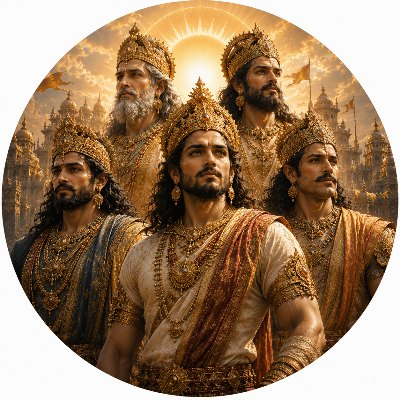
Pushya to Shighra — Five Kings of the Ikshvaku Solar Dynasty, Descendants of Hiranyanabha
Pushya · Dhruvasandhi · Sudarshana · Agnivarna · Shighra
This profile covers five successive kings of the Ikshvaku Solar Dynasty who reigned between Pushya — the son of Hiranyanabha, the celebrated yoga master of Kosala — and Shighra, the father of Maru, the immortal Solar king. These five kings are recorded in the Bhagavata Purana's ninth skandha, chapter twelve, as an unbroken patrilineal succession within the post-Hiranyanabha Kosala line. Of the five, Dhruvasandhi is distinguished by a brief note of royal prosperity in the Puranic Encyclopedia, and Agnivarna is the subject of a celebrated extended portrait in the Raghuvamsha of Kalidasa, the Sanskrit mahakavya that traces the Ikshvaku kings from their origins through the post-Rama succession. Pushya, Sudarshana, and Shighra appear solely in the genealogical lists without independent narrative elaboration in the primary sources consulted.
✦ Dynastic Context
These five kings occupy the segment of the post-Kusha Ikshvaku succession that falls between the spiritually distinguished era of Hiranyanabha — the yoga master who taught Yajnavalkya — and the exceptional era of Maru, the immortal Solar king who holds the dynasty's promise of cosmic renewal into the Kali Yuga. The Raghuvamsha of Kalidasa, which traces the Solar Dynasty's history through verse and which is corroborated by the Puranic genealogical lists as far as Agnivarna, treats this portion of the succession as the final phase of the dynasty's heroic age before the epoch of diminution represented by Agnivarna's reign.
✦ The Succession: King by King
- Pushya: Son of Hiranyanabha — the yoga master of Kosala who transmitted the Atmavidya to the sage Yajnavalkya and who was himself a disciple of Jaimini. Pushya succeeds his spiritually distinguished father in the Kosala throne. The Wisdom Library entry for Dhruvasandhi names Pushya as Pushpa in one variant, noting that Dhruvasandhi is the son of Pushpa, son of Hiranyanabha. No narrative episode is recorded for Pushya in the primary sources consulted beyond his position as son of Hiranyanabha and father of Dhruvasandhi.
- Dhruvasandhi: Son of Pushya. The Puranic Encyclopedia records that during the reign of Dhruvasandhi there was prosperity at Ayodhya and that the people under his rule were virtuous. His name in Sanskrit compounds dhruva, meaning fixed or constant, with sandhi, meaning junction or bond — a name suggesting unwavering stability or firm alliance. The Bhagavata Purana names his son as Sudarshana. Dhruvasandhi is the king at whose name the Raghuvamsha's historical corroboration with the Puranic succession list is most clearly established in secondary scholarship.
- Sudarshana: Son of Dhruvasandhi. His name means one of beautiful appearance or auspicious vision — sudarshana being also the name of the discus weapon of Vishnu, a term of deep Vaishnava significance. No independent narrative episode is recorded for the Ikshvaku king Sudarshana in the primary sources consulted; he serves as the link between Dhruvasandhi and Agnivarna in the succession.
- Agnivarna: Son of Sudarshana. He is by far the most narratively developed of the five kings in this group, owing to the extended portrait of his reign in the nineteenth canto of the Raghuvamsha — the celebrated Sanskrit mahakavya composed by Kalidasa, the foremost poet of the classical Sanskrit tradition. Kalidasa depicts Agnivarna as a king of extraordinary physical beauty and sensuous temperament who, unlike his ancestors, withdraws from the responsibilities of governance and public life in favour of private pleasure within the inner apartments of the palace. His name means one who has the colour of fire — agnivarna — a name of fierce solar connotation that sits ironically against his characterisation as a king of indolence. According to the Raghuvamsha's account, Agnivarna's neglect of royal duties and his immersion in sensual pleasures led to his premature death from a disease contracted in consequence of his dissolute lifestyle. He died leaving the throne without a clearly designated male successor. His pregnant queen — whose name is not given in the genealogical sources — was seated on the throne by the assembled ministers and citizens to govern as regent, with the expectation that the unborn child would carry the Solar Dynasty forward. The Bhagavata Purana names his son as Shighra, indicating that the dynasty continued.
- Shighra: Son of Agnivarna. His name means swift or rapid in Sanskrit — shighra being one of the most common Sanskrit words for speed. No independent narrative episode is recorded for Shighra in the primary sources consulted. His sole significance in the genealogical record is as the father of Maru — the immortal yoga master of the Solar Dynasty who, according to the Bhagavata Purana, resides still in the village of Kalagrama through the power of yogic mastery, awaiting the end of the Kali Yuga when he will revive the extinct Solar line.
✦ The Portrait of Agnivarna in the Raghuvamsha
The nineteenth canto of Kalidasa's Raghuvamsha is devoted almost entirely to Agnivarna and constitutes one of the most unusual portraits of a king in classical Sanskrit literature. Where earlier cantos of the poem celebrate Solar kings of heroic virtue — Dilipa, Raghu, Rama — the Agnivarna canto deliberately presents a king of the opposite type: beautiful, pleasure-seeking, politically negligent, and ultimately self-destructive. Kalidasa describes Agnivarna as so deeply absorbed in the company of women within the inner palace that his subjects could not obtain audience with him. Ministers and citizens who came seeking the king's presence were turned away or received only the touch of his hand extended through a curtain from within the women's apartments.
The canto ends with Agnivarna's death — attributed in Kalidasa's telling to the physical and moral deterioration caused by his manner of life — and the remarkable image of his pregnant queen being installed on the throne in his place. She is adorned with the royal insignia and seated on the throne to hold the kingdom in trust for the unborn heir. This closing image — a regent-queen carrying the future of the dynasty within her body — is one of the most striking in classical Sanskrit poetry and has attracted considerable scholarly attention as a meditation on dynastic continuity, female regency, and the consequences of royal failure.
The Raghuvamsha's account of Agnivarna is corroborated in its genealogical framework by the Puranic succession lists, which confirm Agnivarna as the son of Sudarshana and the father of Shighra. The moral and narrative detail of the canto, however, belongs to Kalidasa's literary elaboration rather than to the Puranic texts, which record Agnivarna only as a name in the succession.
✦ Textual Variants
The Bhagavata Purana's list — which gives the succession as Pushya, Dhruvasandhi, Sudarshana, Agnivarna, Shighra — is corroborated in its main outline by the Raghuvamsha and by the Shiva Purana's solar dynasty list. The Wisdom Library entry for Dhruvasandhi names Pushya as Pushpa in one tradition. The broader Ikshvaku dynasty lists compiled from cross-Puranic genealogies give Dhruvasandhi as Dhruvasandhi in all sources examined. No significant name-variation at these five positions is recorded in the sources consulted beyond the Pushya-Pushpa variant.
✦ Connection to the Wider Genealogy
These five kings form the penultimate segment of the Ikshvaku succession between Hiranyanabha and Maru. Above them stands the entire post-Kusha Ikshvaku chain reaching back to Rama, Dasharatha, and the ancient Solar kings of Ayodhya. Immediately above Pushya in the succession stands Hiranyanabha — son of Vidhriti, grandson of Khagana, great-grandson of Vajranabha, and the yoga master who taught Yajnavalkya the Atmavidya. Immediately below Shighra stands Maru — his son — who is described in the Bhagavata Purana as a perfected master of yoga who still lives in the village of Kalagrama through the power of that discipline, awaiting the appointed time of the dynasty's renewal after the Kalki avatar completes the close of the Kali Yuga. Further below Maru in the succession stand the kings Prashruta, Sandhi, Amarshana, Mahasvan, Vishvasahva, Prasenajit, Takshaka, and finally Brihadbala — the last great warrior-king of the Ikshvaku line, who died at Abhimanyu's hands within the Padmavyuha on the thirteenth day of the Kurukshetra war.
✦ References
- Bhagavata Purana, Skandha IX, Chapter 12, Verses 5–6: Primary source. Records the succession Pushya, Dhruvasandhi, Sudarshana, Agnivarna, Shighra as direct descendants of Hiranyanabha; names Shighra's son as Maru.
- Raghuvamsha of Kalidasa, Canto 19: Primary source. The sole extended literary portrait of Agnivarna in the classical tradition; describes his pleasure-seeking nature, his neglect of royal duties, his withdrawal into the inner palace, his early death, and the installation of his pregnant queen as regent-ruler of the Solar Dynasty. The genealogical framework of the canto corroborates the Puranic succession list through Dhruvasandhi and Agnivarna.
- Shiva Purana, Umasamhita, Chapter 39: Primary source. Contains the solar dynasty genealogical list including these kings within its enumeration of the Suryavamsha succession.
- Vishnu Purana, IV.4: Primary source. Preserves the Ikshvaku succession list including the segment from Pushya to Shighra.
- Brahmanda Purana, III.63; Vayu Purana, 88: Primary sources. Preserve parallel Ikshvaku succession lists consulted for cross-referencing the names in this group.
- Vettam Mani, Puranic Encyclopaedia (1975): Modern reference. The entry for Dhruvasandhi records the note of royal prosperity and popular virtue during his reign; the entry for Agnivarna notes his position in the Ikshvaku succession as son of Sudarshana.
- Wisdomlib.org — Definition page for Dhruvasandhi: Modern reference. The Purana glossary entry confirms Dhruvasandhi as son of Pushpa (variant of Pushya), son of Hiranyanabha, and names his son as Sudarshana; the Bhagavata Purana reference IX.12.3–4 is cited.
- Pargiter, F.E., Ancient Indian Historical Tradition (1972), Motilal Banarasidass: Modern reference. Pargiter's table of royal genealogies, cited in multiple secondary sources, notes the Raghuvamsha's corroboration of the Puranic succession list as far as Agnivarna, establishing the convergence of the epic-literary and Puranic traditions at this segment of the dynasty.
- Cologne Digital Sanskrit Dictionaries — Monier-Williams: Modern reference. Consulted for the etymology and meaning of the individual names Pushya, Dhruvasandhi, Sudarshana, Agnivarna, and Shighra.