
About
Hiranyanabha — King of Kosala, Yoga Master, Preceptor of the Atmavidya
Hiranyanabha · Hiranyanabha of Kosala · Hiranyanabha Kausalya
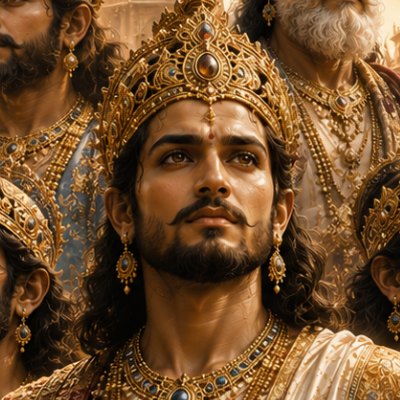
Hiranyanabha was a king of the Kosala kingdom belonging to the Ikshvaku Solar Dynasty, recorded in the Bhagavata Purana as the son of Vidhriti and the father of Pushya. He stands apart from the other kings of the post-Rama Ikshvaku succession by virtue of a distinction that transcends royal governance: he was a master of yoga and a preceptor of the Atmavidya — the spiritual science concerning the nature of the soul — and it was from him that the celebrated sage Yajnavalkya of Kosala received this teaching. The Bhagavata Purana states explicitly that Yajnavalkya obtained instruction in yoga relating to the knowledge of the soul from Hiranyanabha, a teaching described as leading to the attainment of great mystical powers and as severing the knot of ignorance within the heart. The Purana Index further identifies Hiranyanabha as a disciple of the sage Jaimini and as a significant figure in the transmission of the Sama Veda's eastern branch. He appears primarily in the Bhagavata Purana's ninth skandha, and is referenced across the Purana Index compilations drawing from the Vishnu Purana, Vayu Purana, and Brahmanda Purana.
✦ The Name
The name Hiranyanabha is a Sanskrit compound formed from hiranya, meaning gold or golden, and nabha, meaning navel or sky. The compound thus carries the sense of one who has a golden navel, a designation of considerable symbolic weight in the Vaishnava tradition: the navel is the cosmogonic centre from which creation emanates, and its gold-quality indicates divine luminosity and solar energy. The epithet Kausalya — meaning one of Kosala — appears in some textual references to distinguish this figure as the king-sage specifically associated with the Kosala region.
✦ Lineage
- Dynasty: Ikshvaku Solar Dynasty, Kosala branch — descending from Surya through Ikshvaku, through the long line of Ayodhya kings, and through Rama and his son Kusha.
- Father: Vidhriti — an Ikshvaku king of Kosala, son of Khagana (also called Sagana in some Puranic lists), who was himself the son of Vajranabha, the solar-born king of the dynasty.
- Son: Pushya — the next king in the Ikshvaku succession after Hiranyanabha, recorded in both the Bhagavata Purana and the Purana Index; the Wisdom Library entry gives the name as Pushpa in one variant.
- Teacher: Jaimini — the revered sage who served as Hiranyanabha's guru in the discipline of yoga; Jaimini is a figure of great stature in the Vedic and Puranic tradition, associated with the transmission of the Sama Veda and with the Mimamsa school of philosophy, though the Bhagavata Purana translator notes that the Jaimini referred to here is likely an ancient sage of the same name rather than the Purva Mimamsa sutrakara.
- Pupil: Yajnavalkya of Kosala — one of the supreme philosopher-sages of the Upanishadic tradition, most celebrated as the teacher of the Brihadaranyaka Upanishad and the Shukla Yajurveda; in the Bhagavata Purana's account, he received the Atmavidya from Hiranyanabha.
- Further Pupil: Krita — recorded in the Purana Index as a direct disciple of Hiranyanabha who composed the Samasamhita in twenty-four parts, the collection known as the Pracyasamas.
✦ Transmission of the Atmavidya to Yajnavalkya
The Bhagavata Purana's ninth skandha, chapter twelve, records the defining episode of Hiranyanabha's spiritual significance. The sage Yajnavalkya — described in the text as Yajnavalkya of Kosala — approached Hiranyanabha and received from him instruction in yoga pertaining to the Atmavidya, the science of the soul. The Bhagavata Purana characterises this teaching in terms that mark it as exceptional even within the extraordinarily rich tradition of Upanishadic transmission: the knowledge conveyed is described as leading to the attainment of great mystical powers — siddhis — and as capable of severing the inner knot formed by ego and ignorance within the heart of the practitioner.
This episode is theologically remarkable for the intersection it creates between two distinct streams of tradition. Hiranyanabha is a king — a Kshatriya ruler of the Solar Dynasty — and yet he functions here as the teacher of one of the greatest Brahmin sages in the entire Upanishadic corpus. Yajnavalkya's own identity as the chief interlocutor of the Brihadaranyaka Upanishad, as the sage who debated the nature of Brahman before the court of King Janaka, and as the revealer of the Shukla Yajurveda through direct solar revelation, makes the claim that he received a foundational teaching from a Kosala king a statement of considerable significance regarding the reach and diversity of the sources of genuine spiritual knowledge in the tradition.
✦ Role in the Transmission of the Sama Veda
Beyond his role as Yajnavalkya's teacher in yoga, the Purana Index records that Hiranyanabha occupied a position of significance in the transmission lineage of the Sama Veda's eastern branch, known as the Pracyasama. He is described as a Shrutarshi — one who has heard the scriptural revelation — and is associated with the Paushthanji or Sukarman lineage of Saman transmission. His disciple Krita received this teaching from him and composed a collection of twenty-four Samhitas, teaching each to a separate pupil; these texts and their transmission became known as the Pracyasamas and the Kartasamagas tradition. This Vedic transmission role places Hiranyanabha within the history of Sanskrit sacred literature not merely as a genealogical figure but as an active participant in the preservation and elaboration of the Sama Veda.
✦ Textual Variants and Related Figures
The Bhagavata Purana translator G.V. Tagare raises a scholarly note regarding the identification of Jaimini as Hiranyanabha's guru. The Jaimini most familiar in the tradition is the author of the Purva Mimamsa Sutras and a pupil of the sage Vyasa. Since Hiranyanabha is placed fourteen generations before Brihadbala — who was a contemporary of the Pandavas — a chronological tension arises in identifying his guru as the same Jaimini who was Vyasa's disciple. Tagare concludes that the Jaimini referred to in the Bhagavata Purana here is probably an ancient sage of the same name who predated the Mimamsa Jaimini, and that the name was shared by sages of different periods.
A distinct figure named Hiranyanabha appears in the Mahabharata's Shanti Parva, Chapter 149, as a son of Srinjaya who died in infancy, was subsequently revived by the sage Narada, and lived thereafter for a thousand years. This figure is entirely separate from the Ikshvaku king of Kosala and shares only the name.
The Vishnu Purana gives the name of Hiranyanabha's father as Vishvasaha in one reading, which the Purana Index notes as a variant alongside the Bhagavata Purana's Vidhriti. This reflects the broader pattern of modest name-variation across Puranic genealogical lists for the intermediate Ikshvaku kings of this era.
✦ Theological and Philosophical Significance
Hiranyanabha represents a distinctive type within the Puranic tradition: the raja-rishi, the king who is simultaneously a sage. While he holds the throne of Kosala as a Kshatriya successor in the Solar Dynasty, his primary significance in the primary sources lies not in warfare, statecraft, or dynastic achievement but in the transmission of an esoteric spiritual teaching. The knowledge he imparted — characterised in the Bhagavata Purana as yoga leading to siddhis and the dissolution of the ego-knot — is of the kind associated in Upanishadic literature with the highest class of spiritual instruction, the Brahmavidya or knowledge of ultimate reality.
The fact that Yajnavalkya — the Brahmin sage par excellence of the Shukla Yajurveda tradition — is recorded as having sought this teaching from a Kshatriya king of the Solar Dynasty follows a pattern found elsewhere in the Upanishads, where royal figures serve as repositories of philosophical knowledge that transcends the boundaries of varna. The Chandogya Upanishad and the Brihadaranyaka Upanishad both contain episodes in which Kshatriya kings teach Brahmin sages the highest knowledge of Brahman. Hiranyanabha's role in the Bhagavata Purana places him within this broader Upanishadic and Puranic motif of the spiritually realised king whose significance to tradition exceeds his political role.
✦ Connection to the Wider Genealogy
Hiranyanabha stands at the centre of the Ikshvaku succession that bridges the era of Kusha — son of Rama — and the era of the great king Brihadbala who died in the Kurukshetra war. Above him in the succession, separated by thirteen generations, stands Atithi, son of Kusha; above Atithi stands Kusha himself, the son of Rama and Sita; and above Kusha stands the entire ancient Ikshvaku line ascending to Manu Vaivasvata and Surya. Below Hiranyanabha in the succession stands Pushya, then Dhruvasandhi, Sudarshana, Agnivarna, and Shighra, before reaching Maru — the immortal Solar king who lives still in yogic seclusion — and then the later kings down to Prasenajit, Takshaka, and finally Brihadbala. Hiranyanabha's position in this chain is thus precisely at the chronological midpoint between the age of Rama and the age of the Mahabharata war, and his spiritual distinction marks this midpoint with a quality that sets him apart from the otherwise unnarrated succession of Kosala kings.
✦ References
- Bhagavata Purana, Skandha IX, Chapter 12, Verses 3–4: Primary source. Records Hiranyanabha as the son of Vidhriti, identifies him as a preceptor of yoga and a pupil of Jaimini, states that Yajnavalkya of Kosala received from him the Atmavidya pertaining to the soul leading to siddhis and the severing of the ego-knot, and names his son as Pushya.
- Vishnu Purana, IV.4: Primary source. Contains the Ikshvaku genealogical succession including Hiranyanabha; the Purana Index notes the Vishnu Purana gives his father's name as Vishvasaha as a variant reading.
- Vayu Purana and Brahmanda Purana: Primary sources. Referenced in the Purana Index for corroborating genealogical data on the Ikshvaku succession surrounding Hiranyanabha.
- Mahabharata, Shanti Parva, Chapter 149: Primary source. Records a separate and distinct figure named Hiranyanabha — a son of Srinjaya revived by Narada who lived for a thousand years — establishing the need to distinguish this figure from the Ikshvaku king of Kosala.
- Vettam Mani, Puranic Encyclopaedia (1975): Modern reference. The entry for Hiranyanabha records his identity as a Solar Dynasty king, son of Vidhriti and father of Pushya, and confirms the transmission of yoga knowledge to Yajnavalkya drawing from Bhagavata Purana ninth skandha; also notes the separate Shanti Parva figure.
- Wisdomlib.org — Definition page for Hiranyanabha; Bhagavata Purana Chapter 12 translation (G.V. Tagare): Modern reference. The translated verses and Purana Index entry were directly consulted; the Tagare footnote regarding the chronological difficulty of identifying Jaimini as the Mimamsa sage was noted and incorporated; the Purana Index entry for Hiranyanabha's role in the Pracyasama transmission of the Sama Veda — as disciple of Sukarman and teacher of Krita — was verified here.
- Cologne Digital Sanskrit Dictionaries — Monier-Williams: Modern reference. Consulted for the etymology of the name Hiranyanabha and its compound meaning.