
About
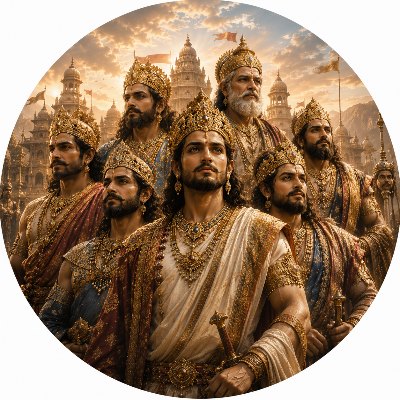
Atithi to Vidhriti — Thirteen Kings of the Ikshvaku Solar Dynasty, Descendants of Kusha
Atithi · Nishadha · Nabha · Pundarika · Kshemdhanva · Devanika · Aniha · Pariyatra · Bala · Sthala · Vajranabha · Khagana · Vidhriti
This profile covers thirteen successive kings of the Ikshvaku Solar Dynasty who reigned between Atithi — the son of Kusha, who was himself the son of Rama — and Vidhriti, the father of Hiranyanabha. These kings are recorded in the Bhagavata Purana's ninth skandha, chapter twelve, as an unbroken patrilineal succession within the Kosala branch of the Solar Dynasty, descending from the ancient royal line of Ayodhya. Their names are preserved in the dynastic genealogical lists of the Bhagavata Purana, Brahmanda Purana, Vayu Purana, and Vishnu Purana, though the names given at several positions differ across these texts. No independent narrative episodes are recorded for any of these thirteen kings in the primary sources consulted; they are known solely through their positions in the dynastic succession. One member of this group — Vajranabha — is distinguished by a single textual detail: the Bhagavata Purana states he was born from the effulgence of the sun god, a mark of special solar connection within an already solar lineage.
✦ Dynastic Context
The Ikshvaku Solar Dynasty — also called the Suryavamsha — is one of the two great royal lineages of Hindu tradition, tracing its descent from the sun god Surya through his son Manu Vaivasvata and Manu's son Ikshvaku, the founder of the line. The branch relevant to this profile descends from Rama — the seventh avatar of Vishnu and the hero of the Ramayana — through his son Kusha. Kusha's son Atithi is the first king in this group. The thirteen kings covered in this profile represent the middle portion of that post-Rama succession, occupying the dynastic record between the era of Kusha and the era of the distinguished yoga master Hiranyanabha. The kingdom associated with this branch of the Solar Dynasty is Kosala, with its ancient capital at Ayodhya, though the Puranic genealogical lists name the dynasty's continuation without always specifying the seat of rule for each individual king.
✦ The Succession: King by King
- Atithi: Son of Kusha, who was the son of Rama. Atithi is the immediate link between the age of Rama's direct descendants and the long succession of Kosala kings. His name in Sanskrit means a guest or one who arrives without fixed appointment — a term of considerable cultural significance in the tradition of hospitality. The Puranic Encyclopedia records the name in one variant as Aditi, though this appears to be a copyist variant.
- Nishadha: Son of Atithi. A name associated in other contexts with the Nishada tribal peoples and with the country of Nishada, though in this genealogical record Nishadha functions solely as the name of an Ikshvaku king with no narrative elaboration.
- Nabha: Son of Nishadha. The name means sky or space in Sanskrit. He occupies his position in the succession without further textual characterisation in the primary sources.
- Pundarika: Son of Nabha. The name means white lotus, a term of auspicious significance in the tradition. No narrative is attached to this king in the primary sources.
- Kshemdhanva: Son of Pundarika. The name compounds kshema, meaning safety or wellbeing, with dhanva, meaning a bow — thus the bearer of the bow of welfare or the archer of peace. No episode is recorded for him beyond his position in the succession.
- Devanika: Son of Kshemdhanva. The name may be parsed as deva (divine) and anika (army or face), suggesting one whose army is divine or who bears a divine countenance. No narrative elaboration exists in the primary sources.
- Aniha: Son of Devanika. In Sanskrit, aniha means one without desire or without effort — a name carrying ascetic or philosophical connotations. The Puranic Encyclopedia gives the name at this position as Rksha in one variant list, suggesting a scribal or textual divergence at this point in the genealogy.
- Pariyatra: Son of Aniha. The Pariyatra mountains, a range referenced in Puranic geographical literature, share this name, though no connection between the king and that geographical feature is stated in the primary sources.
- Bala: Son of Pariyatra. The name simply means strength or force. Some commentaries on the Bhagavata Purana treat Bala and Sthala together, specifying that Sthala is explicitly named as Bala's son in the text.
- Sthala: Son of Bala. The name means ground or firm place. The Puranic Encyclopedia gives the name at this position as Vinda in one variant tradition, and the Bhagavata Purana commentary consulted by Tagare specifies the father-son relationship between Bala and Sthala explicitly. The Purana Index entry for Vajranabha designates his father as Balasthala — a compound suggesting the two names may at some point in the manuscript tradition have been merged or confused.
- Vajranabha: Son of Sthala (or Balasthala in the Purana Index). He is the single most textually distinguished king in this group. The Bhagavata Purana states he was born from a portion — an amsha — of the sun god, making him a direct manifestation of solar divine energy within the human dynasty. His name means one whose navel is like a thunderbolt — vajra being the weapon of Indra and the hardest of substances, and nabha meaning navel or sky. The solar origin attributed to him reinforces the Solar Dynasty's claim to divine descent in a specific and personal form, not merely as a dynastic lineage but as an instance of direct divine emanation. His son is named Khagana.
- Khagana: Son of Vajranabha. The Bhagavata Purana names him as the immediate successor of Vajranabha. No independent narrative is recorded for him. His son is Vidhriti.
- Vidhriti: Son of Khagana and the final king in this group. He is significant solely as the father of Hiranyanabha — the celebrated yoga master of the Ikshvaku line who transmitted the spiritual science of the soul to the sage Yajnavalkya. No independent episode is recorded for Vidhriti himself.
✦ Note on Vajranabha's Solar Origin
The Bhagavata Purana's statement that Vajranabha was born from the effulgence of the sun god is the only individual distinction granted to any of the thirteen kings in this group within the primary sources. The Purana Index entry, drawing from Bhagavata Purana IX.12.2–3, records that he was made of a portion of the sun. This detail echoes the broader Puranic theology of the Solar Dynasty: the Ikshvaku line descends from Surya, and periodically a king within the succession is described as receiving a direct infusion of solar divine energy. Vajranabha's solar birth thus functions as a moment of dynastic renewal within the genealogical record, reaffirming the Solar Dynasty's cosmic legitimacy at a point deep in the succession from Rama.
✦ Textual Variants and Inconsistencies
The genealogical lists in the Bhagavata Purana, Brahmanda Purana, Vayu Purana, and Vishnu Purana do not always agree on the names occupying the intermediate positions in this succession. The Puranic Encyclopedia, drawing from the Bhagavata Purana's ninth skandha, gives the following variants at specific positions: the name Aditi appears where the Bhagavata Purana gives Atithi; Rksha appears where the Bhagavata Purana gives Aniha; and Vinda appears where the Bhagavata Purana gives Sthala. The Brahmanda Purana (III.63) and the Vishnu Purana (IV.4) present a parallel Ikshvaku succession list that diverges at several intermediate positions, reflecting distinct regional or school-based genealogical traditions.
The Purana Index entry for Vajranabha designates his father as Balasthala rather than Sthala alone, which may indicate that Bala and Sthala were treated as a compound designation for a single king in some manuscript traditions, or that Sthala's full name included his father's name as a patronymic. These discrepancies are characteristic of the Puranic genealogical tradition, in which different recensions preserve variant dynastic lists, and they do not affect the overall coherence of the succession from Kusha to Vidhriti.
✦ Connection to the Wider Genealogy
These thirteen kings form the intermediate link in one of the most celebrated dynastic chains in the Puranic tradition. Above them in the succession stands Kusha, the son of Rama and Sita; above Kusha stands Rama himself, the seventh avatar of Vishnu; and above Rama rises the full ancient line of Ayodhya's Solar kings reaching back to Ikshvaku, Manu Vaivasvata, and the sun god Surya. Below Vidhriti in the succession comes Hiranyanabha — the yoga master who received and transmitted a profound spiritual science — followed by Pushya and the kings down to Maru, the immortal Solar king who lives still in yogic seclusion awaiting the end of the Kali Yuga. Further below stands Brihadbala, the last great king of the dynasty, who died at Abhimanyu's hands in the Padmavyuha on the thirteenth day of the Kurukshetra war. The thirteen kings in this profile thus serve as the essential genealogical connective tissue between the age of Rama's immediate descendants and the era of the Mahabharata.
✦ References
- Bhagavata Purana, Skandha IX, Chapter 12, Verses 1–3: Primary source. The foundational genealogical text for this group of kings; names the succession from Kusha through Atithi, Nishadha, Nabha, Pundarika, Kshemdhanva, Devanika, Aniha, Pariyatra, Bala, Sthala, Vajranabha, Khagana, and Vidhriti; states explicitly that Vajranabha was born from an amsha — a portion or effulgence — of the sun god.
- Brahmanda Purana, III.63: Primary source. Preserves a parallel Ikshvaku succession list that diverges at several intermediate positions from the Bhagavata Purana account; provides comparative genealogical data.
- Vishnu Purana, IV.4: Primary source. Contains the Ikshvaku dynastic succession in Book Four's genealogical chapters; presents variant names at some positions in the list.
- Vayu Purana, 88: Primary source. Preserves a further variant Ikshvaku genealogical list consulted for cross-referencing the names in this succession group.
- Vettam Mani, Puranic Encyclopaedia (1975): Modern reference. The entry for Vajranabha records the ascending genealogy and notes variant names at the positions of Atithi, Aniha, and Sthala; confirms the solar birth tradition for Vajranabha drawing from Bhagavata Purana IX.12.
- Wisdomlib.org — Definition pages for Vajranabha and Brihadbala; Bhagavata Purana Chapter 12 translation (G.V. Tagare): Modern reference. The translated chapter and the Purana Index entries were directly consulted to verify the sequence of names, the Balasthala designation, the amsha-of-the-sun detail for Vajranabha, and the son named Khagana; the Tagare translation's footnote was consulted regarding Hiranyanabha's identity as a yoga preceptor.
- Cologne Digital Sanskrit Dictionaries — Monier-Williams: Modern reference. Consulted for the etymology and meaning of the individual names within this succession group.