
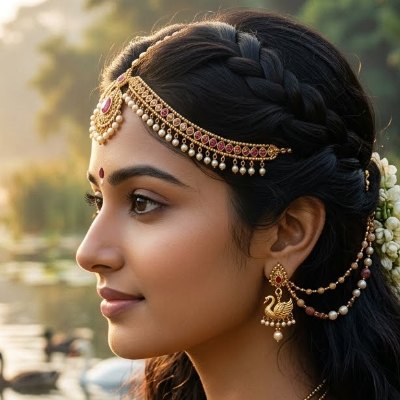
About
Charsani — Consort of Varuna and Mother of the Reborn Bhrigu
Charsani · Carsani · Carshanidevi · Varunapatni · Carshaniputa (as maternal epithet)
Charsani is the wife of Varuna, one of the twelve Adityas — the class of cosmic deities born of the celestial sage Kashyapa and his wife Aditi, herself a daughter of the patriarch Daksha. Varuna is among the most ancient and sovereign of Vedic and Puranic deities, presiding over the cosmic waters, celestial order, and the moral governance of the universe. Charsani is named explicitly in the Bhagavata Purana as Varuna's spouse and is identified there as the mother through whom the great sage Bhrigu took his second birth. Her name, independently attested in Sanskrit lexical and Vedic usage, carries distinct etymological significance. Though her independent narrative is limited in surviving textual sources, her role as the earthly mother of Bhrigu — one of the most consequential sages of the Puranic tradition — gives her a position of considerable genealogical importance.
✦ The Name
The Sanskrit term Carshanī (चर्षणी) is the feminine form of the root Carshani (चर्षणि), which itself derives from the verbal root krishu (to plough or cultivate), with some authorities also proposing derivation from a root meaning to move or to see. The Monier-Williams Sanskrit-English Dictionary records Carshani in the Rigvedic corpus with meanings including agile, swift, and active, and notes the feminine plural form as denoting cultivators or peoples — specifically the settled cultivating races as distinct from nomads. The Rigveda employs the expression pancha carshanayah, meaning the five peoples or five races of humanity, placing the term at the very foundation of the concept of humankind as a cultivating, civilising force.
The Bhagavata Purana records two distinct usages of the term that must be carefully distinguished. In Book VI, Chapter 18, verse 4, the feminine singular form Carshanī is used as a proper name — the personal name of Varuna's wife. Separately, in Book VI, Chapter 6, verse 42, the plural Carshanāh denotes the offspring of the Aditya Aryaman and his wife Matrika, described as the originators of the human race. These two usages share a common etymological root connecting the name to cultivation, human settlement, and the founding of civilised existence, but they refer to entirely different figures and must not be conflated. As applied to Varuna's wife, the name Charsani may thus carry the connotation of the nurturing, cultivating, settled force — though the text does not offer an explicit etymology for her personal name.
✦ Lineage
- Spouse: Varuna — the ninth of the twelve Adityas; son of the sage Kashyapa (a grandson of Brahma through Marichi) and Aditi (daughter of the patriarch Daksha); sovereign deity of the cosmic waters and upholder of celestial moral law
- Son (by adoption and upbringing): Bhrigu — one of the great Prajapati sages of the Hindu tradition; originally born from Brahma in a prior existence, Bhrigu took a second birth in the household of Varuna; Charsani raised him as her son, and as a result he bears the patronymics Varunaputra (son of Varuna) and Varunī Bhrigu in Puranic literature; through her maternal role, Charsani stands as the ancestral mother of the entire Bhrigu lineage of his second birth
✦ The Second Birth of Bhrigu
The most significant narrative in which Charsani appears is the account of Bhrigu's second birth, recorded in the Bhagavata Purana (Book VI, Chapter 18, verse 4) and elaborated in the Puranic Encyclopaedia of Vettam Mani. According to the broader Puranic account, the sage Bhrigu, who had originally come into being as a mind-born son of Brahma, perished in the upheaval that attended the ill-fated sacrifice (yajna) of the patriarch Daksha — an occasion marked by violence and cosmic disorder following the death of Sati, daughter of Daksha and first wife of Shiva. Bhrigu's death at that occasion is described in some Puranic sources, particularly in connection with the Bhagavata Purana's account of that event.
Following this, a second birth of Bhrigu took place in the Vaivasvata Manvantara — the present cosmic age — in the context of a sacred ceremony (yajna) conducted by Varuna. The Puranic Encyclopaedia records that Brahma's generative power descended into the sacred fire of Varuna's ceremony, and from that fire the child who would be Bhrigu was born anew. Varuna and Charsani received and raised this child as their own. The Bhagavata Purana (VI.18.4) states directly that Charsanī was the consort of Varuna and that to her Bhrigu was reborn. As a consequence of this second birth and upbringing, Bhrigu came to be known in various Puranic passages by the patronymic Varunī Bhrigu — Bhrigu of the Varuna line — and also as Varunaputra, the son of Varuna. The epithet Carshanīputra, son of Charsani, is similarly recorded in some Puranic contexts as an acknowledgement of his maternal lineage in this second life.
It should be noted that the Bhagavata Purana verse itself is brief and does not elaborate on the narrative circumstances of this second birth at length within that single chapter. The fuller account of Bhrigu having two distinct existences and two separate genealogies — one from Brahma directly, and one from Varuna and Charsani — is assembled from multiple Puranic passages and is synthesised in secondary sources such as the Puranic Encyclopaedia.
✦ Connection to the Wider Genealogy
Through her role as the mother of the second-birth Bhrigu, Charsani stands at the head of one of the most extensive and celebrated lineages in all of Puranic genealogy. The second Bhrigu vamsha (family line), as recorded in the Puranic Encyclopaedia, traces its descent directly from Varuna and Charsani through Bhrigu. Bhrigu's son Chyavana — a sage of great renown celebrated in the Mahabharata and the Puranas for his marriage to Sukanya and his renewal of youth through the Ashvins — belongs to this line. Descending further through Chyavana's son Aurva, then through Richika and Jamadagni, the lineage reaches Parashurama, the warrior-sage avatar of Vishnu celebrated across the epics and Puranas for his campaign against the Kshatriya order. Bhrigu's son Shukra (also called Bhargava Shukra), the preceptor of the Asuras, is also of this family. Through these figures Charsani is, by the logic of Puranic genealogy, a remote ancestral mother of a vast number of Bhargava sages and their descendants.
Through her marriage to Varuna, Charsani is also connected to the wider Aditya lineage. Varuna's siblings among the twelve Adityas include Mitra, Indra (as Vamana), Bhaga, Dhata, Aryaman, and others — all sons of Kashyapa and Aditi. The Bhagavata Purana (VI.18.5–6) further records that Valmiki, the celebrated sage and author of the Ramayana, is named as another son of Varuna — though Valmiki's birth is described there as having emerged from an ant-hill, and no maternal relationship to Charsani is stated in that verse. The sages Agastya and Vasishtha are described in the same passage as having originated from the combined seed of both Mitra and Varuna, discharged at the sight of the apsara Urvashi — an account entirely separate from the household of Charsani.
✦ Textual Variants and Points of Caution
The primary textual attestation of Charsani as Varuna's wife is confined to a single verse of the Bhagavata Purana (VI.18.4), which identifies her by name and records Bhrigu's rebirth to her. The Puranic Encyclopaedia (Vettam Mani, 1975), drawing on multiple Puranic sources, provides the fuller narrative context of Bhrigu's two births and explicitly records the family tree Varuna = Charsani at the head of the second Bhrigu lineage. Beyond these, her independent narrative in primary sources is not extensive.
The user-supplied background information for this profile also listed Gauri and Jyestha (identified as a daughter of Shukra) as further consorts of Varuna alongside Charsani. These identifications are not corroborated in the primary sources verified for this profile. The Bhagavata Purana VI.18 names Charsani as Varuna's wife without enumerating additional consorts for him in that passage. Accordingly, the claims regarding Gauri and Jyestha as consorts of Varuna are omitted here, as they cannot be confirmed from primary sources examined.
The name Varuni, which appears in some Puranic accounts as a short form of Varunani (Varuna's consort), is also used in the Samudra Manthan (churning of the cosmic ocean) narrative of the Vishnu Purana and Bhagavata Purana to denote a separate goddess of wine who emerged from the ocean. This Varuni of the Samudra Manthan is not identified with Charsani in any primary source examined, and the two figures belong to distinct narrative and genealogical contexts.
✦ References
Primary Sources
- Bhagavata Purana, Book VI, Chapter 18, verse 4 (G. V. Tagare translation, Motilal Banarsidass, 1950): The principal primary attestation; names Carshanī explicitly as the wife of Varuna (identified as the ninth Aditya) and states that Bhrigu was reborn to her.
- Bhagavata Purana, Book VI, Chapter 6, verse 42: Records the separate Carshanāh — the offspring of Aryaman and Matrika — as originators of the human race; establishes the distinct use of the same term in a different genealogical context, clarifying that this passage does not refer to Varuna's wife.
- Bhagavata Purana, Book VI, Chapter 18, verses 5–6: Records Valmiki as another son of Varuna (born from an ant-hill) and the sages Agastya and Vasishtha as born of both Mitra and Varuna at the sight of Urvashi; contextualises Varuna's broader progeny without attributing these births to Charsani.
- Rigveda, multiple hymns: Attests the term Carshani in its common Vedic usage meaning the peoples or cultivating races (pancha carshanayah); establishes the word's deep Vedic presence and its association with settled human civilisation, relevant to the etymology of Charsani's name.
Modern Reference Works
- Mani, Vettam — Puranic Encyclopaedia (1975), entry "Story of Bhrigu": Provides the most detailed secondary synthesis of Bhrigu's two births, explicitly names Varuna and Charsani as the parents of the second-birth Bhrigu, and supplies the family tree of the second Bhrigu vamsha descending through Chyavana, Aurva, Jamadagni, and Parashurama.
- Monier-Williams, M. — Sanskrit-English Dictionary (1899), entry "Carshani": Records the full range of Vedic and classical meanings of the term, including its Rigvedic usage, its application to Aryaman's progeny in the Bhagavata Purana, and its use as the proper name of Varuna's wife with the maternal epithet, confirming the citation Bhagavata Purana VI.18.4.
- Wisdomlib.org — entry "Carshani" (last updated 31 May 2022): Aggregates the Puranic Index entry (Cologne Digital Sanskrit Dictionaries) identifying Carshanī as wife of Varuna (Bhagavata Purana VI.18.4) and Carshani as the sons of Aryaman and Matrika (Bhagavata Purana VI.6.42), confirming the necessity of distinguishing the two usages.
- Tagare, G. V. (translator) — The Bhagavata Purana (Motilal Banarsidass, 1950), Book VI, Chapter 18: English translation with annotations used to verify the verse content and contextual details of Chapter 18's enumeration of the Adityas and their wives and progeny.