
About
Varuni Bhrigu — The Sage Bhrigu in His Second Birth as Son of Varuna
Varuni Bhrigu · Varunabhrigu · Varunaputra · Carsaniputra · Bhargava
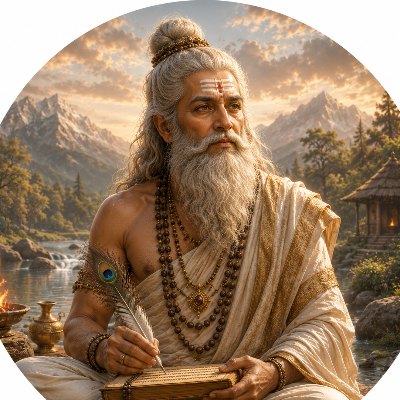
Varuni Bhrigu is the designation used in Puranic literature for the great sage Bhrigu in his second birth — the existence he took as the son of Varuna, one of the twelve Adityas, and Varuna's wife Charsani. Bhrigu is one of the most celebrated sages of the entire Hindu canonical tradition, and the Puranic texts describe him as having had two distinct incarnations within the present cosmic cycle, each giving rise to its own separate genealogical line. His first birth was as a mind-born son of Brahma, the creator deity. After his death in the upheaval that accompanied the ill-fated sacrifice of the patriarch Daksha, Bhrigu took a second birth during the Vaivasvata Manvantara — the present age of Manu — emerging from the sacred fire at a yajna (sacrificial ceremony) performed by Varuna. He was received and raised by Varuna and Charsani, and as a result bears the patronymics Varunaputra (son of Varuna) and Carsaniputra (son of Charsani) in various Puranic passages, as well as the name Varuni Bhrigu. His wife in this second life was Puloma, and through her he fathered a lineage of exceptional sages that includes Chyavana, Shukra, and, through further descent, Parashurama. This profile concerns Bhrigu exclusively in his second-birth identity and genealogy.
✦ The Name and Epithets
The name Bhrigu is derived in the Mahabharata (Anushasana Parva, Chapter 85, verse 105) from his mode of birth — specifically from fire, the Sanskrit word for which relates to the root from which the name is explained. The Mahabharata Adi Parva records that he was produced by Brahma from the fire at Varuna's sacrifice, and this fiery origin is also consistent with the epithet that links him to the sacred sacrificial flame. The designation Varuni Bhrigu is a compound of Varunī (of Varuna, belonging to Varuna's line) and Bhrigu, marking him as the Bhrigu of the Varuna household. Varunaputra simply means son of Varuna, and Carsaniputra means son of Charsani. The broader clan name Bhargava — used for all members and descendants of the Bhrigu lineage — applies equally to those who trace their descent through this second birth. The name Bhrigu itself is ancient and Vedic, appearing in the Rigveda in connection with the discovery and preservation of fire, establishing the sage's association with the sacred flame across both Vedic and Puranic strata of the tradition.
✦ Lineage
- Father (by birth and upbringing in second life): Varuna — the ninth of the twelve Adityas, son of the sage Kashyapa and Aditi; sovereign deity of the cosmic waters and upholder of celestial law; the yajna conducted by Varuna provided the sacred fire from which Bhrigu was reborn
- Mother (by upbringing in second life): Charsani — wife of Varuna; named explicitly in the Bhagavata Purana (VI.18.4) as the consort of Varuna to whom Bhrigu was reborn; her name carries Vedic connotations of cultivation and settled human civilisation
- Biological origin: Brahma — the creator deity; Puranic sources record that Brahma's generative power fell into Varuna's sacrificial fire, making Bhrigu simultaneously a son of Brahma by origin and a son of Varuna and Charsani by birth and upbringing
- Wife: Puloma — a woman whose father had initially betrothed her to a rakshasa (demon) named Puloman before subsequently giving her in marriage to Bhrigu according to proper Vedic rites; her story forms the opening narrative of the Mahabharata's Pauloma Parva in the Adi Parva
- Children by Puloma (six, as recorded in the Puranic Encyclopaedia):
- Bhuta — eldest son; married two wives, Bhuta and Sarupa, by whom he fathered the eleven Rudras (Ekadasha Rudras) and the Rudra Parshadas (attendants of Rudra) and a crore of Rudras respectively
- Chyavana — a sage of great renown celebrated across the Mahabharata and the Puranas; married Sukanya (daughter of king Sharyata) and Arushi; through Arushi he fathered Aurva, from whom the further descent to Parashurama runs; through Sukanya he fathered Pravati
- Vajrasirsha — son recorded in the Puranic Encyclopaedia's list; limited independent narrative in the sources examined
- Shuchi — son recorded in the same list; limited independent narrative in the sources examined
- Shukra — also called Bhargava Shukra or Shukracharya; one of the most celebrated figures of the Puranic tradition; preceptor of the Asuras (Daityas) and repository of the Mritasanjivani knowledge (the lore of reviving the dead); his mother Puloma undertook severe austerities on behalf of the Asuras after they were defeated by the Devas
- Savana — sixth son; recorded in the family list; limited independent narrative in primary sources examined
✦ The Circumstances of the Second Birth
The Puranic tradition, as synthesised in the Puranic Encyclopaedia drawing on the Bhagavata Purana and related texts, records that the first Bhrigu — born of Brahma — was killed during the calamitous events surrounding Daksha's yajna. At that sacrifice, Sati — daughter of Daksha and wife of Shiva — perished, and in the subsequent devastation caused by Shiva's wrath, the sage Bhrigu lost his life at the hands of a being associated with Shiva's forces. His second birth occurred in the Vaivasvata Manvantara, the current cosmic age, during a solemn sacrificial ceremony performed by Varuna. The Mahabharata (Adi Parva, Pauloma Parva, Section V) preserves the tradition that Bhrigu was produced from Brahma's power through the fire of Varuna's sacrifice, and the Bhagavata Purana (VI.18.4) states that Charsani, the wife of Varuna, was the mother to whom he was reborn. The Puranic Encyclopaedia synthesises these accounts by explaining that Brahma's seed fell into the sacred fire of Varuna's ceremony, and the resulting child was raised by Varuna and Charsani as their own son. This dual parentage — Brahma as the ultimate generative source, and Varuna and Charsani as the parents by birth and upbringing — accounts for both the biological and domestic patronymics applied to Bhrigu in the Puranic texts.
✦ The Abduction of Puloma
The most prominent narrative of Varuni Bhrigu's domestic life in the primary epic sources is the episode of Puloma's abduction, which opens the Pauloma Parva of the Mahabharata's Adi Parva. Bhrigu had married Puloma according to proper Vedic rites, with the sacred fire Agni as witness. Before this marriage, her father had betrothed her to a rakshasa also named Puloman, but the formal Vedic marriage to Bhrigu superseded that earlier arrangement. While Bhrigu was absent from the hermitage for his morning ritual ablutions, leaving Puloma there, the rakshasa Puloman came to the ashrama. He questioned Agni — who was present as the sacrificial fire — about the woman's true husband. Agni, torn between the obligation of truth and fear of Bhrigu's curse if he revealed what would enable the abduction, eventually confirmed that Puloma was lawfully Bhrigu's wife, having been formally given by her father with Vedic rites. Despite this, the rakshasa seized Puloma and fled. The shock caused Puloma, who was pregnant, to give birth prematurely. The child who thus fell to the ground was the sage Chyavana — whose name in Sanskrit carries the meaning of one who fell or slipped from the womb. The radiance of the newborn child burned the rakshasa Puloman to ashes.
On returning and learning what Agni had disclosed to the rakshasa, Bhrigu cursed Agni that he would consume all things indiscriminately. This curse on Agni forms a significant theological episode and is discussed in several subsequent Mahabharata passages. The curse was later resolved or mitigated through the intervention of Brahma.
✦ Puloma's Austerities and the Curse on Vishnu
A second major episode involving Bhrigu and Puloma concerns the war between the Devas and the Asuras. The Asuras, having been routed by the Devas, sought refuge at Bhrigu's ashrama under the protection of Puloma, who was the mother of Shukra — the preceptor of the Asuras. Puloma undertook severe ascetic practices to acquire power sufficient to defeat Indra and the Devas. The Matsya Purana version of this episode records that Puloma's accumulated power was so great that she defeated Indra. Vishnu then struck Puloma with his Vajra weapon, severing her head. Bhrigu, enraged by this act, cursed Vishnu to take repeated births as a mortal on earth and to experience the suffering of separation from his wife. According to the Puranic Encyclopaedia's account drawn from the Uttara Ramayana, this curse was the occasion for Vishnu's incarnation as Rama, son of Dasharatha. When Vishnu's weapon the Chakra in turn turned on Bhrigu, the sage fled, ultimately taking shelter with Vishnu himself in the ocean of milk and seeking pardon. Vishnu withdrew the Chakra. Bhrigu then revived Puloma by means of his own ascetic power.
✦ The Second Birth Lineage and Its Significance
The genealogical significance of the second Bhrigu vamsha is considerable. Through his son Chyavana and Chyavana's wife Arushi, the line runs to Aurva, then to Richika, then to Jamadagni. Jamadagni and his wife Renuka — daughter of the king Prasenajit of the Ikshvaku line — were the parents of Parashurama, the warrior-sage avatar of Vishnu celebrated across the Mahabharata, the Ramayana, and the Puranas for his campaign of extermination against the Kshatriya order. Chyavana's other line, through Sukanya and their son Pravati, reaches the sage Shaunaka — the revered head of the sages at the Naimisha forest, to whom the Mahabharata is narrated in its frame story. Through Bhrigu's son Shukra, the line extends to Shukra's daughter Devayani, whose story of love for the Kshatriya prince Yayati is one of the central dynastic episodes of the Mahabharata's early books, and whose father Shukra appears throughout the epics and Puranas as the Daitya-guru, the preceptor and protector of the Asura race. This entire vast genealogical network — encompassing Chyavana, Aurva, Richika, Jamadagni, Parashurama, Pravati, Ruru, Shaunaka, Shukra, and Devayani — flows from Varuni Bhrigu and Puloma as its immediate parents in this second-birth lineage.
✦ Textual Variants and Points of Complexity
The tradition of Bhrigu's two births is not uniformly presented across all primary sources, and readers of the texts must navigate several variant accounts. The Mahabharata Adi Parva (Pauloma Parva, Section V) presents Bhrigu as produced by Brahma from the fire at Varuna's sacrifice, without explicitly framing this as a second birth following an earlier death. The Bhagavata Purana (VI.18.4) simply names Charsani as Varuna's wife and states that Bhrigu was reborn to her, without narrating the full context of the two births. The Puranic Encyclopaedia, drawing on the Bhagavata Purana's fourth skandha account of the Daksha yajna and synthesising multiple Puranic sources, is the most explicit secondary source in presenting the two-birth framework as a coherent biographical whole. Some passages of the Mahabharata also describe Bhrigu simply as a son of Brahma without reference to Varuna, reflecting the first-birth identity. The Mahabharata Anushasana Parva (Chapter 85, verse 127) also gives a list of Bhrigu's sons as seven in number — Chyavana, Vajrasila, Shuchi, Aurva, Shukra, Varenya, and Savana — which differs in some names and in number from the Puranic Encyclopaedia's list of six children by Puloma. These variant lists reflect differences between Puranic and epic sources that are not fully reconcilable and are noted here without any attempt to adjudicate between them.
✦ Connection to the Wider Genealogy
Varuni Bhrigu stands at the junction of two major genealogical streams. Through his parents in this second birth — Varuna and Charsani — he is connected to the Aditya lineage: Varuna is one of the twelve sons of the sage Kashyapa and Aditi, making Bhrigu a nominal member of that cosmic order by adoption. Through his own progeny by Puloma, he is the ancestor of some of the most consequential figures in Puranic and epic literature. His son Shukra is the preceptor of the Asura race, linking this lineage to the Daitya and Danava genealogies. His son Chyavana connects through successive generations to Parashurama, the sixth avatar of Vishnu. His descendants Ruru and Shaunaka belong to the Mahabharata's narrative frame itself. The second Bhrigu vamsha is thus one of the most genealogically fertile lines in all of Puranic literature, with ramifications that extend across the divine, heroic, and priestly orders of the tradition.
✦ References
Primary Sources
- Bhagavata Purana, Book VI, Chapter 18, verse 4 (G. V. Tagare translation, Motilal Banarsidass, 1950): Names Charsani as wife of Varuna and states that Bhrigu was reborn to her; the principal primary verse establishing the second-birth parentage.
- Mahabharata, Adi Parva, Pauloma Parva, Section V (Ganguli translation; Kisari Mohan Ganguli): Narrates Bhrigu's birth from Brahma's power at Varuna's sacrifice; opens the story of Puloma, her abduction by the rakshasa Puloman, and the birth of Chyavana; establishes the immediate family of Varuni Bhrigu in the epic tradition.
- Mahabharata, Adi Parva, Pauloma Parva, Sections V–IX: Continues the narrative of Puloma's abduction, Bhrigu's curse on Agni, and the subsequent resolution; primary source for the domestic episodes of Varuni Bhrigu.
- Mahabharata, Anushasana Parva, Chapter 85, verse 105: Records the etymology of the name Bhrigu as derived from fire.
- Mahabharata, Anushasana Parva, Chapter 85, verse 127: Records a list of seven sons of Bhrigu — Chyavana, Vajrasila, Shuchi, Aurva, Shukra, Varenya, and Savana — differing in some names from the Puranic Encyclopaedia's list of six; relevant to the textual variants section.
- Uttara Ramayana (as cited in the Puranic Encyclopaedia): Source for the episode of Puloma's austerities, Vishnu's slaying of Puloma with his Vajra, Bhrigu's curse on Vishnu, and the resulting chain of events leading to Vishnu's incarnation as Rama.
- Matsya Purana, Part 1, Chapter 47 (as summarised in secondary sources): Records the episode of Puloma's austerities and her defeat of Indra in the context of the Deva-Asura conflict; contextual background for the episode of Bhrigu's curse on Vishnu.
- Bhagavata Purana, Book VI, Chapter 18, verses 5–6: Contextualises Varuna's household and progeny in the same passage as verse 4; names Valmiki as another son of Varuna and records the origins of Agastya and Vasishtha from Mitra and Varuna.
Modern Reference Works
- Mani, Vettam — Puranic Encyclopaedia (1975), entry "Story of Bhrigu": The most comprehensive secondary synthesis; explicitly frames the two-birth structure, names Varuna and Charsani as the second-birth parents, gives the full family list of six children by Puloma with their own spouses and descendants, and provides the family tree of the second Bhrigu vamsha down to Parashurama and Shaunaka.
- Wisdomlib.org — "Story of Bhrigu" (Puranic Encyclopaedia entry, last updated January 2019): Digital presentation of the Vettam Mani entry with the full second-birth family tree; used to verify the list of children and the downstream genealogy.
- Wikipedia — "Puloma" article: Provides a summary of the Puloma abduction episode from the Mahabharata Adi Parva, useful for verifying the principal narrative details of the episode as recorded in the epic; secondary source only.