
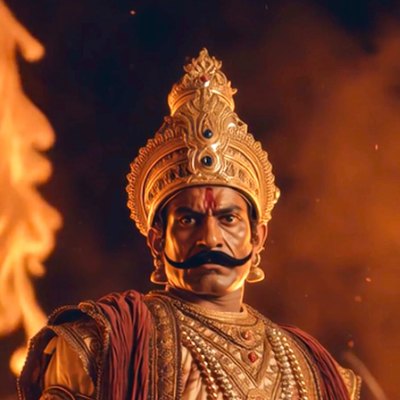
About
Damaghosha — King of Chedi and Father of Shishupala
Damaghosha · Damaghosa · king of Chedi · Cedi prince
Damaghosha was the king of the Chedi kingdom, a realm situated in the central Indian region roughly corresponding to the Bundelkhand division. He is recorded in the Mahabharata, the Harivamsa, the Vishnu Purana, the Bhagavata Purana, the Brahmanda Purana, and the Vayu Purana as the husband of Shrutashrava — a princess of the Shurasena-Yadava line and the sister of Vasudeva, the father of Krishna — and as the father of Shishupala, the king of Chedi whose death at Krishna's hands during the Rajasuya sacrifice of Yudhishthira is narrated in the Sabha Parva of the Mahabharata. Damaghosha himself plays a secondary but attested role in several narrative episodes connected with the activities of his ally Jarasandha and with the arranged marriage negotiations for his son.
✦ The Name
The name Damaghosha is a Sanskrit compound of dama, meaning self-restraint or taming, and ghosha, meaning sound, proclamation, or renown. The compound thus conveys something approaching one whose fame is that of self-mastery or one renowned for restraint. The Monier-Williams Sanskrit-English Dictionary identifies the name as that of a Chedi prince and lists its attestations across the Mahabharata, the Harivamsa, and several Puranas.
✦ Lineage
- Parentage: The parentage of Damaghosha is not recorded in any surviving primary source. His own genealogical origins within the Chedi royal line are not specified in the Mahabharata or the Puranas.
- Kingdom: Chedi — a kingdom of central India, historically associated with the region along the river Ken in the Bundelkhand area; its capital was Suktimati.
- Wife: Shrutashrava — daughter of Shurasena of Mathura and sister of Vasudeva (father of Krishna); one of five daughters born to Shurasena and Marisha.
- Son: Shishupala — born with three eyes and four arms; destined by celestial prophecy to be slain by Krishna; became king of Chedi after Damaghosha's death.
✦ Role in the Birth and Infancy of Shishupala
The most prominent episode in which Damaghosha features is the birth of his son Shishupala, narrated in the Mahabharata's Sabha Parva and in the Bhagavata Purana. The child was born with three eyes and four arms and emitted a cry resembling a donkey's bray. Damaghosha, together with his wife Shrutashrava, was filled with alarm at these inauspicious signs and gave consideration to abandoning the infant. A celestial voice then addressed them, counselling against abandonment, promising the child's future power, and revealing that the one who would cause the extra limbs to vanish and who would eventually slay the child was already born. Damaghosha thereafter received the many kings and relatives who came to Chedi to test the prophecy by holding the infant.
✦ Alliance with Jarasandha
The Bhagavata Purana records that during the siege of the hill-fortress of Gomanta by the emperor Jarasandha of Magadha, Damaghosha was stationed on the southern flank of the besieging army. This places Damaghosha firmly among the allied kings of Jarasandha's coalition, a political alignment that his son Shishupala would continue and deepen throughout his own reign. Jarasandha was the most powerful ruler of the age and the foremost enemy of Krishna and the Yadavas; Damaghosha's participation in his military campaigns indicates the extent of Chedi's commitment to that alliance.
✦ The Rukmini Marriage Negotiations
The Bhagavata Purana records that Damaghosha personally undertook the preliminary arrangements for a proposed marriage between his son Shishupala and Rukmini, the princess of Vidarbha and the daughter of King Bhishmaka. In the course of these negotiations, Damaghosha travelled to the city of Kundina, the capital of Vidarbha, where he was received and entertained by Bhishmaka. The marriage was ultimately thwarted by Krishna's abduction of Rukmini before the ceremony could take place, an episode that became a major source of Shishupala's lasting enmity toward Krishna. Damaghosha's role in the episode is that of a father actively managing his son's matrimonial alliances with the courts of other kingdoms.
✦ Attendance at Syamantapanchaka
The Bhagavata Purana also notes that Damaghosha was among those who traveled to Syamantapanchaka on the occasion of a solar eclipse, a pilgrimage gathering at which many kings and great personages of the age assembled. This brief notice places him in the broader social and religious world of the epic period without elaborating on his specific activities there.
✦ Connection to the Wider Genealogy
Through his marriage to Shrutashrava, Damaghosha was connected by affinal ties to the Shurasena-Yadava lineage. His wife's brother Vasudeva was the father of Krishna, making Damaghosha Krishna's uncle by marriage. His wife's sister Pritha (Kunti) was the mother of the five Pandava brothers — Yudhishthira, Bhima, Arjuna, Nakula, and Sahadeva — making Damaghosha an uncle by marriage to the Pandavas as well. His son Shishupala's daughter Karenumati was subsequently given in marriage to the Pandava Nakula, further intertwining the Chedi and Pandava lines. Damaghosha's own death is not narrated in the primary sources; it is noted only that Shishupala ascended the throne of Chedi after Damaghosha died.
✦ References
Primary Sources
- Mahabharata, Adi Parva, Chapter 186, verse 86: Identifies Damaghosha as the father of Shishupala and king of Chedi.
- Mahabharata, Sabha Parva, Chapters 38–44: Contextualises Damaghosha as the father of Shishupala in the narrative of the Rajasuya and Shishupala's death.
- Bhagavata Purana, IX.24.39: Places Damaghosha as the husband of Shrutashrava and king of Chedi within the genealogical account of the Shurasena line.
- Bhagavata Purana, VII.1.17: References Damaghosha in the context of Shishupala's identity and birth.
- Bhagavata Purana (Canto 10, Rukmini episode): Records Damaghosha's journey to Kundina for the Rukmini marriage negotiations and his reception by Bhishmaka.
- Bhagavata Purana (Gomanta siege episode): Notes Damaghosha's deployment on the southern flank during Jarasandha's siege of Gomanta.
- Bhagavata Purana (Syamantapanchaka episode): Lists Damaghosha among those attending the pilgrimage at the solar eclipse gathering.
- Vishnu Purana, IV.14.44: Corroborates Damaghosha as king of Chedi and father of Shishupala.
- Brahmanda Purana, III.71.159: Provides supporting attestation of Damaghosha's identity and role.
- Vayu Purana, 96.158: Further corroborates the Chedi king's connection to Shrutashrava and his son Shishupala.
- Harivamsa: References Damaghosha in the context of Chedi's place in the network of contemporary kingdoms.
Secondary Sources
- Wisdomlib, Puranic Encyclopaedia entry "Damaghosha": Consolidates references from the Mahabharata, Harivamsa, Vishnu Purana, Bhagavata Purana, Brahmanda Purana, and Vayu Purana; notes variant queen-names Patushrava and Rujakanya in some manuscript traditions.
- Monier-Williams Sanskrit-English Dictionary, entry "Damaghosha": Provides the Sanskrit etymology and lists primary textual attestations.