
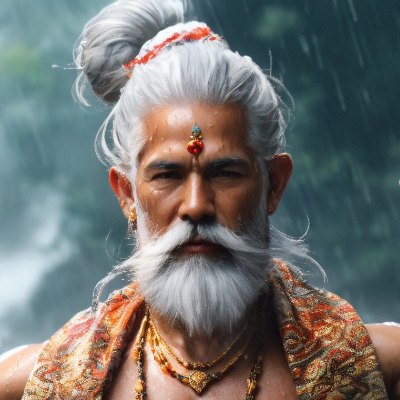
About
Chakshus — Son of Dirghatamas, Brother of Kakshivat, and Sage Who Attained Brahmahood at Girivraja
Chakshus · Cakshus · Dairghatamasa · Angirasakula
Chakshus is a sage of the Angirasa lineage recorded in the Brahmanda Purana and the Vayu Purana as the brother of Kakshivat — one of the significant hymn-composers of the Rigveda's first Mandala — and as the companion through whom both brothers jointly attained full Brahmahood through severe austerities at the ancient hill-site of Girivraja in the Magadha region. He is the son of the blind sage Dirghatamas, one of the most celebrated figures of the Angirasa tradition and the composer of philosophically distinguished hymns in the Rigveda's first Mandala including the Asya Vamasya hymn. Chakshus has no independent narrative in any primary source examined beyond his named appearance in the Puranic passages concerning his brother Kakshivat's spiritual biography. His significance in the tradition is therefore genealogical and contextual — he represents the shared spiritual trajectory of the two brothers born of ambiguous hereditary status who elevated themselves through learning and tapas to the highest standing within the Brahminic order. The textual basis for this profile is limited to two Puranic sources, and this brevity is a faithful reflection of the evidence.
✦ The Name
The Sanskrit word Cakshus means eye, sight, or the faculty of vision — derived from the verbal root caksh, meaning to see, to look, or to illuminate. It is a word of frequent occurrence in Sanskrit philosophical and medical literature in connection with the sense of sight, the organ of the eye, and in certain cosmological contexts in connection with the sun as the eye of the universe. As a personal name applied to this sage, the meaning is not elaborated in the Puranic passages that mention him. The name may carry a symbolic resonance as the counterpart to his father Dirghatamas — whose name means one in prolonged darkness or eternal night — with the son's name Cakshus (vision, sight) forming a deliberate or inherited contrast. Whether this contrast is intentional or coincidental cannot be established from the primary sources.
✦ Lineage
- Father: Dirghatamas — the blind sage of the Angirasa lineage; son of Utathya and Mamata; composer of the Asya Vamasya hymn (Rigveda I.164) and of the hymns spanning Rigveda I.140–I.164; whose life was marked by blindness from birth, abandonment by his sons on the Ganga, rescue by a royal patron, and subsequent extraordinary productivity in sacred verse and progeny; a figure of the first rank in the Angirasa tradition
- Mother: The Vayu Purana (Vol 2, Ch 37, verses 70–73) identifies the mother of both Chakshus and Kakshivat as a woman of Shudra origin, without naming her. The Puranic Encyclopaedia (drawing on a distinct Puranic strand) names the mother as Ushi, a maidservant of the royal household, in the context of the Kalinga variant of the birth narrative. The Mahabharata account of Kakshivat's birth gives an unnamed maidservant of Queen Sudeshna in King Bali of Anga's household. Chakshus is not specifically named in the Mahabharata birth narrative; he appears only in the Puranic sources. Whether the mother named Ushi is to be identified with the Shudra mother of the Vayu Purana cannot be confirmed from the texts themselves.
- Brother: Kakshivat — also spelled Kakshivan; son of Dirghatamas and the same mother; one of the most significant hymn-composers of the Rigveda's first Mandala; attributed with hymns I.116–I.126 addressing the Ashvins, Indra, and Ushas; father of the Rigvedic female seer Ghosha and the sage Chandakaushika; named in the Mahabharata as one of seven Barhishads who were the celestial gurus of Indra; his marriage to the ten daughters of King Bhavayavya is recorded in the Rigveda itself at hymns I.125–I.126
- Paternal grandfather: Utathya — elder brother of Brihaspati the divine preceptor of the gods; a sage of the Angirasa lineage of great authority
- Paternal great-grandfather: Angiras — one of the most ancient of the primordial sages; a mind-born son of Brahma; progenitor of the entire Angirasa lineage
- Half-brothers (through Dirghatamas and Queen Sudeshna of King Bali of Anga's household, Mahabharata account): Anga, Vanga, Kalinga, Pundra, and Suhma — founders of five eastern kingdoms whose names correspond to major regions of the subcontinent
✦ Birth and Hereditary Status
The Vayu Purana (Vol 2, Ch 37, verses 70–73) records that both Chakshus and his brother Kakshivat were born of Dirghatamas and a mother of Shudra origin. Because of this mixed parentage — a Brahmin father of the Angirasa lineage and a Shudra mother — both brothers were born into an intermediate status that placed them outside the full Brahmin standing that their father's lineage might otherwise have conferred. The same passage records that despite this hereditary ambiguity both brothers duly studied the Vedas and became masters and expounders of sacred learning, described in the Purana as great enlightened Siddhas and as those with direct vision of Dharma. This account in the Vayu Purana places Chakshus and Kakshivat among the textual examples of spiritual elevation through learning and tapas rather than through birth — a theme of enduring significance in the Puranic tradition. The Brahmanda Purana's parallel account confirms the same trajectory without additional biographical detail specific to Chakshus.
✦ The Austerities at Girivraja and Attainment of Brahmahood
The sole episode in which Chakshus plays an active role in the primary sources is the account of the brothers' joint austerities at Girivraja. The Brahmanda Purana (III.74.71, 95, 99) and the Vayu Purana (99.70, 93–97) record that Kakshivat — after following his father Dirghatamas — proceeded with his brother Chakshus to Girivraja and engaged in tapas there. The Vayu Purana (Ch 37, verses 93–94) states explicitly that Kakshivat and his brother Chakshus, after great penance, both attained Brahmahood. The Brahmanda Purana records the same event in its genealogical account of Kakshivat, confirming the joint attainment.
Girivraja — meaning the mountain enclosure or mountain-surrounded city — is the ancient name of what later became Rajagriha, the capital of Magadha in the sub-Himalayan east. It is a site of considerable significance in both the Mahabharata and the Buddhist canonical texts: in the Mahabharata it is associated with the court of King Brihadratha of Magadha and with Jarasandha — the powerful king whose own birth was facilitated by the sage Chandakaushika, son of Kakshivat. The brothers' choice of this location for their austerities therefore connects the Dirghatamas family to the Magadha landscape at multiple generational levels: Chakshus and Kakshivat sanctified the hill terrain through their tapas, and Kakshivat's son Chandakaushika later came to the Magadha court as the sage who made possible the birth of its greatest king.
Through the attainment of Brahmahood at Girivraja, Chakshus and his brother completed the spiritual transformation that their birth status had made necessary: sons of a Brahmin father and a Shudra mother, they entered the world in ambiguous standing, mastered the Vedic learning that their father's tradition demanded, and through the accumulated power of sustained austerities crossed the threshold into full Brahmin status. The Puranic sources record this elevation as a fact of their biography without elaborating the specific content or duration of the tapas involved.
✦ Textual Scope and Limits
Chakshus is attested in two primary Puranic sources — the Brahmanda Purana and the Vayu Purana — and in both cases exclusively in the context of his brother Kakshivat's biography. He receives no independent entry in the Puranic Encyclopaedia of Vettam Mani, no attribution of any Vedic hymn in the Rigvedic anukramani, no independent narrative episode in the Mahabharata or any Purana examined, and no iconographic or worship tradition in the sources consulted. The Wisdomlib entry for Chakshus as a Sanskrit term gives only the common meaning of the word (eye, sight) and does not record a separate biographical entry for this sage. This profile therefore reflects proportionally the limited but genuine textual basis for Chakshus's existence as a named figure in the tradition.
✦ Connection to the Wider Genealogy
Through his father Dirghatamas and grandfather Utathya, Chakshus is a third-generation descendant of Angiras — the primordial mind-born son of Brahma — in the Angirasa lineage. He is thus a cousin-lineage figure relative to Brihaspati, the divine preceptor of the gods, and through Brihaspati a cousin-lineage figure relative to Bharadvaja, whose son Drona trained the central generation of Mahabharata warriors. Through his brother Kakshivat, Chakshus is the paternal uncle of the Rigvedic female seer Ghosha — composer of hymns X.39 and X.40 of the Rigveda's tenth Mandala — and of the sage Chandakaushika, whose role in the birth of Jarasandha of Magadha connects the Dirghatamas family to one of the Mahabharata's most consequential political narratives. Through his half-brothers Anga, Vanga, Kalinga, Pundra, and Suhma, born of Dirghatamas through Queen Sudeshna of King Bali's household, Chakshus is the half-brother of the founders of five eastern kingdoms whose names correspond to major regions of the subcontinent.
✦ References
Primary Sources
- Brahmanda Purana, III.74.71, 95, 99: The principal Puranic source; names Cakshus as the brother of Kakshivat in the context of the attainment of Brahmahood at Girivraja through austerities; the passage is embedded within the genealogical account of Kakshivat and does not give Chakshus an independent narrative.
- Vayu Purana, Vol 2, Chapter 37, verses 70–73: Records both Kakshivat and Chakshus as sons of Dirghatamas and a Shudra mother; states that they studied the Vedas, became masters and expounders of sacred learning, and are described as great enlightened Siddhas with direct vision of Dharma.
- Vayu Purana, Vol 2, Chapter 37, verses 93–94: States explicitly that Kakshivat and his younger brother Chakshus, after great penance, both attained Brahmahood; the verse cited by secondary sources as the primary basis for confirming the joint attainment.
- Vayu Purana, 99.70, 93–97: Parallel passage in a different chapter of the same Purana confirming the Girivraja episode and the spiritual attainment of both brothers within the broader genealogical account of the Angirasa tradition.
Modern Reference Works
- Mani, Vettam — Puranic Encyclopaedia (1975), entry "Story of Kakshivan": Records the Girivraja austerities and the joint attainment of Brahmahood by Kakshivat and Chakshus; the fullest secondary synthesis of the relevant Puranic passages; Chakshus does not receive a separate independent entry.
- Wisdomlib.org — entry "Kakshivat" (Cologne Digital Sanskrit Dictionaries, Purana Index): Confirms the citation of Cakshus as Kakshivat's brother in the Brahmanda Purana and Vayu Purana entries; the primary digital aggregator of the Puranic references used in this profile.
- Wisdomlib.org — entry "Chakshus": Records the Sanskrit meanings of the term (eye, sight, vision) and its grammatical forms; confirms the absence of a separate biographical Puranic entry for Chakshus as a distinct sage, supporting the assessment of this profile's limited textual scope.
- Puneetchandra (blog) — "Can a Shudra become a Brahmin according to the Vedas?" (2020): Cites the Vayu Purana (Vol 2, Ch 37, verses 70–73 and 93–94) with chapter and verse specificity regarding both brothers' Shudra maternal origin and their joint attainment of Brahmahood; used here as a secondary source identifying the precise verse references within the Vayu Purana for verification.