
About
The Ten Daughters of Svanaya Bhavayavya — Wives of the Sage Kakshivat
Svanayakanya · Bhavayavyakanya · Duhitarah Svanayasya · Kakshivatpatnyah
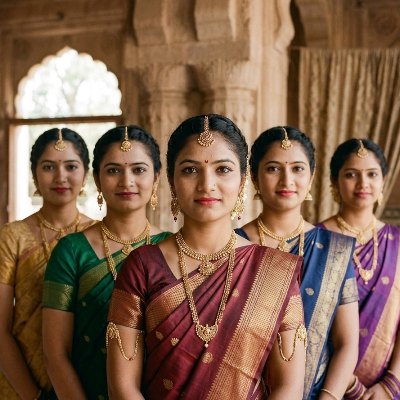
The ten daughters of Svanaya Bhavayavya are a group of women recorded collectively in the tradition surrounding Rigveda Sukta 1.125 and 1.126 — the dana-stuti hymns of the sage Kakshivat — as having been given in marriage by their father to the sage Kakshivat of the Angirasa lineage. Their father Svanaya is the son of King Bhavayavya, who dwelt on the banks of the Sindhu (Indus) river and is eulogised in Rigveda 1.126; and Bhavayavya is the son of the king Bhavya. Their mother is Romasha — daughter of Brihaspati, the divine preceptor of the gods, and herself a Rigvedic female seer (Rishika) and Brahmavadini who composed the seventh verse of Rigveda 1.126. Kakshivat, their husband, is one of the principal hymn-composers of the Rigveda's first Mandala, attributed with hymns I.116–I.126, and a member of the Angirasa family of sages tracing descent through Dirghatamas and Utathya to the primordial sage Angiras. The ten daughters are not named individually in any primary source examined — neither in the Rigveda, in Sayana's commentary, nor in any Puranic or secondary text — and are recorded throughout the tradition exclusively as a collective group. This profile therefore treats them as a single unit, which is the honest reflection of the textual evidence.
✦ Lineage
- Father: Svanaya — son of King Bhavayavya and Queen Romasha; celebrated in Rigveda 1.125 as a royal patron of extraordinary generosity. It was Svanaya who encountered the sage Kakshivat sleeping by the roadside, brought him home, ascertained his worthy lineage, and gave him all ten of his daughters in marriage, together with lavish gifts of gold, horses, cattle, and chariots. Sayana's commentary on Rigveda 1.125.1 identifies him explicitly as the son of Bhavayavya. His full Rigvedic designation Svanaya Bhavayavya is a name-plus-patronymic construction meaning "Svanaya, son of Bhavya/Bhavayavya." The word Bhavya appearing in Rigveda 1.126.1 is used by Sayana as an epithet or alternative designation for Svanaya within that hymn, not as a reference to a separate ancestral figure.
- Paternal grandfather: Bhavayavya — also known by the short form Bhava; a king who dwelt on the banks of the Sindhu; eulogised in Rigveda 1.126 as an unconquered sovereign of great liberality. He is the husband of Romasha and the father of Svanaya. The Vishnu Purana (Book I, Chapter XIII) identifies him as Bhavya, son of Dhruva and his wife Shambhu; Dhruva was the celebrated royal devotee of Vishnu, son of Uttanapada and grandson of Svayambhuva Manu. The identification of the Rigvedic Bhavayavya with the Puranic Bhavya son of Dhruva rests on the patronymic evidence — the designation Bhavayavya applied to Svanaya means "son of Bhavya" — and is attested in the secondary scholarly tradition including Sayana's commentary.
- Paternal grandmother: Romasha — daughter of Brihaspati, the divine preceptor of the gods; wife of Bhavayavya; Brahmavadini and composer of Rigveda 1.126.7, the verse in which she speaks in her own voice to assert her identity and worth when her husband initially regarded her as too young. She is the mother of Svanaya and the maternal grandmother of the ten daughters given to Kakshivat. Some secondary sources erroneously describe Romasha as the wife of Svanaya; the primary sources — Sayana's commentary and the Rigvedic text itself — place her in the generation above Svanaya as his mother.
- Paternal great-grandfather: Dhruva — son of Uttanapada and his queen Suniti; grandson of Svayambhuva Manu; the celebrated royal ascetic who performed intense penance in the forest as a child and was granted by Vishnu the imperishable station of the Pole Star. The Vishnu Purana names him as the father of Bhavya, who is identified with Bhavayavya of the Rigveda. Dhruva is thus the paternal great-grandfather of Svanaya and great-great-grandfather of the ten daughters.
- Maternal great-grandfather (through Romasha): Brihaspati — the divine preceptor of the gods, son of the primordial sage Angiras, and elder brother of Utathya; father of Romasha; the tradition therefore makes Brihaspati and the sage Dirghatamas — biological father of Kakshivat, through Utathya — members of the same immediate Angirasa family. The ten daughters and their husband Kakshivat were thus both connected to the Angirasa lineage through their respective parents.
- Husband (of all ten daughters collectively): Kakshivat — one of the principal hymn-composers of the Rigveda's first Mandala; son of Dirghatamas of the Angirasa line by the maidservant of Sudeshna; married to all ten daughters simultaneously, as documented in Rigveda 1.126 and Sayana's commentary on 1.125.1; father of the Rigvedic seer Ghosha among others.
- Individual names of the ten daughters: Not recorded in any primary or secondary source examined. They are referred to throughout the tradition only collectively as the ten daughters of Svanaya.
✦ The Encounter and the Marriage
The narrative context for the marriage of the ten daughters to Kakshivat is preserved in Sayana's commentary on Rigveda 1.125.1 — the legend cited by that commentary as the background for the dana-stuti hymns 1.125 and 1.126. Kakshivat, having completed his course of Vedic study under his preceptor and taken formal leave of him, was journeying home. When night overtook him on the road he lay down to sleep by the roadside. At dawn, Svanaya — son of Bhavayavya — came along that road attended by his retinue, and the movement of the party disturbed Kakshivat's sleep. On the sage starting up, Svanaya addressed him with great cordiality. He questioned Kakshivat about his identity and lineage, and on learning that he was a son of Dirghatamas and a member of the Angirasa tradition, the king was struck by both his person and his sacred learning. Svanaya brought Kakshivat home to his father's palace. There the king gave Kakshivat his ten daughters in marriage and presented him with lavish gifts in acknowledgement of the honour of receiving such a sage into the family.
The gifts are recorded precisely in Rigveda 1.126 and in Sayana's commentary as drawn from the legend: a hundred nishkas of gold, a hundred horses, a hundred bulls, one thousand and sixty cows, and eleven four-horse-drawn chariots — one chariot for each of the ten wives and one for Kakshivat himself. Kakshivat then returned to his father Dirghatamas and presented these gifts to him. He subsequently composed the dana-stuti hymns 1.125 and 1.126 in praise of the generosity of the Bhavayavya royal house — which are thus not only a record of Kakshivat's gratitude but also the primary Rigvedic documentation of his marriage to the ten daughters of Svanaya.
✦ Rigvedic Documentation
The ten daughters appear in the Rigveda exclusively through Kakshivat's two dana-stuti hymns. Rigveda 1.125 — titled Svanaya in the anukramani and addressed principally to that king — refers to the encounter and the gifts in terms of praise for Svanaya's generosity. Rigveda 1.126 — titled Bhavayavya — records the specific gifts in detail: the hundred necklets, the hundred gift-steeds, the thousand cows, the ten chariots with dusky mares, and the sixty thousand cattle that followed. The ten daughters themselves are not named in either hymn; the hymns record the gifts accompanying them rather than their individual identities. The seventh verse of 1.126 is attributed by Sayana and the anukramani to Romasha — the wife of Bhavayavya and a Brahmavadini — making the mother of the household a speaker within the very hymn that Kakshivat composed in praise of that household's generosity. This is a rare instance in the Rigveda where a hymn composed by a male sage in praise of a royal patron also includes a verse composed by a woman of that patron's family, creating a multi-voiced document of the marriage event.
✦ Significance — An Angirasa Convergence
The marriage of the ten daughters to Kakshivat is genealogically notable for the convergence it creates within the Angirasa tradition. Kakshivat is a descendant of Angiras through Utathya and Dirghatamas. Romasha, the wife of Bhavayavya and mother (or grandmother) of the ten daughters, is the daughter of Brihaspati — who is himself the son of Angiras and the elder brother of Utathya. This means that the ten daughters, through their maternal connection to Romasha and through her father Brihaspati, are related to the same Angirasa lineage into which they married through Kakshivat. Brihaspati and Utathya are brothers; Kakshivat descends from Utathya through Dirghatamas, and the daughters descend through Romasha from Brihaspati — making the marriage a union within the broader Angirasa family, though through distinct sub-lines. This convergence gives the ten daughters a doubly Angirasa identity — by birth through Romasha's paternal line, and by marriage through Kakshivat.
✦ Textual Scope and Limits
The ten daughters are attested in the tradition of Rigveda 1.125–126 and in Sayana's commentary on those hymns as women given collectively in marriage to Kakshivat. No source in the primary Rigvedic corpus, the Puranic Encyclopaedia, the anukramani, or any secondary text examined for this profile names any of the ten individually or records any episode, attribute, or biographical detail pertaining to any one of them. Their existence as a named group of ten wives of Kakshivat is firmly established; their individual identities are completely absent from the textual record. This profile is a faithful reflection of that evidential state.
✦ References
Primary Sources
- Rigveda 1.125 (Griffith translation; H. H. Wilson translation; Wisdomlib): The dana-stuti hymn of Kakshivat titled Svanaya in the anukramani; the primary Rigvedic documentation of Svanaya's identity and of the narrative of Kakshivat's encounter with him; the background legend provided by Sayana in his commentary on 1.125.1 gives the fullest surviving account of the marriage of the ten daughters.
- Rigveda 1.126 (Griffith translation; Wikisource; Astrojyoti text): The dana-stuti hymn titled Bhavayavya in the anukramani; records the specific gifts including the ten chariots described as Svanaya's gift in verse 3; Romasha is identified by Sayana as the Rishika of verse 7; the primary Rigvedic text documenting both the gifts accompanying the marriage and the multi-authored character of the hymn.
- Sayana — Rigveda Bhashya, commentary on 1.125.1 and 1.126: The authoritative medieval commentary preserving the background legend (akhyana) of Kakshivat's encounter with Svanaya, the journey home from his preceptor, the roadside meeting, the marriage to ten daughters, and the precise enumeration of gifts; identifies Romasha as a Brahmavadini and as the composer of 1.126.7.
- Shankhyayana Shrautasutra, 16.4.5 and 16.11.5: Confirms Bhavayavya as the patron of Svanaya (16.4.5) and Svanaya as the son of Bhavayavya (16.11.5); cited in the Cologne Digital Sanskrit Dictionaries; one of the primary sources for the genealogy of the Bhavayavya royal family.
Modern Reference Works
- Wisdomlib — entry "Svanaya": Confirms Svanaya as son of Bhavayavya with citations to Rigveda 1.126.3, Sayana to 1.125.1, and the Shankhyayana Shrautasutra; notes that the daughter of this king who is praised in the Rigveda was married by Kakshivan; aggregates primary references for Svanaya's genealogical position.
- Wisdomlib — entry "Bhavayavya": Confirms Bhavayavya as the subject of Rigveda 1.126; records that he married Romasha, daughter of Brihaspati; gives the Cologne Dictionaries citation establishing Bhavayavya as the patronymic of Svanaya in the Shankhyayana Shrautasutra.
- Wisdomlib — Rigveda 1.125.1 legend note: Preserves Sayana's background legend of Kakshivat's encounter with Svanaya, the marriage to ten daughters, and the enumeration of gifts; used to verify narrative details.
- Cologne Digital Sanskrit Dictionaries — Bohtlingk and Roth, entry "Svanaya" and "Bhavayavya": The most authoritative secondary source for the genealogy; confirms Svanaya as son of Bhavayavya with primary citations; confirms Bhavayavya as author or subject of Rigveda 1.126.6 and as patronymic of Svanaya in the Shankhyayana Shrautasutra.
- dbpedia — "Bhava (king)" entry: Confirms the genealogy: Bhava or Bhavayavya was a king on the banks of the Indus eulogised in RV 1.126; his son Savanya or Bhavya is the subject of 1.125; used to verify the royal lineage chain.
- VedkaBhed.com — "The Menace of Dowry and its Origin": Paraphrases Sayana's legend for Rigveda 1.125–126 with precision; records the exact gifts given and confirms the ten daughters; used for cross-verification of the Sayana account.
- Hindupad — "Romasha" article: Secondary source confirming Romasha as the daughter of Brihaspati and the wife of King Svanaya Bhavayavya; used to establish the maternal connection to Romasha in the lineage of the ten daughters.
- Macdonell, A. A. and Keith, A. B. — Vedic Index of Names and Subjects (1912), entries "Svanaya" and "Bhavayavya": Standard scholarly reference for the Vedic genealogy of the Bhavayavya royal family; establishes the relationship between Svanaya, Bhavayavya, and the dana-stuti tradition of Rigveda 1.125–126.