
About
Chandakaushika — Sage of the Gautama-Angirasa Tradition and Benefactor of the Magadha Line
Chandakaushika · Chanda Kaushika · Chandakausika · Kakshivanputra
Chandakaushika is a sage identified in the Jarasandhavadha Mahakavyam as a son of Kakshivat of the Gautama-Angirasa race — Kakshivat being one of the principal hymn-composers of the Rigveda's first Mandala and a figure of the Angirasa lineage descending from the blind sage Dirghatamas. Chandakaushika is most prominently known in the Hindu tradition for his role in the birth of Jarasandha, the powerful king of Magadha who is a major figure of the Mahabharata. By gifting a supernaturally empowered mango fruit to the childless King Brihadratha of Magadha and subsequently returning to prophesy Jarasandha's extraordinary destiny, Chandakaushika set in motion a chain of events that shaped the political landscape of the Mahabharata's pre-war period. His story is narrated in the Mahabharata (Sabha Parva, Rajasuyarambha Parva, Chapters 17–19) and elaborated in the Jarasandhavadha Mahakavyam, a Sanskrit epic by Goswami Hariraiji based on the Mahabharata and the Bhagavata Purana. He has no recorded wife or children in any primary source examined.
✦ The Name
The name Chandakaushika is a compound of two Sanskrit elements. Chanda — from the root chad, to please or to be fierce — carries in its primary sense the meanings of fierce, violent, passionate, or wrathful; in another register it also means delighting or pleasing. As an epithet applied to powerful sages in the Puranic tradition it most commonly suggests intense spiritual energy and the severe power accumulated through austerities. Kaushika is a gotra designation meaning of the Kausika lineage — a designation associated in the broader tradition most prominently with Vishvamitra, whose clan name was Kausika; however, Kaushika as a gotra or lineage term is not exclusive to Vishvamitra's line and is used across multiple Puranic genealogies. In Chandakaushika's case, as the son of Kakshivat of the Gautama-Angirasa race, the Kaushika element reflects his lineage designation within the Gautama gotra tradition — the Gautama family being one of the principal subdivisions of the Angirasa clan. The compound name thus identifies him as the fierce or energetically powerful one of the Kausika tradition within the Gautama-Angirasa lineage. A Sanskrit play of the same name — Chandakaushika, authored by the playwright Kshemishvara (approximately 10th–11th century CE) — draws on the Mahabharata narrative concerning this sage as its dramatic subject; this play is a later literary composition and is not itself a primary scriptural source for Chandakaushika's biography, though its existence confirms the tradition's prominence in the broader Sanskrit literary canon.
✦ Lineage
- Father: Kakshivat — also spelled Kakshivan; one of the most significant hymn-composers of the Rigveda's first Mandala, attributed with hymns I.116–I.126 addressing the Ashvins, Indra, and the dawn goddess Ushas; son of the blind sage Dirghatamas of the Angirasa tradition; his marriage to the ten daughters of King Bhavayavya is recorded in Rigveda I.125–I.126; named in the Mahabharata as one of seven Barhishads who were the celestial gurus of Indra; father also of the Rigvedic female seer Ghosha and of one thousand sons known as the Kushmanda Gautamas
- Paternal grandfather: Dirghatamas — the blind sage of the Angirasa lineage; son of Utathya and Mamata; composer of the Asya Vamasya hymn (Rigveda I.164); his life was marked by blindness from birth, abandonment by his sons, rescue by King Bali of Anga, and extraordinary productivity in both sacred verse and genealogical progeny
- Paternal great-grandfather: Utathya — elder brother of Brihaspati the divine preceptor of the gods; a sage of great authority within the Angirasa lineage
- Paternal great-great-grandfather: Angiras — one of the most ancient of the primordial sages; a mind-born son of Brahma; progenitor of the entire Angirasa lineage of hymn-composition and sacred learning
- Paternal aunt: Ghosha (also Ghosha Kakshivati) — daughter of Kakshivat; a Rigvedic seer and composer of hymns X.39 and X.40 of the Rigveda's tenth Mandala, both addressed to the Ashvins; afflicted from youth with a skin disease from which she was cured through devotion to the Ashvins; subsequently married and mother of the hymn-composer Suhastya
- Paternal uncle: Chakshus — brother of Kakshivat; son of Dirghatamas; accompanied Kakshivat to Girivraja and jointly attained Brahmahood through austerities there, as recorded in the Brahmanda Purana and the Vayu Purana
It should be noted that the identification of Chandakaushika as a son of Kakshivat rests on the Jarasandhavadha Mahakavyam, a Sanskrit epic of medieval composition drawing on the Mahabharata. The Mahabharata itself, in its Sabha Parva account of the birth of Jarasandha, does not name Chandakaushika's father. The parentage from Kakshivat should therefore be understood as attested in the Mahakavyam tradition rather than in the original Mahabharata text, and is recorded here with that textual qualification.
✦ The Visit to Brihadratha and the Gift of the Mango
The principal narrative episode involving Chandakaushika is narrated by Krishna to Yudhishthira in the Mahabharata's Sabha Parva (Rajasuyarambha Parva, Chapters 17–18), in the context of Krishna's explanation of why Jarasandha must be killed before the Rajasuya sacrifice can be performed. Brihadratha, the founder of the Brihadratha dynasty and the ruling king of Magadha — whose capital was at Girivraja, the ancient hill-city later known as Rajagriha — had married the twin daughters of the king of Kashi and loved both queens equally. Despite his power, piety, and performance of many sacrificial rites, he had no son and was burdened by deep sorrow at his childlessness.
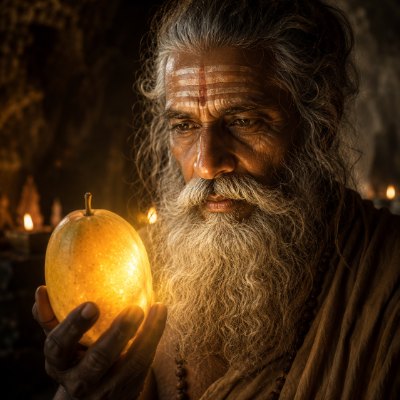
When Brihadratha heard that the sage Chandakaushika had come to his kingdom, he went to meet him in the forest in the company of his two queens and served him with great devotion and with offerings of jewels and other gifts. Moved by the king's sincere service, Chandakaushika wished to grant him a boon. At that moment a mango fruit fell from a tree directly into the sage's hands. The sage uttered sacred mantras over the fruit, endowing it with the power to grant the birth of a son, and presented it to the king with the instruction to give it to his wife. Brihadratha accepted the fruit with joy. Not wishing to favour one queen over the other, and unaware that dividing the fruit would produce a divided result, he cut the mango into two equal halves and gave one half to each queen. Both queens consumed their respective portions and both became pregnant. In due course each queen gave birth to a half-formed, lifeless fragment of a human body — one producing the upper half and the other the lower. Horrified at these grotesque births, the frightened queens ordered the two pieces to be cast outside the city walls.
A Rakshasi (demoness) named Jara, who roamed the outskirts of the city, came upon the two cast-away halves. She picked them up intending to carry them off, one in each hand. When her two hands came together and the two halves touched, they joined into a single whole living child, who immediately cried out with a powerful voice that shook the city. Startled and moved by the living child, Jara brought him to the king. Brihadratha received the child with wonder and gratitude. He named the boy Jarasandha — meaning he who was joined by Jara — in acknowledgement of the means by which the child had come to life. Jara herself prophesied before departing that the child would be strong and powerful.
✦ The Return to Magadha and the Prophecy
The Sabha Parva of the Mahabharata records (Chapter 19) that after Jarasandha's miraculous birth and reception by Brihadratha, Chandakaushika returned to the kingdom of Magadha. He saw the child and delivered a prophecy to Brihadratha concerning Jarasandha's future. The sage declared that the boy would be most handsome, powerful, and valorous; that no other king would match him in strength or martial prowess; that the glory of all other kings would be eclipsed by him; and that divine weapons — divyastras — would not be able to harm him. Following this prophecy, Brihadratha installed Jarasandha as crown prince and heir of Magadha, and thereafter retired to the forest with his two queens to undertake ascetic practice, leaving Jarasandha as the ruler of the kingdom. Chandakaushika's double appearance in the narrative — as the bestower of the boon and subsequently as the prophet of Jarasandha's invincibility — gives him a role that frames the entire arc of Jarasandha's career from birth to destiny.
Jarasandha, fulfilling Chandakaushika's prophecy, grew to extraordinary power. He became the most dominant king of Magadha, extending his father's realm, defeating numerous kings and holding them captive for eventual human sacrifice to Shiva, forming alliances with Shishupala as his commander-in-chief, and becoming the father-in-law of Kamsa — the king of Mathura whom Krishna killed. It was precisely because Jarasandha then turned his enmity toward Krishna that the Sabha Parva's central political crisis arose. Krishna's explanation of Jarasandha's origin through Chandakaushika's boon is the occasion for the narrative, and Chandakaushika thus stands at the beginning of one of the Mahabharata's most consequential political storylines.
✦ Textual Notes and Points of Caution
The Mahabharata's Sabha Parva is the earliest and most authoritative primary source for the narrative involving Chandakaushika. In that text he is named as Chanda Kaushika — the specific form of his name used throughout the Sabha Parva account — and is described simply as a rishi (sage) without further genealogical identification of his father. The identification of his father as Kakshivat of the Gautama race appears in the Jarasandhavadha Mahakavyam by Goswami Hariraiji, a Sanskrit epic of medieval composition that draws on the Mahabharata and the Bhagavata Purana as its sources. This Mahakavyam is a derivative literary work of considerable learning, not an independent primary source of equal antiquity to the Mahabharata itself. The parentage is therefore recorded in this profile with the clear note that it rests on the Mahakavyam tradition rather than on the original Mahabharata text.
The Jain tradition contains an episode of a serpent named Chandakaushika in connection with the life of the Jain tirthankara Mahavira, recorded in the Trishashti Shalaka Purusha Caritra. This Chandakaushika — a fierce cobra associated with a Jain narrative of non-violence — is an entirely different figure from the Vedic sage of the Mahabharata tradition. The two share only a name and must not be conflated. Their narrative contexts, religious traditions, and nature are wholly distinct.
The Puranic Encyclopaedia of Vettam Mani does not record a separate entry for Chandakaushika as a distinct biographical figure, though it includes the narrative of Jarasandha's birth in the relevant sections. No wife, children, independent spiritual episode, Vedic hymn attribution, or further genealogical progeny of Chandakaushika is recorded in any primary or secondary source examined for this profile.
✦ Connection to the Wider Genealogy
Through his father Kakshivat and grandfather Dirghatamas, Chandakaushika stands as a fourth-generation descendant of Angiras — the primordial mind-born son of Brahma and progenitor of the Angirasa lineage — making him a great-great-grandson of Angiras in the direct male line. Through Angiras's son Utathya and Utathya's brother Brihaspati — the divine preceptor of the gods — Chandakaushika is a cousin-lineage figure relative to Bharadvaja, whose son Drona trained the central generation of Mahabharata warriors. Through his father Kakshivat's thousand Kushmanda Gautama sons, Chandakaushika has a large body of collateral kin within the Gautama-Angirasa tradition. Through the birth of Jarasandha — which Chandakaushika made possible — he is the indirect catalyst of one of the Mahabharata's most consequential political narratives: Jarasandha's enmity with Krishna, his captivity of kings for human sacrifice, his alliance with Shishupala, and his eventual death in single combat with Bhima at the instigation of Krishna during the Rajasuyarambha episode. Chandakaushika's role at the origin of this chain of events gives his brief narrative moment an outsized genealogical and political significance within the tradition.
✦ References
Primary Sources
- Mahabharata, Sabha Parva, Rajasuyarambha Parva, Chapter 17 (Ganguli translation; critical edition): The primary source for the narrative of Chandakaushika's visit to Brihadratha, the gift of the mango fruit, and the circumstances leading to the birth of Jarasandha; narrated by Krishna to Yudhishthira in the context of the proposed Rajasuya sacrifice.
- Mahabharata, Sabha Parva, Rajasuyarambha Parva, Chapter 18: Continues the narrative with the birth of the two lifeless halves, their abandonment, the Rakshasi Jara's joining of the halves, the birth of Jarasandha, and his naming.
- Mahabharata, Sabha Parva, Rajasuyarambha Parva, Chapter 19: Records Chandakaushika's return to Magadha and his prophecy of Jarasandha's invincibility; Brihadratha's coronation of Jarasandha and retirement to the forest.
- Jarasandhavadha Mahakavyam by Goswami Hariraiji, Parts 4–5 (English translation, Wisdomlib): A Sanskrit epic of medieval composition based on the Mahabharata, Harivansha Purana, and Bhagavata Purana; the only source examined that explicitly identifies Chandakaushika as the son of Kakshivana of the Gautama race; records the narrative of the mango gift and Jarasandha's birth in the Mahakavyam's elaborated form.
Modern Reference Works
- Wikipedia — "Jarasandha" article: Secondary summary confirming the role of Chandakaushika in the birth of Jarasandha as narrated in the Sabha Parva; confirms the mango narrative and the naming episode; also notes his identification in secondary sources as the sage who visited Brihadratha.
- Wikipedia — "Sabha Parva" article: Confirms the chapter structure of the Sabha Parva's Rajasuyarambha sub-parva and identifies Chapters 17–19 as the sections covering the birth of Jarasandha and Chandakaushika's prophecy.
- Wisdomlib.org — "Kaushika" entry (Puranic Encyclopaedia, Vettam Mani, 1975): Lists multiple distinct figures bearing the name Kaushika in the Puranic and epic tradition; confirms the presence of a Kausika who is a minister of Jarasandha (a distinct figure from Chandakaushika the sage); useful for distinguishing the several Kaushika-named figures in the tradition.
- Kshemishvara — Chandakaushika (Sanskrit drama, c. 10th–11th century CE): A Sanskrit play based on the story of the sage Chandakaushika from the Mahabharata tradition; cited here to acknowledge the sage's prominence in the Sanskrit literary canon beyond the epic and Puranic sources, while noting that this dramatic work is not itself a primary Puranic or epic source.
- Vedadhara.com — "Story of Jarasandha" (summary of Sabha Parva account): Secondary paraphrase of the Sabha Parva narrative; confirms the sequence of events involving Chandakaushika including the mango gift, the twin births, Jara's joining of the halves, and the sage's prophetic return; used to verify narrative details against the primary Mahabharata account.