
About
Odra — Eponymous Founder of the Kingdom of Odra
Odra · Ondra · Odhra · Udra
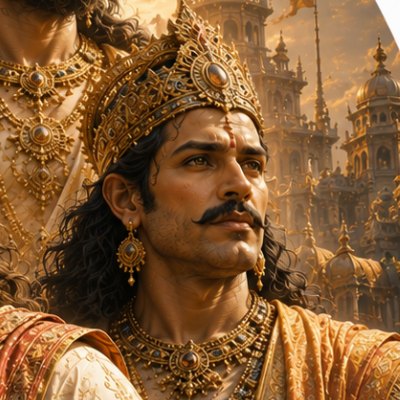
Odra is recorded in the Bhagavata Purana as the sixth son born through Queen Sudeshna, wife of King Bali, through the niyoga blessing of the blind Vedic sage Dirghatamas, son of the rishi Utathya and grandson of the primordial sage Angiras. He is named as the eponymous ancestor of the Odra people, whose territory is identified with what is now northern Odisha. Crucially, Odra does not appear in the account given in the Mahabharata's Adi Parva (I.104), which lists only five sons — Anga, Vanga, Kalinga, Pundra, and Suhma. His inclusion is a feature of the Bhagavata Purana's version of the narrative. The Mahabharata does, however, mention the Odras as a people in other contexts, and the name Odra is the etymological basis for the modern regional name Odisha (also spelled Orissa). Beyond his parentage in the Bhagavata Purana and the identity of the people and region named after him, the primary sources record nothing further about Odra as an individual.
✦ The Name
The name Odra — rendered also as Odhra, Ondra, and Udra across different texts and transliterations — is the basis for the Sanskrit territorial name Odra-desa, which evolved over time into the medieval Odriya and the modern Odisha and Oriya. No Sanskrit etymology for the name Odra as a personal name is offered by the primary texts. The Jatland Wiki entry notes that the Puranas refer to the people also as Sakano-dhrana, indicating the Odras' presence in lists of eastern peoples alongside other groups.
✦ Lineage
- Biological father: Dirghatamas — the blind Vedic sage, son of Utathya, grandson of Angiras; named as biological father in the Bhagavata Purana account.
- Legal father: Bali — Chandravanshi king, son of Sutapas, descended from Anu, son of Yayati.
- Mother: Sudeshna — queen of Bali; named in the Bhagavata Purana as the mother of six sons through Dirghatamas's blessing.
- Brothers: Anga, Vanga, Kalinga, Pundra, and Suhma — the five brothers named in the Mahabharata; Odra appears only as a sixth in the Bhagavata Purana.
✦ Textual Status and the Question of the Sixth Son
The discrepancy between the Mahabharata's five sons and the Bhagavata Purana's six is a genuine textual inconsistency. The Mahabharata's Adi Parva (I.104), which is the earliest systematic account of the niyoga episode involving Dirghatamas and Sudeshna, explicitly names five sons and pronounces that Sudeshna will bear five children. The Bhagavata Purana's list of six — replacing or expanding the Mahabharata's Suhma with both Suhma (here called Sambhu in some renderings) and Odra — represents a later Puranic elaboration. The Wikipedia article on the Odra kingdom confirms that the Bhagavata Purana specifically names Odra among the six sons of Dirghatamas by Sudeshna. The Mahabharata does mention the Odras independently in its Sabha Parva (II.47.19) as a people who sent tribute to Yudhishthira's Rajasuya sacrifice, listed alongside the Vangas, Angas, and Paundras — but that passage does not connect the Odras to the founding narrative of Bali and Dirghatamas. Odra's profile must therefore be understood as resting primarily on the Bhagavata Purana's account, not on the Mahabharata's founding narrative.
✦ The Kingdom of Odra
The territory of the Odras is placed by modern scholars in northern Odisha — broadly the hilly country between Kalinga to the south and Dakshina Kosala to the west. The scholar R.D. Banerji identified the Odras with the people of northern Odisha; B.C. Majumdar similarly placed the Odra land in this transitional zone. The name Oriya — the language and people of Odisha — is held to derive directly from Odra through successive phonological changes. The Odras are mentioned in the Mahabharata Sabha Parva as sending tribute alongside other eastern peoples, and the Wikipedia article on the Odra kingdom notes a further mention at Sabha Parva (II.28.48) in the context of Bhima's conquests of eastern territories.
✦ References
Primary Sources
- Bhagavata Purana, Skandha 9: The principal primary source for Odra as a son of Dirghatamas and Sudeshna; the only canonical text to include him in this founding narrative.
- Mahabharata, Sabha Parva (II.47.19; II.28.48): Mentions the Odras as an eastern people sending tribute to Yudhishthira, without connecting them to the Dirghatamas–Sudeshna niyoga narrative.
- Mahabharata, Adi Parva, Section CIV (I.104.53–54): The founding narrative from which Odra is absent; names only five sons: Anga, Vanga, Kalinga, Pundra, Suhma. Included here to document the textual inconsistency explicitly.
Secondary Sources
- Wikipedia, article on Odra kingdom: Confirms the Bhagavata Purana reference, notes the absence of Odra from the Mahabharata founding narrative, and collates the scholarly identification of Odra territory.
- Jatland Wiki, article on Odra: Records the Puranic mention and traces the genealogical and territorial tradition of the Odra people.