
About
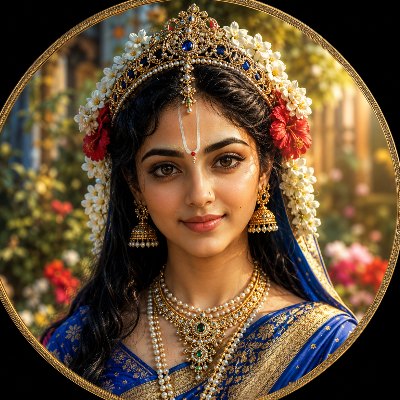
Radha — Eternal Consort of Krishna, Embodiment of Divine Love
Radha · Radhika · Radharani · Kishori · Vrishabhanu-nandini · Hladini Shakti
Radha is the foremost among the gopis, the cowherd maidens of Vraja, and is venerated across the Puranic and Gaudiya Vaishnava traditions as the eternal feminine counterpart and divine consort of Krishna, the cowherd form of Vishnu who is worshipped in much of Vaishnava devotionalism as the supreme deity in his own right. She is identified as the daughter of Vrishabhanu, the chieftain of the cowherds of Vraja, and his wife Kirtida Devi, and is the elder sister of Ananga Manjari and, in certain genealogical traditions, of Sridama. Radha's textual presence is concentrated in a body of literature distinct from the eighteen Mahapuranas proper — principally the Brahma Vaivarta Purana, the Uttara Khanda of the Padma Purana, the Garga Samhita, the Devi Bhagavata Purana, and the twelfth-century Sanskrit poem the Gita Govinda of Jayadeva — and she occupies a position of supreme theological importance within Gaudiya Vaishnavism, the tradition founded on the teachings of Chaitanya Mahaprabhu, where she is identified as the Hladini Shakti, the personification of Krishna's own power of divine bliss. Her absence by name from the Bhagavata Purana's account of the Rasa Lila, set against her overwhelming prominence in the later devotional and Upapuranic corpus, constitutes one of the most significant textual questions surrounding any figure in the Krishna tradition.
✦ The Name
The name Radha is derived from the Sanskrit root radh, which carries the senses of to succeed, to prosper, to accomplish, or to be perfected — and is closely related to the noun aradhana, meaning worship, adoration, or devoted service. In Gaudiya Vaishnava theological writing, both meanings are held to be active in the name simultaneously: Radha is she through whom worship is perfected, and she is herself the perfection and accomplishment of devotion in its highest form. Some commentators additionally connect the name to a reversal or play upon Hara, one of the names of Krishna, framing Radha and Krishna as mirrored or reversed reflections of a single divine reality.
Radhika is the diminutive and most commonly used form of her name in devotional address, conveying affection and intimacy. Radharani — literally Queen Radha — is an honorific widely used in Gaudiya Vaishnava worship, particularly at her principal shrines, and reflects her status as the queen of Vraja and as Krishna's eternal consort and co-ruler of the divine realm of Goloka. Kishori, meaning a young maiden or adolescent girl, is used to describe her eternal youthful form, in which she and Krishna are conceived as ever-fresh, ever-renewing adolescents whose love never ages or diminishes. Vrishabhanu-nandini, meaning daughter of Vrishabhanu, identifies her by her earthly parentage among the cowherds of Vraja. Hladini Shakti, meaning the energy of bliss or the power of delight, is her designation within the Gaudiya theological system of Krishna's threefold internal potency, where she represents the aspect of divine power through which Krishna experiences and bestows transcendental joy.
✦ Lineage
- Father: Vrishabhanu — chieftain of the cowherds of Vraja, identified in the Brahma Vaivarta Purana and the Garga Samhita as the head of a prominent Gopala family of Vraja. In the genealogical tradition recorded in Rupa Goswami's Shri Radha-Krishna-Ganoddesha-Dipika, Vrishabhanu shared the chieftainship of his branch of the cowherds with his brothers Bhanu, Subhanu, and Ratnabhanu, and the family is identified by the recurring solar element bhanu, meaning sun, in each brother's name.
- Mother: Kirtida Devi — wife of Vrishabhanu and Radha's mother, venerated in Gaudiya Vaishnava tradition as one of the most exalted of mortal mothers for having given birth to the form in which the supreme feminine principle descended to Vraja.
- Paternal grandfather: Mahibhanu — identified in Rupa Goswami's Shri Radha-Krishna-Ganoddesha-Dipika, specifically in its Shri Radha-Parijvara-Nirupana section, as the father of Vrishabhanu and thus Radha's paternal grandfather, situating Vrishabhanu's household within an established cowherd lineage of Vraja bearing the Bhanu name.
- Paternal grandmother: Sukhada (also rendered Shukada Devi) — named in the same Gaudiya genealogical tradition as the wife of Mahibhanu and Radha's paternal grandmother.
- Sister: Ananga Manjari — Radha's younger sister, recorded in the Brahma Vaivarta Purana and in Gaudiya Vaishnava devotional literature as a close attendant and confidante within Radha's intimate circle, and venerated at certain shrines in the Braj region.
- Brother: Sridama (also Shridama) — recorded in certain strands of the Vraja genealogical tradition as Radha's brother, a cowherd companion of Krishna among the circle of Krishna's male friends in Vraja.
- Eternal consort: Krishna — the cowherd form of Vishnu, worshipped in Vaishnava tradition as an avatar of Vishnu and, within Gaudiya Vaishnavism and several other Krishna-centred schools, as the supreme deity from whom all other divine forms, including Vishnu, emanate. Radha and Krishna are conceived in this tradition not as separate beings who are united, but as a single divine reality that manifests in two complementary forms — Krishna as the possessor of bliss and Radha as his Hladini Shakti, the power of bliss itself.
- Variant tradition — husband Ayan Ghosha: In certain folk and regional retellings of the Vraja narratives, a figure named Ayan Ghosha, sometimes identified as a cousin of Krishna, is given as Radha's wedded husband, with the implication that her love for Krishna was extramarital in form, an arrangement termed parakiya in the technical vocabulary of Vaishnava aesthetic theology. This tradition is not found in the Brahma Vaivarta Purana or the Garga Samhita and is treated with considerable reserve, reinterpretation, or outright rejection within Gaudiya Vaishnavism, where Radha's relationship with Krishna is more commonly understood theologically rather than as a literal account of worldly marital circumstance.
✦ Accounts of Radha's Birth and Origin
The Brahma Vaivarta Purana provides one of the principal accounts of Radha's appearance in Vraja, describing her as discovered by Vrishabhanu near the banks of the river Yamuna, where she was found within a lotus, radiant with a golden complexion, and recognised as no ordinary infant but as a manifestation of the supreme goddess descended to share in Krishna's earthly pastimes. This account situates her birth as a divine appearance into a mortal household rather than an ordinary human birth, paralleling the manner in which Krishna himself, though born to Devaki and Vasudeva, is understood in the tradition to be an unborn, eternal being who appears rather than is born in the conventional sense.
The Uttara Khanda of the Padma Purana provides a complementary account that situates Radha's origin prior to her appearance in Vraja, describing her as emerging from the left side of Krishna's own form in the transcendent realm of Goloka, the highest spiritual abode in Gaudiya Vaishnava cosmology, where Krishna resides eternally in his original two-armed cowherd form. In this account, Radha's emergence from Krishna's own body establishes her not as a separate created being who comes to be united with him, but as an extension or facet of his own being made manifest as a distinct form, so that the two might engage in the loving exchanges that constitute the highest expression of divine relationship in this theological system. The Padma Purana account is also connected to a narrative in which Vrishabhanu, in a former life, was a king named Suchandra, who through devotion and austerity was granted the boon of becoming, in a subsequent birth, the father of the supreme goddess in her descended form — leading to his birth into the household of the Yadava cowherd chieftain identified in the genealogical tradition as Surabhanu.
These two accounts — the lotus-discovery narrative of the Brahma Vaivarta Purana and the Goloka-emanation narrative of the Padma Purana — are not generally treated within the tradition as mutually exclusive but as descriptions of the same event from different vantage points: the metaphysical account of her eternal origin in Goloka, and the earthly account of how that eternal being became visible within the household of Vrishabhanu in Vraja.
✦ The Rasa Lila and the Gopis of Vraja
The Rasa Lila, described principally in the tenth book of the Bhagavata Purana, is the central narrative episode associated with Krishna's youth in Vraja and with the gopis as a collective. In this episode, Krishna, upon hearing the gopis' longing expressed through their singing on an autumn night, draws them to the forest of Vrindavana by the sound of his flute and dances with them in a circle, multiplying himself so that each gopi experiences his presence as though exclusively her own. The episode is presented in the Bhagavata Purana as an expression of the soul's longing for union with the divine and of the divine response to that longing, conducted with a purity that the text explicitly states transcends ordinary romantic or sensual categories.
The Bhagavata Purana's account of the Rasa Lila does not name any individual gopi as pre-eminent above the others, describing the gopis as a collective body of devotees whose love for Krishna is undifferentiated in its totality. It is in the later devotional and Upapuranic tradition — the Brahma Vaivarta Purana, the Garga Samhita, and subsequently the poetic tradition exemplified by the Gita Govinda — that Radha is identified as the foremost among the gopis, the one whose love for Krishna is of a uniquely elevated quality, and around whom the entire Rasa Lila is reorganised as a drama of two principal figures rather than a collective dance.
✦ The Gita Govinda and the Theme of Separation
The Gita Govinda, composed by the twelfth-century poet Jayadeva in the Sanskrit language, is the single most influential literary work in establishing Radha's place at the centre of Krishna devotional poetry and performance. The poem narrates, across a sequence of lyrical cantos intended for musical performance, the unfolding of love between Radha and Krishna through stages of union, Krishna's temporary attraction to other gopis, Radha's resulting anguish and jealousy, the painful separation that follows, and the eventual reconciliation and reunion of the divine pair. The emotional register of separation, termed viraha in Sanskrit poetics, becomes in the Gita Govinda and in the subsequent devotional tradition a central theological metaphor: the pain of separation from the beloved is understood as a heightened, even superior, mode of devotional experience to the comfort of union, because it intensifies longing to its furthest extent.
The Gita Govinda's portrayal of Radha as a figure of intense emotional depth — capable of jealousy, anguish, longing, and eventual forgiveness — humanises the divine relationship in a manner that proved immensely influential for subsequent Vaishnava poetry, temple performance traditions, and painting throughout eastern and northern India, particularly in the regions of Odisha, Bengal, and Braj.
✦ Theological Significance: Hladini Shakti and the Gaudiya Vaishnava Synthesis
Within Gaudiya Vaishnavism, the school of Vaishnava devotion founded upon the teachings and example of Chaitanya Mahaprabhu, a sixteenth-century Bengali saint regarded by his followers as a combined incarnation of Radha and Krishna in a single body, Radha occupies a position of theological centrality unparalleled in earlier tradition. The Gaudiya theological system, articulated most systematically by the Goswamis of Vrindavana — among them Rupa Goswami, whose Shri Radha-Krishna-Ganoddesha-Dipika catalogues the genealogies and relationships of Radha, Krishna, and their eternal associates — describes Krishna's own being as possessing three primary internal potencies: the Sandhini Shakti, governing existence; the Samvit Shakti, governing knowledge; and the Hladini Shakti, governing bliss. Radha is identified as the personification of this Hladini Shakti in its most concentrated and perfect form.
In this framework, Radha is not a separate divine being who stands in relation to Krishna as one person stands to another, but is rather Krishna's own capacity for relationship, love, and bliss, given a distinct form so that Krishna himself might experience that bliss as though from another. The relationship between Radha and Krishna thus becomes, in Gaudiya theology, the paradigm and source of all relationship within the created order — the original duality from which the possibility of loving exchange between the divine and its devotees arises. Chaitanya Mahaprabhu himself is understood within this tradition as the union of these two principles in a single descended form: Krishna, overwhelmed by a desire to experience the intensity of Radha's love for himself, took on Radha's mood and complexion while retaining his own identity, appearing as Chaitanya in order to taste, from within, the supreme devotion that Radha embodies.
✦ Iconography and Worship
Radha is conventionally depicted standing beside Krishna, typically to his left, with a fair or golden complexion that is frequently contrasted in iconography and poetry with Krishna's dark blue or black colouring — a visual pairing understood within the tradition to represent the union of complementary divine principles, light and depth, bliss and its possessor. She is shown adorned in fine garments and ornaments befitting a queen, often in a posture of tender intimacy with Krishna, with the two figures together referred to in worship as Radha-Krishna or, in many temples, installed as a single combined deity form addressed by names that join both their identities.
Radha Ashtami, observed on the eighth day of the bright lunar fortnight in the Hindu month of Bhadrapada, is celebrated as Radha's appearance day and is among the most significant festivals in Gaudiya Vaishnava and Braj devotional calendars, particularly at her principal shrines. The town of Barsana, in the Braj region of Uttar Pradesh, is venerated as Radha's birthplace and as the seat of Vrishabhanu's household, and is home to the Shri Radha Rani Temple, also known as the Shriji Temple, situated atop a hill and dedicated to Radha as the presiding deity in her own right — one of the very few temples in India where a female deity is worshipped as the primary and pre-eminent figure of a Radha-Krishna pairing. Vrindavana, the principal site of Krishna's youthful pastimes, contains numerous temples dedicated to combined Radha-Krishna worship, among the most prominent being the Radha Raman temple, established by the Gaudiya tradition in the sixteenth century.
✦ Textual Variants and Inconsistencies
The most significant textual question surrounding Radha concerns her absence by name from the Bhagavata Purana, the text that provides the most extensive and theologically influential account of Krishna's life among the eighteen Mahapuranas, including its celebrated tenth book's narration of the Rasa Lila. The Bhagavata Purana describes the gopis collectively and at certain points refers to one gopi who is led away privately by Krishna during the Rasa Lila, an episode some later commentators have identified with Radha, though the text itself does not supply this name. Radha's emergence as a named, individuated figure of supreme importance occurs in a body of texts later than or contemporaneous with, but distinct from, the Bhagavata Purana — principally the Brahma Vaivarta Purana, an Upapurana whose dating relative to the Bhagavata Purana remains a matter of scholarly discussion, the Garga Samhita, and the Padma Purana's Uttara Khanda, itself widely regarded as a comparatively late addition to that Purana.
A further variant concerns the question of Radha's marital status, discussed above in the Lineage section: the folk tradition of a husband named Ayan Ghosha stands in considerable tension with the Gaudiya theological framing of Radha's relationship with Krishna as the eternal and original archetype of divine love, prior to and independent of any worldly social institution. The two traditions are generally treated as belonging to different registers — one a regional folk narrative concerned with the social circumstances of Vraja, the other a theological account concerned with the eternal nature of Radha and Krishna in Goloka — rather than as directly competing claims requiring reconciliation.
The two accounts of Radha's origin — her discovery in a lotus by Vrishabhanu as recorded in the Brahma Vaivarta Purana, and her emanation from Krishna's own form in Goloka as recorded in the Padma Purana's Uttara Khanda — represent a further instance of textual variation, though as noted above the tradition generally reads these as complementary descriptions of a single event at different levels of reality rather than as contradictory accounts.
✦ Connection to the Wider Genealogy
Within the cowherd lineage of Vraja, Radha is the daughter of Vrishabhanu and Kirtida Devi, the granddaughter of Mahibhanu and Sukhada through her father's line, and the sister of Ananga Manjari and, in certain genealogical traditions, of Sridama. This lineage situates her within the Abhira cowherd community of Vraja, a pastoral community distinct from, though closely interwoven in narrative with, the Yadava lineage of Krishna's own birth into the royal house of Mathura through his parents Vasudeva and Devaki. Through her eternal relationship with Krishna, Radha is connected to the entirety of the Krishna narrative tradition — the Yadava dynasty of Dwaraka, the Pandava and Kaurava lineages of the Mahabharata with whom Krishna is closely involved, and the cowherd community of Vraja in which Krishna's childhood unfolds. Within Gaudiya Vaishnava theology, this earthly genealogy is understood as the visible, descended form of an eternal relationship that exists prior to and independent of any lineage — Radha and Krishna together constituting, in this tradition, the source from which all subsequent divine and devotional relationships are held to derive.
✦ References
- Primary Sources
- Bhagavata Purana, Book 10, Chapters 29–33 (the Rasa Lila) — Provides the foundational narrative of Krishna's circle dance with the gopis of Vraja, the textual basis from which Radha's later pre-eminence among the gopis develops, without naming Radha individually.
- Brahma Vaivarta Purana, Krishna Janma Khanda — Primary source for Radha's discovery by Vrishabhanu near the Yamuna in the form of a radiant infant within a lotus, and for her identification as Ananga Manjari's elder sister.
- Padma Purana, Uttara Khanda — Primary source for the account of Radha's emanation from the left side of Krishna's form in Goloka, and for the narrative of Vrishabhanu's former life as King Suchandra and his subsequent birth into the household of the cowherd chieftain Surabhanu.
- Garga Samhita, Canto 1 — Provides genealogical and narrative material concerning Radha's family, her parentage through Vrishabhanu and Kirtida, and the broader Vraja setting of her appearance.
- Devi Bhagavata Purana — Contains material situating Radha within the broader tradition of goddess theology, identifying her with the supreme feminine principle.
- Gita Govinda of Jayadeva — Twelfth-century Sanskrit lyrical poem providing the foundational literary treatment of Radha and Krishna's love, separation, and reunion, of central importance to the devotional and artistic tradition surrounding Radha.
- Shri Radha-Krishna-Ganoddesha-Dipika of Rupa Goswami, Shri Radha-Parijvara-Nirupana section — Sixteenth-century Gaudiya Vaishnava genealogical and theological compendium; primary source for Radha's paternal grandparents Mahibhanu and Sukhada, and for the structure of Vrishabhanu's extended household.
- Secondary Sources
- Mani, Vettam. Puranic Encyclopaedia. Motilal Banarsidass, 1975. — Consulted for cross-verification of Radha's appearances across the Puranic and Upapuranic corpus.
- Radha Kunda Desire Tree, "Meeting Radha's Family" — Secondary compilation translating and consolidating Rupa Goswami's genealogical material concerning Radha's family, including the Mahibhanu-Sukhada-Vrishabhanu line.
- Bharatpedia, entry on Vrishabhanu — Secondary reference consolidating the Garga Samhita and Padma Purana material concerning Vrishabhanu's ancestry through Surabhanu and his former life as King Suchandra.