
About
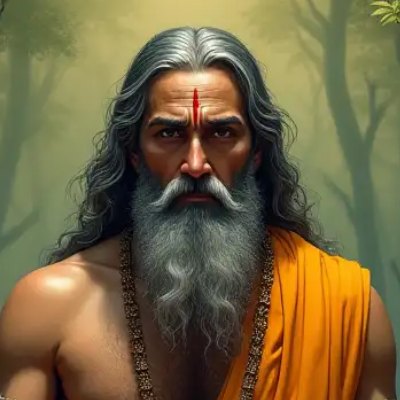
Suhastya — Rigvedic Sage, Son of Ghosha, and Composer of Hymn X.41
Suhastya · Suhastya Ghausheya · Ghausheya · Angirasakula
Suhastya is a Rigvedic sage of the Angirasa tradition, identified in Katyayana's Sarvanukramani — the authoritative ancient index of the Rigveda — as the composer of Sukta 10.41 of the Rigveda's tenth Mandala, a hymn addressed to the Ashvins, the twin divine physicians of the Vedic pantheon. He is the son of Ghosha — the celebrated Rigvedic female seer and Brahmavadini who composed Suktas 10.39 and 10.40 of the same Mandala, also addressed to the Ashvins — and bears the metronymic Ghausheya, meaning son of Ghosha, by which he is designated in the anukramani and in the Monier-Williams Sanskrit-English Dictionary. His maternal grandfather was Kakshivat, one of the principal hymn-composers of the Rigveda's first Mandala, and his maternal great-grandfather was Dirghatamas, the celebrated blind sage of the Angirasa lineage. Suhastya thus continues a family tradition of Ashvin devotion that spans three consecutive generations within a single lineage — his grandfather's Ashvin hymns in the first Mandala, his mother's in the tenth, and his own immediately following hers. No wife, children, or independent biographical narrative of Suhastya is recorded in any primary or secondary source examined. The textual basis for this profile is limited to the anukramani attribution and the Rigvedic hymn itself, and the profile reflects that scope proportionally.
✦ The Name
The Sanskrit name Suhastya is a compound of su — a prefix meaning good, excellent, well, or auspicious — and hasta — meaning hand — with the adjectival suffix ya. The compound yields the meaning of one with excellent or skilful hands, or more broadly, one who is adept, dexterous, or gifted in his work. The Monier-Williams Sanskrit-English Dictionary records suhastya as an adjective meaning skilful-handed or clever and then as a proper name, the name of a sage who is the author of Rigveda X.41, with the metronymic Ghausheya. As applied to a sage and hymn-composer, the epithet skilful-handed carries the sense of one deft in the crafting of sacred verse — an apt designation for a figure from a family whose multi-generational sacred poetry was composed with exceptional refinement. The metronymic Ghausheya is formed from Ghosha — his mother's name — with the suffix eya denoting descent, yielding the meaning son of Ghosha. This metronymic is significant in the Rigvedic tradition as the primary identifier by which Suhastya is known in the anukramani, marking him as a figure whose identity is defined through his maternal rather than paternal lineage — his father's name is not recorded in any source examined.
✦ Lineage
- Mother: Ghosha — also designated Ghosha Kakshivati, daughter of Kakshivat; a Rigvedic female seer (Rishika) and Brahmavadini; composer of Rigveda Suktas 10.39 and 10.40, both addressed to the Ashvins; afflicted from youth with a disfiguring skin disease from which she was healed through the grace of the Ashvins and through the Madhu Vidya they taught her; holder of the epithets Mantradrika (well versed in mantras) and Brahmavadini (speaker of Brahman)
- Father: Not recorded in any primary or secondary source examined
- Maternal grandfather: Kakshivat — one of the most significant hymn-composers of the Rigveda's first Mandala; attributed with hymns I.116–I.126 addressing the Ashvins, Indra, and the dawn goddess Ushas; son of the blind sage Dirghatamas of the Angirasa tradition; named in the Mahabharata as one of seven Barhishads who served as celestial gurus of Indra; his marriage to the ten daughters of King Bhavayavya is documented in Rigveda I.125–I.126
- Maternal great-grandfather: Dirghatamas — the blind sage of the Angirasa lineage; son of Utathya and Mamata; composer of the Asya Vamasya hymn (Rigveda I.164) and the hymns spanning I.140–I.164; a figure of the first rank in the Vedic tradition
- Maternal great-great-grandfather: Utathya — elder brother of Brihaspati the divine preceptor of the gods; a sage of great authority within the Angirasa lineage
- Maternal great-great-great-grandfather: Angiras — primordial mind-born son of Brahma; progenitor of the entire Angirasa lineage
- Maternal uncle: Chandakaushika — son of Kakshivat; a sage of the Gautama-Angirasa tradition who gave the sacred mango to King Brihadratha of Magadha, thereby facilitating the birth of Jarasandha
✦ Rigveda X.41 — The Hymn
Suhastya's sole firmly attributed composition in the Rigveda is Sukta 10.41, placed in the tenth Mandala immediately following his mother Ghosha's two hymns at 10.39 and 10.40. The anukramani entry for 10.41.2 as recorded on Wisdomlib gives: Rishi — suhastyo ghauseyah (Suhastya Ghausheya); Devata — ashvinau (the Ashvins); Chandas — nicritjagati. The deity addressed is the same as in both of his mother's hymns — the Ashvins — making the sequence of three consecutive suktas (10.39, 10.40, 10.41) a familial Ashvin cluster within the tenth Mandala, unified by the devotional tradition of the Angirasa-Kakshivat family.
The metre of Sukta 10.41 is recorded as nicritjagati — a defective or contracted form of the jagati metre, in which one or more syllables of the standard jagati pattern (four lines of twelve syllables each) are reduced. This distinguishes Suhastya's metre slightly from his mother Ghosha's standard jagati in Suktas 10.39 and 10.40. The variation is a recognised Vedic metrical sub-form rather than an irregular composition. The Quora source cited in the Ghosha profile notes that Suhastya's suktas directly follow his mother's in the Rigveda and invoke the Ashvins as she taught him — placing the hymn within the living devotional and pedagogical tradition of the household. The Dharmapedia analysis of Mandala 10 confirms that the anukramani groups hymns 39 through 41 of the tenth Mandala as a triad — 39–41 forming a recognisable group by number of verses, deity, and metre — further affirming the compositional coherence of Ghosha's and Suhastya's hymns as a family cluster.
✦ The Mandala 1 Reference — A Textual Note
The Wisdomlib Puranic Encyclopaedia entry on Suhastya also records a reference placing him at Rigveda Mandala 1, Anuvaka 17, Sukta 120. This reference appears alongside the statement that he was the son of Ghosha. If accurate, this would give Suhastya a presence in the first Mandala in addition to his primary attribution at 10.41. However, the Monier-Williams Sanskrit-English Dictionary — which draws directly on Katyayana's Sarvanukramani — records Suhastya Ghausheya exclusively as the author of Rigveda X.41, without mentioning Mandala 1, Sukta 120. The Mandala 1 reference in the Puranic Encyclopaedia is not confirmed by the anukramani citation in Monier-Williams and may reflect either a separate tradition within the Puranic Encyclopaedia's sources or a confusion with another figure or passage. This profile records both references honestly without adjudicating between them.
✦ The Three-Generation Ashvin Tradition
Suhastya's principal significance in the wider Rigvedic tradition is his position as the third generation of a single family's devoted hymn-composition to the Ashvins. His maternal grandfather Kakshivat composed the most mythologically rich Ashvin hymns in the first Mandala — narrating the twins' miraculous deeds in the genre of Ashvin-stuti and making those hymns a primary source for Ashvin mythology in the Vedic corpus. His mother Ghosha composed two deeply personal Ashvin hymns in the tenth Mandala, turning to the same divine twins as healers in her own affliction, receiving the Madhu Vidya, and recovering. Suhastya then composed his own Ashvin hymn, trained — according to the Quora source citing the tradition associated with the hymns — in that devotion by his mother. The Ashvin triad of 10.39–10.41 thus represents one of the Rigveda's most coherent inter-generational compositional sequences: a grandmother-father tradition of institutional Ashvin praise passing through a daughter who made it intensely personal, and then transmitted to a son who continued it in the same Mandala. Within the broad Angirasa tradition, which accounts for a large proportion of the Rigveda's hymns, this family cluster stands out for the depth and continuity of its single-deity devotional focus.
✦ Textual Scope and Limits
Suhastya is attested by name and metronymic in Katyayana's Sarvanukramani as the composer of Rigveda X.41, addressed to the Ashvins in the nicritjagati metre. This attestation is confirmed by the Wisdomlib Rigveda translation entry for 10.41.2 and by the Monier-Williams Sanskrit-English Dictionary. Beyond his composition and his parentage through Ghosha, no independent biographical narrative, spouse, children, place of residence, spiritual episode, or further genealogical progeny of Suhastya is recorded in any primary or secondary source examined for this profile. The Puranic Encyclopaedia of Vettam Mani names him as a muni extolled in the Rigveda and as the son of Ghosha, but adds no further biographical detail. This profile is correspondingly brief and is a faithful reflection of the available evidence.
✦ Connection to the Wider Genealogy
Through his mother Ghosha and maternal grandfather Kakshivat, Suhastya is a fifth-generation descendant of Angiras — the primordial mind-born son of Brahma and progenitor of the Angirasa lineage — in the direct line of descent through Angiras, Utathya, Dirghatamas, Kakshivat, and Ghosha. He thus stands at the fifth remove from the founding ancestor of one of the most prolific hymn-composing families in the entire Rigveda. Through his maternal uncle Chandakaushika, whose role in the birth of Jarasandha of Magadha is recorded in the Mahabharata's Sabha Parva, Suhastya's family connects to one of the Mahabharata's most consequential political narratives. Through Kakshivat's half-brothers Anga, Vanga, Kalinga, Pundra, and Suhma — founders of five eastern kingdoms — Suhastya is a second-degree collateral relative of the progenitors of those royal houses. Within the Rigvedic corpus itself, Suhastya's hymn at 10.41, placed immediately after his mother's two suktas, represents the culmination of the Angirasa-Kakshivat family's engagement with the Ashvin tradition — carrying that devotion from the first Mandala's ancient hymns through to the latest stratum of the Rigvedic collection in a single unbroken line of family transmission.
✦ References
Primary Sources
- Rigveda, Mandala X, Sukta 10.41 (attributed to Suhastya Ghausheya; H. H. Wilson translation; Wisdomlib Rigveda translation): The primary source for Suhastya's identity and compositional activity; the hymn is addressed to the Ashvins, composed in the nicritjagati metre, and is placed in the tenth Mandala immediately following his mother Ghosha's two Ashvin suktas at 10.39 and 10.40.
- Rigveda Anukramani — Katyayana's Sarvanukramani (c. 2nd century BCE): The authoritative Rigvedic index; records suhastyo ghauseyah as the Rishi of Sukta 10.41 with the Ashvins as deity and nicritjagati as metre; the canonical source for the attribution of this hymn to Suhastya and for his metronymic designation as son of Ghosha.
Modern Reference Works
- Monier-Williams, M. — Sanskrit-English Dictionary (1899), entry "Suhastya": The most authoritative secondary attestation; records suhastya as an adjective meaning skilful-handed or clever, and then as the name of a Rshi with the metronymic Ghausheya who is the author of Rigveda X.41, citing the Anukramani; confirms both the name's meaning and the hymn attribution.
- Wisdomlib — entry "Suhastya" (last updated March 2021): Aggregates the Monier-Williams entry and the Puranic Encyclopaedia entry; confirms Suhastya as son of Ghosha and author of Rigveda X.41; also records the Puranic Encyclopaedia reference placing him at Rigveda Mandala 1, Anuvaka 17, Sukta 120 — noted in this profile as an unconfirmed secondary reference.
- Wisdomlib — Rigveda 10.41.2 entry: Direct anukramani-level attestation from the Wisdomlib Rigveda translation database; records Rishi: suhastyo ghauseyah; Devata: ashvinau; Chandas: nicritjagati — the most precise primary-level digital confirmation of the hymn attribution and its technical details.
- Mani, Vettam — Puranic Encyclopaedia (1975), entry "Suhastya": Records Suhastya as a muni extolled in the Rigveda and as the son of Ghosha; provides the Mandala 1, Anuvaka 17, Sukta 120 reference that is not confirmed by the Monier-Williams anukramani citation; used here with the textual qualification noted in the profile.
- Dharmapedia — "Mandala 10" article: Confirms the anukramani grouping of Rigveda 10.39–10.41 as a hymn triad by number of verses, deity, and metre; supports the understanding of Ghosha's and Suhastya's hymns as a coherent compositional family cluster within the tenth Mandala.
- Wikipedia — "Ghosha" article: Secondary source confirming Suhastya as Ghosha's son and as a Rigvedic hymn-composer; used for cross-verification of the mother-son relationship and of Suhastya's compositional activity.