
About
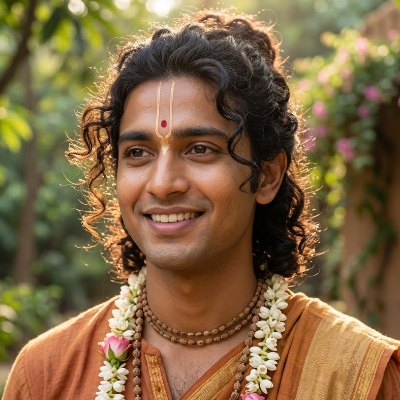
Sridama — Elder Brother of Radha, Foremost Cowherd Friend of Krishna
Sridama · Shridama · Priya-narma-sakha
Sridama is identified in Rupa Goswami's sixteenth-century Gaudiya Vaishnava genealogical compendium, the Shri Radha-Krishna-Ganoddesha-Dipika, as the eldest child of Vrishabhanu, the cowherd chieftain of Vraja, and his wife Kirtida Devi, making him the elder brother of Radha, the eternal consort of Krishna, and of Ananga Manjari. Within the same text, Sridama is also identified as the dearest of Krishna's cowherd companions, holding the status of priya-narma-sakha, an intimate and high-ranking category of friendship in Krishna's circle of companions in Vraja. Sridama's dual position — brother of Radha within Vrishabhanu's household, and closest friend of Krishna among the cowherd boys — is explained in the Garga Samhita's Goloka Khanda and the Patala Kanda of the Padma Purana through a narrative of a mutual curse exchanged between Sridama and Radha in the celestial realm prior to their earthly births, which is the principal narrative episode associated with him.
✦ The Name
The name Sridama is a Sanskrit compound of shri, meaning auspiciousness, splendour, or beauty, and dama, which can be read either as a form related to dama, meaning rope, garland, or bond, or as a form of the verbal root meaning to give or bestow. The name may accordingly be read as he who bestows auspiciousness or as he who is adorned with a garland of splendour. The name Sridama is closely similar to, and is sometimes confused with, the name Sudama — a separate figure recorded in the Bhagavata Purana as an impoverished brahmin friend of Krishna's childhood whose visit to Krishna's palace at Dwaraka forms an entirely distinct narrative episode. Sridama and Sudama are not the same figure, and the textual traditions concerning each are independent of one another.
✦ Lineage
- Father: Vrishabhanu — cowherd chieftain of Vraja, identified in the Brahma Vaivarta Purana, the Padma Purana's Uttara Khanda, the Garga Samhita, and the Shri Radha-Krishna-Ganoddesha-Dipika as the father of Radha. Vrishabhanu shared the chieftainship of his branch of the Vraja cowherds with his brothers Bhanu, Subhanu, and Ratnabhanu.
- Mother: Kirtida Devi — wife of Vrishabhanu, recorded together with her husband as having discovered the infant Radha near the banks of the Yamuna, and venerated within Gaudiya Vaishnava tradition as one of the most exalted of mortal mothers.
- Younger sister: Radha — venerated across the Brahma Vaivarta Purana, the Padma Purana's Uttara Khanda, the Garga Samhita, and the wider Gaudiya Vaishnava tradition as the foremost of the gopis of Vraja and as the eternal consort of Krishna, identified theologically as his Hladini Shakti, the personification of Krishna's own potency of divine bliss.
- Younger sister: Ananga Manjari — the youngest child of Vrishabhanu and Kirtida Devi, recorded in the Brahma Vaivarta Purana and in Gaudiya Vaishnava devotional literature as a close attendant and confidante within Radha's intimate circle.
✦ The Celestial Curse and Its Earthly Resolution
The Goloka Khanda of the Garga Samhita and the Patala Kanda of the Padma Purana recount a narrative set in the celestial realm of Goloka, prior to the earthly births of the figures involved, in which Sridama and Radha exchanged curses following a dispute. In this narrative, Radha pronounced a curse upon Sridama that condemned him to be born on earth into circumstances involving conflict with demonic forces — a condition that materialises in Vraja through Sridama's later confrontation with an Asura figure associated with the name Shankhachuda. In turn, Sridama pronounced a curse upon Radha that condemned her to endure a period of prolonged earthly separation from Krishna, a separation of considerable duration that becomes a major theme of the Vraja narrative and of the devotional poetry, such as Jayadeva's Gita Govinda, that elaborates upon Radha's longing.
Because both Sridama and Radha were destined by these mutual curses to descend to earth for the unfolding of Krishna's pastimes in Vraja, the tradition holds that their cosmic design placed them within the same household — that of Vrishabhanu and Kirtida Devi — so that Sridama could occupy a dual role on earth: he became, simultaneously, Radha's elder brother within the household, charged with a protective familial role toward her, and Krishna's most intimate cowherd companion, a priya-narma-sakha, free to engage with Krishna in the playful and sometimes contentious familiarity that this category of friendship permits. The earthly sibling relationship between Sridama and Radha is thus presented in the tradition not as an incidental genealogical fact but as the resolution and earthly working-out of a celestial conflict between the two figures.
✦ Sridama Among Krishna's Cowherd Companions
Within the Gaudiya Vaishnava classification of Krishna's companions in Vraja, the cowherd boys who share in Krishna's childhood games and pastimes are organised into categories according to the degree of intimacy and the character of their friendship with him. Sridama is identified as holding the foremost position among the priya-narma-sakhas, the category of friends distinguished by a particularly close and unguarded familiarity with Krishna, in which affectionate rivalry, teasing, and uninhibited play are characteristic. The Shri Radha-Krishna-Ganoddesha-Dipika, in cataloguing the inhabitants of Krishna's eternal realm of Goloka Vrindavana, places Sridama at the head of this group, reflecting his standing as Krishna's dearest friend among the cowherd boys.
✦ Connection to the Wider Genealogy
Sridama, as the eldest child of Vrishabhanu and Kirtida Devi, occupies a position within the household at Barsana from which Radha and Ananga Manjari also descend, situating him within the Abhira cowherd line of Vraja. Through his sister Radha, his household is connected to the central relationship of Gaudiya Vaishnava theology — that of Radha and Krishna as the Hladini Shakti and its possessor — while through his own status as Krishna's foremost cowherd companion, Sridama maintains an independent connection to Krishna that runs alongside, rather than solely through, his sister. This double connection — as brother-in-law-to-be of Krishna through Radha, and as Krishna's own dearest friend — places Sridama at an unusually dense point of intersection within the genealogical and relational structure of Vraja.
✦ References
- Primary Sources
- Shri Radha-Krishna-Ganoddesha-Dipika of Rupa Goswami, section on Krishna's cowherd companions (approximately verses 32–35 of the relevant portion) — Primary source for Sridama's identification as the son of Vrishabhanu and Kirtida Devi, elder brother of Radha and Ananga Manjari, and foremost among Krishna's priya-narma-sakhas. The precise verse numbering has not been independently verified.
- Garga Samhita, Goloka Khanda — Primary source for the narrative of the mutual curse exchanged between Sridama and Radha in the celestial realm prior to their earthly births.
- Padma Purana, Patala Kanda — Parallel primary source for the celestial curse narrative and its consequences for Sridama's and Radha's earthly lives.
- Bhagavata Purana, Book 10, Chapters 80–81 — Source for the separate narrative of Sudama, the impoverished brahmin friend of Krishna, included here to distinguish that figure clearly from Sridama.
- Secondary Sources
- The Gaudiya Treasures of Bengal, "Krishna's Cowherd Friends in Krishna Vrindavan" — Secondary compilation translating and consolidating the Shri Radha-Krishna-Ganoddesha-Dipika's material on Sridama's parentage, sibling relationships, and status among Krishna's companions.
- Wikipedia, entry on Radha — Consulted for cross-reference on the Garga Samhita and Padma Purana curse narrative connecting Sridama and Radha.