
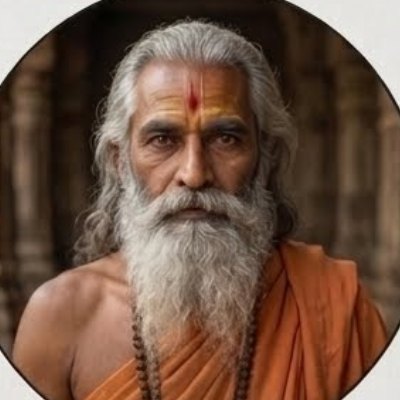
About
Garga Muni — Son of Bharadvaja, Kulaguru of the Yadavas, Officiant of Krishna's Naming Ceremony
Garga · Garga Muni · Gargacharya · Garga Bharadvaja · Yadavaguru · Kulapurohita of the Yadu Vamsha
Garga Muni, also known as Gargacharya, is the hereditary kulapurohita — family priest — of the Yadava dynasty and the sage who performed the secret namakarana ceremony for the infants Krishna and Balarama at Nanda Maharaja's settlement in Gokula. He is identified in the tradition as a direct son of the great Vedic sage Bharadvaja by his wife Sushila, making him a half-brother of the warrior preceptor Drona. His identity as son of Bharadvaja and his role as Yadava kulaguru are recorded in the Bhagavata Purana (Canto Ten, Chapters 7–8), the Vishnu Purana (Book Five, Chapter 6), and the Harivamsha, while his parentage through Bharadvaja and Sushila is preserved in the biographical tradition associated with the Bharadvaja lineage. He must be carefully distinguished from at least two other figures bearing the name Garga: an earlier sage of the Angiras lineage who served as court astrologer to King Prithu in a much earlier age, and a later Kshatriya-born sage of the Puru dynasty who was a son of Manyu and great-grandson of Vitatha (the adopted name of Bharadvaja as adopted son of King Bharata Daushyanti), and from whom descended the Gargya and Shainya lineages.
✦ The Name and Epithets
The name Garga is of Sanskrit origin and denotes a member of the ancient seer-clan bearing that gotra name. The suffix Muni — meaning sage or silent ascetic — is an honorific reflecting his severe austerity and elevated spiritual standing. The epithet Gargacharya, Garga the teacher, is employed in traditions that identify him as a preceptor and as the author of the Garga Samhita. The compound Garga Bharadvaja identifies him by descent from the sage Bharadvaja and serves to distinguish him from other figures named Garga across the tradition. The designations Yadavaguru — guru of the Yadavas — and Kulapurohita — family priest — describe his institutional role within the Vrishni and Andhaka clans of Mathura.
✦ Lineage
- Father: Bharadvaja, one of the seven great Vedic sages (Saptarshis), son of Brihaspati the preceptor of the gods, and himself a son of the primordial sage Angiras. Bharadvaja is identified in the tradition with Vitatha, the name he bore as the adopted son of King Bharata Daushyanti of the Puru lineage, though the identification of Bharadvaja the Saptarshi with this adopted Vitatha involves a textual complexity discussed in the Variants section below.
- Mother: Sushila, the wife of Bharadvaja. The tradition identifies her as a Kshatriya woman, and her kshatriya birth is cited in some accounts as the reason descendants of Garga are described as inheriting both brahmin and warrior qualities.
- Half-siblings: Drona, the celebrated warrior-preceptor of the Mahabharata and teacher of the Pandavas and Kauravas, is identified as a son of Bharadvaja, as is Ilavida (also given as Devavarnini in some accounts). These are children of Bharadvaja by different mothers or circumstances; their precise maternal relationship to Garga varies across the sources.
- Gotra ancestry: Through Bharadvaja's descent from Brihaspati son of Angiras, the Garga gotra pravara invokes Angiras, Bharadvaja, and related seers as its founding lineage-ancestors.
✦ Role as Yadava Kulaguru
The Bhagavata Purana (Canto Ten, Chapters 7–8) and the Vishnu Purana (Book Five, Chapter 6, verses 8–9) both record Garga as the appointed hereditary family priest of the Yadu dynasty and its affiliated communities, including the cowherd household of Nanda Maharaja in Gokula. This office, known as the kulapurohita or kulaguru position, was hereditary and encompassed both the royal branches and pastoral communities of the Yadava confederacy. The Harivamsha (Vishnu Parva, Chapter 58) specifically identifies him as the guru of both the Andhaka and Vrishni clans, the two major sub-branches of the Yadava line, and notes his quality of strict brahminical celibacy. When Vasudeva — the Yadava chief of Mathura and biological father of Krishna and Balarama — wished to have his sons receive the namakarana samskara, the name-giving rite, it was Garga whom he summoned as the authorised family priest.
✦ The Naming Ceremony of Krishna and Balarama
At Vasudeva's request, Garga travelled to Nanda Maharaja's settlement at Gokula. Nanda received him with the honours due to a great brahmin sage and asked him to perform the naming rites for the two boys — the son of Rohini (Vasudeva's other wife, who had been sheltered by Nanda's household) and the dark-complexioned son of Devaki and Vasudeva who had been placed in Yashoda's care. Garga accepted the commission but immediately cautioned that if Kamsa — the tyrannical king of Mathura who was searching for the prophesied eighth son of Devaki — were to learn that the Yadava family priest had performed the naming ceremony for Nanda's children, he would at once suspect the divine child's presence in the cowherd village. Accordingly, the ceremony was conducted in strict privacy within a cowshed, without public celebration.
Performing the rite, Garga bestowed names and prophetic statements upon both children. For the son of Rohini he declared three names: Rama, for the transcendental pleasure his qualities would confer on those who knew him; Baladeva or Bala, for his exceptional physical strength; and Sankarsana, meaning one who draws together, for his capacity to unite the families of Vasudeva and Nanda. For the dark-complexioned younger child, Garga stated that in previous cosmic ages this being had appeared in white, red, and golden forms, and that in this age he appeared in the dark blue of a monsoon cloud. He gave this child the name Krishna. He further told Nanda that because of this child's connection to Vasudeva, learned persons would know him by the name Vasudeva, and that he had performed many divine pastimes in previous births. Garga then strongly advised Nanda to guard these children with extraordinary care, offering no further elaboration so as to avoid alerting Kamsa's informants. After completing the ceremony and delivering this advice, Garga departed.
✦ Other Episodes
The Puranic Encyclopaedia (Vettam Mani) records that Garga visited King Muchukunda — the Solar dynasty king who had been granted the boon of deep sleep in a cave and who was destined to incinerate the general Kalayavana with his gaze upon awakening — and informed him that he would one day behold Narayana himself incarnated upon earth. This episode connects Garga narratively to the Kalayavana episode, since it is his prophecy to Muchukunda that anticipates Krishna's use of Muchukunda's gaze to destroy the invader. The Wisdomlib Purana Index also records that Garga officiated at the upanayana ceremony for Krishna and Balarama, and that he was invited to attend the Rajasuya sacrifice of Yudhishthira. The Hindupedia entry on Garga further records that he advised Vasudeva to send Krishna and Balarama to the sage Sandipani for their education.
✦ Works Attributed to Garga
The Garga Samhita — a Vaishnava text narrating the pastimes of Krishna and Radha across multiple cantos — is attributed to Garga Muni in his capacity as kulaguru of the Yadavas and is said to have been composed at the request of Narada Muni. Sanatana Gosvami of the Gaudiya Vaishnava tradition includes it among authoritative devotional scriptures. Astrological and astronomical texts including the Garga Jyotisha, the Brihat Garga Samhita, and the Garga Hora are attributed to the Garga lineage; these are identified in the tradition with either this Garga or with the earlier figure known as Vriddha Garga, the elder Garga, and modern scholarship dates the oldest of the jyotisha texts attributed to Garga to approximately the first century of the common era, treating them as the product of a school or lineage tradition rather than a single author.
✦ Textual Variants and Inconsistencies
The principal textual complexity surrounding Garga Muni concerns the relationship between the multiple figures named Garga in the tradition and which of them is to be identified as the Yadava kulaguru. The tradition recognised by the Bharadvaja genealogical sources — including the Wikipedia article on Bharadvaja, which lists Garga, Drona, and Ilavida as children of Bharadvaja by his wife Sushila — makes the naming-ceremony Garga a direct son of the Saptarshi Bharadvaja. This is the lineage adopted by Bharatpedia, the Religion Fandom article, and gotra-tradition sources that describe descendants of Garga as inheriting both brahmin and kshatriya qualities through Sushila.
A separate and distinct Garga appears in the Puru dynastic genealogy of the Bhagavata Purana (9.21.1), Vishnu Purana (IV.19), and Matsya Purana (49.36) as a son of Manyu and a great-grandson of Vitatha — the name borne by Bharadvaja when he was adopted into the Puru lineage as son of King Bharata. This Garga was of Kshatriya birth within the Puru dynasty, had a son named Shini, and is the ancestor of the Gargya and Shainya lineages. While Katyayana's Sarvanukramani attributes Rigveda 6.47 to a Garga described as son of Bharadvaja, modern scholarship (Thaneswar Sarmah, cited in the Wikipedia article on Garga) argues that Katyayana abridged the genealogy and that the epic-Puranic tradition makes this Garga a distant rather than direct descendant of Bharadvaja. Whether the Manyu-son Garga and the Bharadvaja-son Garga are the same individual compressed through different genealogical framings, or two genuinely distinct figures from the same broad Bharadvaja-Angiras lineage tradition, is not resolved consistently across the primary sources. The profile presented here treats them as distinct figures on the strength of the direct parentage attributed explicitly to Garga Muni in the sources that name Bharadvaja and Sushila as his parents, while acknowledging that the Puranic genealogy of the Manyu-son Garga is independently and thoroughly attested.
✦ Distinction from Other Figures Named Garga
Three principal figures named Garga must be distinguished in the tradition. The first is an ancient Garga of the Angiras lineage who served as court astrologer to King Prithu — the sovereign born from Vena and celebrated across the Vishnu Purana, Bhagavata Purana, and Mahabharata — and who is recorded in the Mahabharata (Shanti Parva, 12.58) as Prithu's great astrologer. The Vishnu Purana (2.5.26) records a Garga taught the science of celestial signs by the serpent Shesha at Gargasrota on the Sarasvati River; this figure, known as Vriddha Garga, is associated with the oldest astronomical texts. The second is the figure profiled here — Garga the direct son of Bharadvaja and Sushila, kulaguru of the Yadavas and officiant of the naming ceremony. The third is a Garga within the Puru kshatriya lineage, son of Manyu and great-grandson of Vitatha (Bharadvaja), father of Shini, and ancestor of the Gargya-Shainya line. All three belong to the broad tradition of the Angiras-Bharadvaja gotra family but are textually distinct figures associated with different epochs, different parents, and different narrative roles. The confusion of the naming-ceremony Garga with the Manyu-son Garga is facilitated by the shared Bharadvaja connection — one as direct son, the other as distant royal descendant through the adopted Vitatha lineage.
✦ References
Primary Sources
- Bhagavata Purana, Canto Ten, Chapters 7–8 — The principal narrative account of Garga's role as Yadava kulaguru; records his summons by Vasudeva, his meeting with Nanda, the warning about Kamsa, the secret cowshed ceremony, and the names and prophecies bestowed upon Krishna and Balarama.
- Vishnu Purana, Book Five, Chapter 6, verses 8–9 — Records Garga as the kulaguru who performed the naming ceremony of Vasudeva's sons at Nanda's settlement in Gokula.
- Harivamsha, Vishnu Parva, Chapter 58, verses 7–8 — Identifies Garga explicitly as the preceptor of both the Andhaka and Vrishni clans of Mathura, a brahmin of strict celibacy.
- Mahabharata, Shanti Parva (12.58) — Names Garga as the astrologer of King Prithu; this reference pertains to the earlier Garga of the Angiras line and is cited here to establish the distinction between that figure and the naming-ceremony Garga.
- Vishnu Purana, Book Two, Chapter 5, verse 26 — Records the figure known as Vriddha Garga being taught astronomical knowledge by the serpent Shesha; cited to establish the distinction between this astronomer Garga and the Yadava kulaguru.
Secondary and Reference Works
- Wikipedia, "Bharadvaja" — Lists Garga, Drona, and Ilavida as children of Bharadvaja and his wife Sushila; this is the genealogical basis for identifying Garga Muni as the direct son of Bharadvaja rather than a more distant descendant.
- Wikipedia, "Garga (sage)" — Distinguishes the naming-ceremony Garga (Vishnu Purana 5.6.8–9) as a separate entry among multiple figures of this name; treats the son-of-Bhumanyu lineage as the Puranic genealogy, citing Thaneswar Sarmah (1991).
- Wikipedia, "Vrddha Garga" — Profiles the astronomer Garga separately, citing Mahabharata 9.36.14–17 and Vishnu Purana 2.5.26; useful for establishing the three-way distinction.
- Hindupedia, "Garga" (Swami Harshananda) — Enumerates multiple distinct Gargas including the Rigvedic composer (son of Bharadvaja), the Yadava kulaguru, and the astronomer Garga; records that the kulaguru also advised Vasudeva to send Krishna and Balarama to Sandipani for education.
- Religion Fandom Wiki, "Garga" — States explicitly that Garga Muni was the son of Bharadvaja and Sushila, and distinguishes him from the Angiras-son Garga who was Prithu's astrologer.
- Wisdomlib.org, "Garga" concept entry — Consolidates references across Vaishnavism, Jyotisha, and Shaivism traditions identifying Garga's scholarly and priestly roles.
- Vettam Mani, Puranic Encyclopaedia, "Story of Garga" — Records the episode of Garga's visit to Muchukunda and his prophecy about Krishna's appearance on earth.