
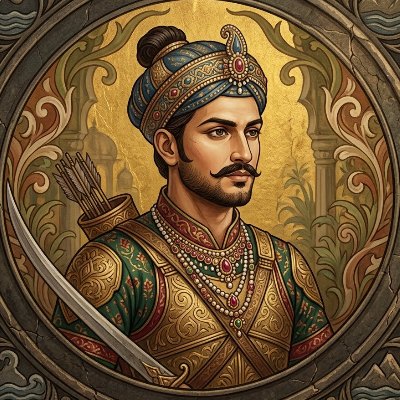
About
Satyajit — Prince of Panchala and Appointed Guardian of Yudhishthira
Satyajit · Satyajita · Drupadaputra · Panchalakumara
Satyajit was a prince of the Panchala kingdom, the son of King Drupada — also known as Yajnasena — who ruled the southern portion of Panchala with his capital at Kampilya. He was the brother of Dhrishtadyumna, the supreme commander of the Pandava army at Kurukshetra; of Shikhandi, the warrior whose presence broke Bhishma's resolve on the tenth day; and of Draupadi, the wife of the five Pandava brothers and one of the epic's central figures. Satyajit is attested in the Adi Parva, the Udyoga Parva, and the Drona Parva of the Mahabharata. He is remembered principally for his designation by Arjuna as the personal guardian of King Yudhishthira on the twelfth day of the Kurukshetra War, and for his death in battle against Dronacharya — the supreme commander of the Kaurava army — while fulfilling that protective charge. His death was the immediate cause of Yudhishthira's retreat and one of the most significant losses sustained by the Pandava side on the twelfth day. In some recensions, Satyajit's son is recorded as eventually ascending to the Panchala throne after the war.
✦ The Name
The name Satyajit is a Sanskrit compound formed from satya — truth, reality, or righteousness — and jit, a past participial form of the root ji, meaning to conquer or to overcome. The compound thus means one who conquers through truth, or one who is victorious by means of righteousness. It belongs to a common class of Kshatriya names that invoke the concept of moral or martial victory, and its application to this prince of the Panchala house, whose defining act was a selfless and ultimately fatal stand in defence of his king, carries a resonance that the tradition preserves in the dramatic irony of his story.
✦ Lineage
- Father: Drupada — King of Southern Panchala, also known by his birth name Yajnasena and the epithet Drupadaputra. He was the son of King Prishata and a childhood friend of Dronacharya during their shared education at the hermitage of the sage Bharadvaja. His humiliation of Drona in later life — when he refused to acknowledge their former friendship — initiated the chain of events that produced Dhrishtadyumna and Draupadi from the sacrificial fire, and that made the Panchala house the central ally of the Pandava cause. Drupada fought at Kurukshetra on the Pandava side and was killed by Drona on the fifteenth day of the war.
- Siblings: Dhrishtadyumna — the eldest son and Drupada's heir apparent, who was born from the sacrificial yajna fire specifically to kill Drona and who served as the supreme commander of the Pandava armies throughout the war. Shikhandi — a warrior born female, named Shikhandini, who later obtained manhood, and who was a prior incarnation of Amba, the princess of Kashi; his role in Bhishma's death on the tenth day was pivotal. Draupadi — the princess who emerged from the same sacrificial fire as Dhrishtadyumna, who became the shared queen of the five Pandava brothers, and whose humiliation at the dice game became the moral engine of the war. The Critical Edition of the Mahabharata names Satyajit as the first among eleven sons of Drupada, with the remaining brothers including Uttamaujas, Yudhamanyu, Kumar, Vrika, Panchalya, Suratha, Shatrunjaya, and Janmejaya.
- Son: An unnamed son of Satyajit is recorded in some recensions of the Mahabharata as having survived the war and eventually ascended to the throne of Panchala, continuing the Drupada line after the destruction of so many of its members at Kurukshetra.
✦ Pre-War Attestation
Satyajit appears in the Adi Parva in the context of the young Kuru princes' military training under Dronacharya. When Drona demanded as his preceptorial fee that his students capture King Drupada and bring him before him, the Kauravas attacked Panchala first but were repelled by Drupada's fierce resistance. Arjuna and the Pandavas subsequently succeeded in defeating Drupada and taking him prisoner. The Adi Parva records that in the course of this engagement, Satyajit — the Panchala general — was discomfited in battle by Arjuna, who repeatedly cut off his bows and killed his horses before Satyajit withdrew from the field. This pre-war engagement establishes Satyajit as a figure of standing within the Panchala military hierarchy and as someone whose path had crossed with Arjuna in combat before the main conflict began.
✦ Bhishma's Assessment
In the Udyoga Parva's Rathatiratha-sankhyana — Bhishma's formal pre-war assessment of the warriors on both sides — Satyajit was classified as an Atiratha, the highest tier of warrior, described as the equal of eight Rathas in individual combat and declared to be the equal in capacity of Dhrishtadyumna himself. Bhishma further predicted that Satyajit would achieve great feats in the cause of the Pandavas, being deeply devoted to their cause and endued with great bravery. This formal endorsement from the supreme elder of the Kaurava side gave Satyajit's standing an authority within the tradition that transcended his relatively limited narrative presence in the earlier Parvas.
Bhishma's description of Satyajit as young in years creates an internal textual difficulty: Satyajit appears in the Adi Parva as the Panchala general at a time when Drona's students were relatively young men, which would place him as a contemporary or elder of the Pandavas rather than a younger warrior by the time the war was fought. Commentators have noted this inconsistency, and it is possible that the Udyoga Parva's characterisation reflects a different recension's understanding of Satyajit's place within the Drupada family.
✦ Arjuna's Appointment: Guardian of Yudhishthira
The twelfth day of the Kurukshetra War opened with a strategic crisis for the Pandava command. The Samshaptaka warriors — a body of Trigarta soldiers who had sworn to fight Arjuna to the death — drew the great archer away from the main battlefield to the southern flank, precisely as Dronacharya had arranged, leaving the Pandava centre exposed. Drona had made a vow to Duryodhana to capture King Yudhishthira alive — a feat that, if accomplished, would effectively end the war — and with Arjuna removed, the opportunity seemed at hand.
Before departing to engage the Samshaptakas, Arjuna addressed Yudhishthira and made a deliberate and solemn appointment. The Drona Parva (Section 15, Dronabhisheka Parva) records Arjuna's declaration that Satyajit would be Yudhishthira's protector in battle that day, and that as long as Satyajit lived, Drona would not be able to attain his desire of capturing the Pandava king. Arjuna further warned Yudhishthira that if Satyajit were slain, the king should not remain on the battlefield even if surrounded by all the remaining Pandava warriors. The weight of this statement — a direct prediction that Yudhishthira's safety was entirely contingent on one man's life — gives the subsequent narrative its tragic inevitability.
✦ The Duel with Drona and Death
The Drona Parva (Section 21, Sacred Texts Archive, Ganguli translation) narrates the encounter in full. When Drona advanced directly toward Yudhishthira with the intent of seizing him, Satyajit moved to intercept, rushing at the preceptor with the explicit goal of preventing his approach. The text compares their initial engagement to the battles between Indra and Vali — a comparison that acknowledges both the mismatch in their ultimate capacities and the ferocity of the resistance Satyajit offered despite it.
Satyajit fought with exceptional energy and skill. He struck Drona's charioteer with five arrows that left him insensible. He pierced Drona's horses with ten shafts and struck both flanking drivers with further volleys. He moved in a circular chariot pattern, invoking a mighty weapon, and cut down Drona's standard. He was joined in the engagement by the prince Vrika — one of his Panchala brothers — who struck Drona in the chest with sixty arrows, and the two of them fought together to hold Drona's advance. Drona retaliated with concentrated fire that cut off both their bows. Satyajit took up a second bow; Drona cut that too. Satyajit took up a third, tougher bow and continued pressing Drona, striking his horses, his charioteer, and his standard afresh. Through bow after bow, Satyajit refused to yield.
The primary text records that Drona, having observed Satyajit's unbroken intensity through this sustained exchange, resolved that the prince had to be killed. He shot at Satyajit with concentrated precision, covering his horses and standards and the handle of his bow with incessant showers. When Satyajit's bow was once again destroyed, Drona struck him directly — and severed his head with a crescent-shaped arrow, the Kshurapra, killing him on his chariot seat. The text notes that the assembled Pandava forces cried out at his fall. In precise fulfilment of Arjuna's earlier warning, Yudhishthira — upon seeing his appointed guardian slain — immediately fled the field carried by his swift horses, abandoning the engagement with Drona rather than face capture.
✦ Narrative Significance
Satyajit's death functions in the Drona Parva as one of the war's most precise demonstrations of Drona's capacity as a supreme commander. The Kaurava preceptor had identified Yudhishthira's dependence on Satyajit through Arjuna's own declaration and systematically removed the protective barrier. Satyajit had performed exactly as his mandate required — he had delayed and wounded Drona's forces significantly and had refused to yield even under sustained pressure — but he could not ultimately match the preceptor. The Pandava army's response to his fall — the universal cry of distress and Yudhishthira's immediate retreat — confirmed the scale of the loss.
The tradition's image of Satyajit is consistent across the passages in which he appears: a warrior of formidable capability and absolute loyalty, who stood between his king and certain capture or death, and who spent his life in that service without flinching. His story occupies a small narrative space in the overall arc of the Mahabharata but within that space is presented with unusual precision and completeness by the primary text.
✦ Post-War Account
A secondary source account associated with Rosen and Schweig's Essential Hinduism records that Satyajit married Kumbhaka, a daughter of Bhurishravas — the Kaurava Maharathi who was killed by Satyaki on the fourteenth day of the same war. This account, if accepted, represents a post-war dynastic union between the Panchala house and the Bahlika collateral branch of the Kuru lineage. The Vyasa Mahabharata Online Encyclopedia records separately that Satyajit's son eventually ascended to the Panchala throne having survived or escaped the Kurukshetra War — a statement consistent with the tradition that Satyajit died in the war and his line continued through his son. This post-war genealogical detail belongs to secondary and recension-specific material rather than the core primary text.
✦ Connection to the Wider Genealogy
Satyajit stood at the intersection of several of the Mahabharata's central genealogical networks. As a son of Drupada and brother of Draupadi, he was a brother-in-law of all five Pandava brothers. As the brother of Dhrishtadyumna — the commander-in-chief of the Pandava armies and the man destined to kill Drona — he belonged to the house most directly shaped by the Drupada-Drona enmity that was the war's original institutional cause. His death at Drona's hands placed him in a precise genealogical symmetry: Drona killed the brother of the man born expressly to kill him, in the same sequence of days that would eventually lead to Drona's own death at Dhrishtadyumna's hands. Satyajit's unnamed son, recorded as a post-war survivor who inherited the Panchala throne, provided the dynastic continuity that allowed the Panchala line to persist beyond the catastrophic losses it sustained at Kurukshetra.
✦ References
Primary Sources
- Mahabharata, Adi Parva, Section CXLI (Chapter 141) — Records the pre-war encounter in which Satyajit, serving as the Panchala general, was discomfited in battle by Arjuna during the Kuru princes' capture of Drupada as their preceptorial offering to Dronacharya; establishes Satyajit's pre-war standing as a military commander of Panchala.
- Mahabharata, Udyoga Parva, Section CLXXII (Rathatiratha-sankhyana) — Contains Bhishma's formal pre-war assessment in which Satyajit is rated as an Atiratha equal to eight Rathas and declared the equal of Dhrishtadyumna; describes him as devoted to the Pandava cause and destined to achieve great feats.
- Mahabharata, Drona Parva, Dronabhisheka Parva, Section 15 — Records Arjuna's formal appointment of Satyajit as Yudhishthira's personal guardian before departing to fight the Samshaptakas on the twelfth day; contains Arjuna's explicit declaration that Yudhishthira's safety depended entirely on Satyajit's survival.
- Mahabharata, Drona Parva, Dronabhisheka Parva, Section 21 — The principal primary source for Satyajit's death: narrates in full his interception of Drona's advance, his repeated replacement of cut bows, his wounding of Drona's charioteer and horses, his joint engagement with Vrika, and his final decapitation by Drona's crescent-headed arrow; records the immediate retreat of Yudhishthira upon Satyajit's fall.
Modern and Secondary Reference Works
- Sacred Texts Archive — Mahabharata, Drona Parva, Section 21 (sacred-texts.com/hin/m07/m07021.htm) — Provides the Ganguli English translation of Satyajit's duel with Drona and death in full, the principal primary-text source for the narrative of his final battle.
- Sacred Texts Archive — Mahabharata, Udyoga Parva, Section CLXXII (sacred-texts.com/hin/m05/m05172.htm) — Provides the Ganguli English translation of Bhishma's assessment of Satyajit as Atiratha and equal of Dhrishtadyumna.
- Vyasa Mahabharata Online Encyclopedia — Satyajit entry (vyasaonline.com/encyclopedia/satyajit) — Provides a detailed narrative summary of Satyajit's duel with Drona drawn from the primary text, confirming the sequence of bow-cutting, the joint engagement with Vrika, and the crescent-arrow decapitation; also records that Satyajit's son eventually ascended to the Panchala throne.
- Vyasa Mahabharata Online Encyclopedia — Drupada entry (vyasaonline.com/encyclopedia/drupada) — Lists Satyajit as the first-named among Drupada's eleven sons, confirming his standing within the Panchala royal family.
- Wikipedia — Drupada article (en.wikipedia.org/wiki/Drupada) — Confirms Satyajit as one of the eleven sons of Drupada named in the Critical Edition of the Mahabharata.
- Wisdomlib — Mahabharata English Summary, Drona Parva (wisdomlib.org/hinduism/book/mahabharata-english-summary) — Confirms the chapter-level sequence placing Satyajit's appointment and death within the twelfth-day narrative structure of the Drona Parva.
- Bharatpedia — Drona Parva article (en.bharatpedia.org/wiki/Drona_Parva) — Corroborates the narrative sequence: Drona repeatedly cuts Satyajit's bow before severing his head; confirms Yudhishthira's immediate retreat following Satyajit's fall.
- Rosen, Steven J., and Graham M. Schweig — Essential Hinduism, Greenwood Publishing, 2006, p. 96 — The cited secondary source for the account of Satyajit's marriage to Kumbhaka, daughter of Bhurishravas, and the post-war genealogical details attributed to their sons.