
About
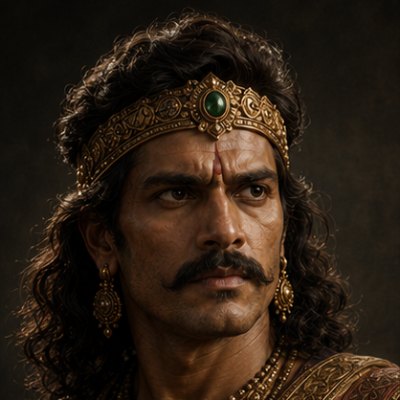
Somaka — King of Panchala and Father of One Hundred Sons
Somaka · Somaka Sahadevya · Sahadevya · Saumaki
Somaka was a king of Panchala in the lunar dynastic lineage descending from Ajamidha, placed in the Mahabharata and several major Puranas as the father of one hundred sons, the eldest of whom was Jantu and the youngest of whom was Prishata. He is the paternal grandfather of King Drupada, the great-grandfather of Dhrishtadyumna, Draupadi, and Shikhandi, and the progenitor of the dynastic branch known in the Mahabharata as the Somaka clan, whose name became so widespread that it served in many passages of the epic as a collective designation for all the Panchala Kshatriyas. His principal narrative appearance is in the Vana Parva of the Mahabharata, where the episode of his sacrifice of his son Jantu is told by the sage Lomasa to Yudhishthira during the Pandavas' pilgrimage. He appears additionally in the genealogical lists of the Vishnu Purana, the Bhagavata Purana, the Agni Purana, and the Vayu Purana, and is mentioned in the Sabha Parva and the Anushasana Parva of the Mahabharata.
✦ The Name
The name Somaka is derived from Soma, the sacred ritual drink of the Vedic tradition and also the name of the moon deity. The suffix ka functions as a diminutive or affiliative particle, and the name thus broadly carries associations with the lunar dynasty to which this king belongs. The Wisdomlib compilation notes an interpretation that Somaka as a tribal name meant "one who belonged to the Lunar Dynasty," and that the designation may have originated as a distinction applied by rulers of the Solar Dynasty. As a dynastic collective name, Somakas came to refer to all the Panchala Kshatriya tribes in the usage of the Mahabharata. The patronymic Somaka Sahadevya, meaning "Somaka son of Sahadeva," is used in Vedic and historical references to identify him within his lineage. The Adi Parva of the Mahabharata states directly that all Kshatriyas of the Somaka dynasty are called Somakas.
✦ Lineage
- Father: Saudasa, also called Sahadeva — a king of Panchala and the son of Sudasa. The Puranic Encyclopaedia (Wisdomlib) describes Somaka as the son of Sahadeva and grandson of Subhasa. The Vishnu Purana traces the Panchala lineage through Divodasa, Mitreyu, Sudasa, and Saudasa to Somaka.
- Sons — one hundred in total: The Vishnu Purana, Bhagavata Purana, and Vayu Purana all record that Somaka fathered one hundred sons. The Mahabharata Vana Parva narrates that these sons were obtained through a sacrificial ritual in which his only earlier son, Jantu, was offered as the victim. The eldest of the hundred sons born from this yajna was Jantu himself, reborn in the same mother, and the youngest was Prishata.
- Son (eldest): Jantu — Somaka's only son before the sacrifice, born after a long period of childlessness from one among his hundred wives. After being sacrificed in the yajna prescribed by the family priest, Jantu was reborn as the eldest among the hundred sons subsequently born to all of Somaka's wives, bearing a mark of gold on his back as prophesied. He was considered the most meritorious among all the hundred sons and remained the most beloved to the queens.
- Son (youngest): Prishata — the youngest of the hundred sons of Somaka and the king of Panchala who maintained a close friendship with the sage Bharadwaja. Prishata is the father of King Drupada, the principal Panchala king of the Mahabharata era.
- Grandson: Drupada (also known as Yajnasena) — king of Panchala, son of Prishata, and the father of Dhrishtadyumna, Draupadi, and Shikhandi. It is during Drupada's reign that the Panchala kingdom was divided by Drona with the help of the Pandavas.
✦ Textual Variant on Somaka's Parentage
A variant tradition recorded in the Matsya Purana and Brahma Purana, as cited by the Vishnu Purana's commentary tradition, holds that the Ajamidha lineage became extinct with Sahadeva, and that Ajamidha himself was reborn as Somaka in order to continue the dynasty. In this account, Somaka is not simply a descendant of Ajamidha in the ordinary genealogical sense but a reincarnation of the progenitor himself, and the lineage from this point onwards is accordingly called the Somaka family. The Bhagavata Purana independently presents Somaka as one of four sons of Mitreyu rather than placing him as the son of Saudasa directly, though the sequence converges when read alongside the Vishnu Purana's fuller treatment. These variant readings do not alter Somaka's role as the father of Jantu and Prishata, which is consistent across all major Puranic sources.
✦ The Sacrifice of Jantu
The principal episode in which Somaka appears as a named participant in the Mahabharata is narrated in the Vana Parva, Chapters 127 and 128, as part of the sage Lomasa's recitation of sacred and instructive tales during the Pandavas' pilgrimage. The episode is also indexed in the Mahabharata's own table of contents given in the Adi Parva.
Somaka had one hundred wives but remained without a single son for a long period. Eventually, one son named Jantu was born from among his hundred queens. All the wives lavished their care upon the single child, and the boy became the centre of the entire household's affection. The trigger for the subsequent sacrifice came when an ant stung the boy at the hip, causing him to cry out in pain. The distress of all the queens, who rushed to comfort Jantu, reached the king's ears. Somaka was moved to reflect on the precariousness of having only one son and the grief that would ensue if he were lost to illness or accident. Summoning his family priest, he asked whether any ritual existed by which he could obtain a hundred sons.
The family priest described a sacrifice that would guarantee a hundred sons but required the offering of Jantu himself as the victim. The priest promised that when Jantu's fat was rendered as an oblation and the smoke rose, each of Somaka's wives who inhaled it would conceive, and that Jantu himself would be reborn as the eldest among the hundred sons in his own former mother's womb, bearing a mark of gold on his back. Somaka agreed to the performance, declaring that whatever was necessary should be done.
When the sacrifice was performed, the queens, in their grief, tried forcibly to prevent Jantu from being taken. They seized the boy by his right hand and wept, but the priest dragged him away, killed him, and offered his fat into the sacrificial fire. The mothers inhaled the rising smoke and swooned with anguish. After ten months, a hundred sons were born from all the queens. Jantu was reborn as the eldest, in the womb of his own former mother, and was marked with gold on his back as foretold. He was the most beloved to all the mothers and was also the most meritorious of the hundred brothers.
After his death, when Somaka entered the afterlife, he found his family priest suffering punishment in a terrible hell as a consequence of having officiated in the sacrifice. Somaka refused to proceed to the celestial regions without the priest and declared to Yama that since the deed had been shared between them, the fruit of it — whether meritorious or sinful — must also be shared. Yama agreed, and both king and priest underwent the prescribed period of suffering together before being released to enjoy the rewards of their meritorious acts. The episode is narrated at the hermitage of Somaka, which the sage Lomasa points out to Yudhishthira during their pilgrimage.
✦ Other Mentions in the Mahabharata
Beyond the Vana Parva sacrifice narrative, Somaka is mentioned in several other contexts in the Mahabharata. The Sabha Parva records that Somaka dwells in the palace of Yama offering him praise, which is consistent with the post-death narrative in the Vana Parva. The Anushasana Parva records that Somaka made gifts of cows and thereby attained heaven, and separately that he was a king who never ate meat in his life. These passages present him as a figure of some personal virtue even within the moral complexity of his central narrative act.
✦ Theological and Narrative Significance
The Somaka episode functions within the Mahabharata as an embedded cautionary narrative about the moral limits of sacrifice and the shared responsibility of those who commission and perform ritual acts. The narrative does not present Somaka simply as a villain: he is described as a virtuous king, is characterised as generous and as one who never consumed meat, and his loyalty to his family priest in the afterlife is portrayed with a degree of admiration. Yet the episode clearly registers the human sacrifice of a child as something that entails karmic consequences, with both king and priest suffering before attaining liberation. Lomasa's narration of the tale to Yudhishthira in the context of a pilgrimage implies its function as a morally instructive story for the Pandava king during his own period of suffering and reflection.
✦ Connection to the Wider Genealogy
Somaka stands at a generationally pivotal position in the Panchala dynastic line. He is the son of Saudasa (also called Sahadeva), himself the son of Sudasa, who descends from Divodasa through Mitreyu in the Vishnu Purana's account. Somaka's hundred sons mark the widest generational branching of the Panchala line, and it is through his youngest son Prishata, and then through Prishata's son Drupada, that the lineage reaches the Mahabharata's central narrative. Drupada's daughter Draupadi married the five Pandava brothers, and Drupada's son Dhrishtadyumna killed Drona on the fifteenth day of the Kurukshetra War. Downward from Dhrishtadyumna, the Puranas name Dhrishtaketu as the next in the line. The name Somaka as a collective dynastic designation continued to be applied to the Panchala Kshatriyas throughout the Mahabharata, demonstrating the foundational importance of Somaka's position in the lineage.
✦ References
Primary Sources
- Mahabharata, Vana Parva, Tirtha-yatra Parva, Chapters 127–128: The principal narrative source for the Jantu sacrifice episode, narrated by Lomasa to Yudhishthira. Provides all the details of Somaka's childlessness, the family priest's prescription, the performance of the sacrifice, the birth of a hundred sons, Jantu's rebirth, and Somaka's shared experience of karmic consequence in the afterlife.
- Mahabharata, Adi Parva, Sangraha Parva, Chapter 2: The epic's own table of contents lists the story of prince Jantu and how king Somaka obtained a hundred sons by sacrificing his only son, establishing the episode as a recognised and named sub-narrative of the epic.
- Mahabharata, Adi Parva, Chapter 122, Verse 40: Records that all Kshatriyas of the Somaka dynasty are called Somakas, establishing the dynastic use of the name.
- Mahabharata, Sabha Parva, Chapter 8, Verse 8: Places Somaka in the palace of Yama offering praise, consistent with the post-death narrative of the Vana Parva.
- Mahabharata, Anushasana Parva, Chapter 76, Verse 25: Records that Somaka attained heaven through gifts of cows.
- Mahabharata, Anushasana Parva, Chapter 115, Verse 63: States that Somaka never consumed flesh during his lifetime.
- Vishnu Purana, Book IV, Chapter XIX: Provides the dynastic genealogy placing Somaka as son of Saudasa (Sahadeva) and father of one hundred sons including Jantu (eldest) and Prishata (youngest).
- Bhagavata Purana, Skandha IX, Chapter 22, Verses 1–2: Corroborates Somaka's position as father of Jantu and Prishata in the Panchala dynastic sequence.
- Agni Purana, Chapter 278: Includes Somaka in the Puru lineage genealogy leading to Drupada and Dhrishtadyumna.
- Vayu Purana, Chapter 99, Verse 208: Referenced in the Wisdomlib compilation as corroborating the genealogical position of Somaka as father of Prishata.
Secondary and Reference Sources
- Wisdomlib.org, "Somaka: 12 definitions": Aggregates Puranic and epic references to Somaka across multiple texts, including the Matsya-Brahma Purana variant regarding Ajamidha's rebirth as Somaka.
- Wisdomlib.org, Puranic Encyclopaedia, "Story of Somaka": Identifies Somaka as son of Sahadeva and grandson of Subhasa, and catalogues the specific Mahabharata chapter and verse references for each of his appearances.
- Vyasaonline.com, "Somaka": Provides the full narrative of the Jantu sacrifice episode drawn from the Vana Parva.
- Sacred-texts.com, Mahabharata Vana Parva, Chapters 127–128 (Ganguli translation): Canonical English translation of the Jantu sacrifice narrative, used for factual verification of episode details.