
About
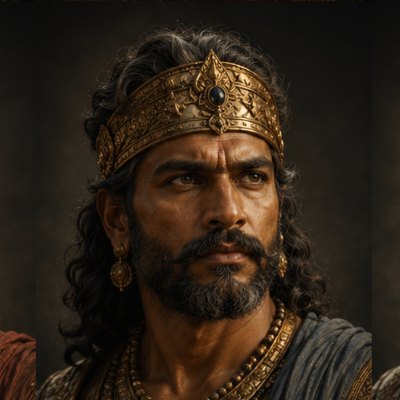
Jantu — Sacrificed Prince of Panchala
Jantu · Jantu of Panchala · eldest son of Somaka
Jantu was a prince of Panchala, the only son born to King Somaka before a Vedic sacrifice transformed the royal household by producing a hundred further sons. He is recognised as the eldest among Somaka's hundred sons and is consequently the eldest paternal uncle of King Drupada, who ruled Panchala in the generation of the Mahabharata war. Jantu's narrative appears in the Vana Parva of the Mahabharata, recounted by the sage Lomasa to the Pandava king Yudhishthira during the pilgrimage of the five brothers. Lomasa narrates the story to explain the purifying spiritual power of the site at the river Kokamukha, associated with the hermitage of Somaka, which he and Yudhishthira are visiting. Jantu's name also appears in the dynastic genealogies of the Panchala line preserved in the Vishnu Purana and the Bhagavata Purana, which record him as the eldest of Somaka's hundred sons. The Agni Purana presents a divergent genealogical position for Jantu, discussed in the variants section below. His narrative is brief but singular: he is the child whose ritual sacrifice and miraculous rebirth constitute the defining episode of his father Somaka's life and the founding moment of Somaka's dynastic expansion.
✦ The Name
The name Jantu is a common Sanskrit word denoting a living creature, a being, or an organism subject to birth and death. The term carries an implicit resonance with mortal vulnerability, which is consonant with the sacrificial fate that becomes the centre of his story. No special epithet, honorific, or patronymic is recorded for Jantu in any primary source. He is identified consistently by his given name alone and by his relationship to his father Somaka.
✦ Lineage
- Father: Somaka — king of Panchala, son of Sahadeva, and the progenitor of the Somaka dynastic clan within the Panchala line. The Bhagavata Purana and Vishnu Purana place Somaka in the sequence Chyavana — Sudasa — Sahadeva — Somaka. Somaka is described in the Vana Parva as a virtuous king who had a hundred wives but remained without a son for an extended period before Jantu's birth.
- Mother: One among Somaka's hundred queens. The Mahabharata does not record her name. She is identified only as the queen from whose womb Jantu was born and into whose womb he was reborn following the sacrifice. She is described as the queen who wept most bitterly at the time of the ritual killing and who, after the rebirth, was the mother most cherished by all the other queens on account of the child she carried.
- Brothers (after rebirth): Ninety-nine sons born to Somaka's other queens following their inhalation of the sacrificial smoke. Their individual names are not recorded in the primary sources.
- Youngest brother: Prishata — explicitly identified in the Bhagavata Purana as the youngest of Somaka's hundred sons. Prishata became king of Panchala and was the father of Drupada.
- Nephew: Drupada, also known as Yajnasena — son of Prishata, king of Panchala, and father of Dhrishtadyumna, Draupadi, and Shikhandi. Drupada is a major figure in the Mahabharata as the father-in-law of the five Pandavas and an ally in the Kurukshetra war.
✦ The Sacrifice of Jantu
The Vana Parva records that Somaka had grown old and had long sought a son from his hundred wives without success. When Jantu was finally born, all hundred queens shared equally in caring for him and took great delight in the child, so that his upbringing became a matter of common joy throughout the royal household.
The immediate occasion that set the sacrificial events in motion was an ant that stung Jantu at the hip. The boy's cry of pain brought all the queens rushing to him in distress, and the resulting tumult reached Somaka in his assembly hall. The king went to comfort the child, and once calm was restored he fell into anxious reflection: he had only a single son and no assurance of a secure lineage. This prompted him to summon his family priest — referred to throughout the narrative only by his priestly titles, Purohita and Ritwik, and not by any personal name — and to ask whether any rite existed that could grant him a hundred sons.
The priest prescribed the sacrifice of Jantu himself. The boy was to be offered into a sacred fire, and his rendered fat was to serve as the oblation. Each of the hundred queens who inhaled the smoke rising from that oblation would conceive and bear a valiant son. The priest further assured Somaka that Jantu himself would be reborn as the eldest among those hundred sons, in the womb of his own former mother, bearing a mark of gold upon his back as a sign of recognition.
When the sacrifice was performed, the queens attempted in their grief to prevent Jantu's death, seizing him by the right hand and weeping. The priest pulled the boy away from them and completed the ritual killing, rendering his fat as an oblation into the fire. The queens inhaled the smoke and collapsed with anguish. After ten months, a hundred sons were born to the hundred queens. Jantu was reborn as the eldest among them, from the womb of his own former mother, bearing the promised golden mark upon his back. Among his hundred brothers he was the most beloved to all the mothers collectively and the most meritorious in character.
✦ The Afterlife of Somaka and His Priest
The narrative in Vana Parva Chapter 128 continues without interruption from the sacrifice episode into the deaths of Somaka and his priest and their subsequent experience in the afterlife. Lomasa presents this continuation as the doctrinal culmination of the story and as the explanation for the sanctifying power of the site at the river Kokamukha.
When Somaka passed from the world and entered the afterlife, he found his Purohita undergoing severe punishment in hell. The priest himself explained the cause: he was condemned to suffer on account of having officiated at the sacrifice of a child. Somaka, moved by loyalty to the man who had served him in this life, appealed to Dharmaraja — the presiding deity of justice and the dead — asking that he be allowed to take the priest's place in hell so that his teacher might be freed.
Dharmaraja refused the substitution on doctrinal grounds, stating the governing principle of individual karma: the fruits of one's actions, whether virtuous or sinful, belong to the actor alone and cannot be transferred to or borne by another. No person can suffer in place of another, nor enjoy the merit accumulated by another. The karmic consequence of the child sacrifice therefore remained the priest's alone to exhaust.
Somaka refused to leave. He declared that he would not go to heaven while his priest remained in torment and insisted on remaining in hell alongside him. Confronted with this unwavering resolve, Dharmaraja did not alter the karmic principle but offered a resolution of timing: he ruled that Somaka might remain in hell and serve his own allotted period of suffering concurrently with the priest. Once both had completed their respective sentences and their accumulated sin was thereby exhausted, they would ascend to heaven together.
The redemption, as framed in the text, is achieved through the full temporal exhaustion of each man's karmic burden, served simultaneously. Somaka's act of solidarity did not dissolve the priest's sin through grace or transfer; it caused Somaka to voluntarily take on his own hell-sentence alongside him, so that their release came at the same moment. Both ascended to heaven together at the conclusion of their shared period of suffering.
✦ Textual Variants and Inconsistencies
Two distinct inconsistencies arise across the primary sources and are recorded here.
On Somaka's parentage: The Bhagavata Purana and the Vishnu Purana give Somaka's father as Sahadeva, placing the sequence as Chyavana — Sudasa — Sahadeva — Somaka. The Garuda Purana presents a variant in which Sudasa's son is called Saudasa — a patronymic form meaning son of Sudasa — who then fathers Sahadeva before Somaka. This introduces an additional generational link not found in the mainstream Puranic accounts. The Bhagavata Purana and Vishnu Purana reading is adopted as the standard genealogical position in this profile; the Garuda Purana variant is noted for completeness.
On Jantu's generational position: The Vishnu Purana and Bhagavata Purana are consistent in recording Jantu as the eldest son of Somaka and the eldest brother of Prishata, with Prishata being the youngest of the hundred sons. The Agni Purana, in its Panchala genealogy at Chapter 278, Verse 39, presents a divergent account in which Jantu appears not as Prishata's brother but as his father, making Jantu a separate generational link between Somaka and Prishata. These two positions are irreconcilable: in the Vishnu Purana and Bhagavata Purana account Jantu and Prishata are brothers and sons of Somaka, while in the Agni Purana account Jantu is Somaka's son and Prishata's father. The Vishnu Purana and Bhagavata Purana account is corroborated by the Vana Parva narrative and is taken as the standard in this profile.
✦ Connection to the Wider Genealogy
Jantu belongs to the Panchala royal line, which descends through the lunar dynasty. His father Somaka is the progenitor of the Somaka sub-clan of the Panchalas, which takes its dynastic name from him. Through his youngest brother Prishata and his nephew Drupada, Jantu is the eldest paternal ancestor of the generation that stands on the Pandava side at Kurukshetra. Drupada's daughter Draupadi became the common wife of the five Pandavas, and Drupada's son Dhrishtadyumna served as the commander-in-chief of the Pandava army. The Somaka line thus connects directly to the central martial and dynastic contest of the Mahabharata, though Jantu himself belongs to an earlier generation and does not appear in the war narrative.
✦ References
Primary Sources
- Mahabharata, Vana Parva, Chapter 127: The opening chapter of Lomasa's continuous narrative, providing all details of Jantu's birth, the ant episode, the sacrifice, and the rebirth of Jantu as the eldest of Somaka's hundred sons.
- Mahabharata, Vana Parva, Chapter 128: The concluding chapter of Lomasa's narrative, covering the deaths of Somaka and his priest, the afterlife encounter in hell, Dharmaraja's ruling on the individual nature of karma, the concurrent serving of their sentences, and their joint ascent to heaven. Also establishes the narrative's framing purpose as an explanation of the sanctifying power of the river Kokamukha site.
- Vishnu Purana, Book IV, Chapter 19: Names Jantu as the eldest of Somaka's hundred sons, with Prishata as the youngest, within the dynastic genealogy of Panchala. Gives Sahadeva as Somaka's father.
- Bhagavata Purana, Canto 9, Chapter 22, Verses 1–2: Corroborates Jantu's position as Somaka's eldest son, explicitly identifies Prishata as the youngest of the hundred sons, and gives the genealogical sequence Chyavana — Sudasa — Sahadeva — Somaka.
- Agni Purana, Chapter 278, Verse 39: Presents the variant genealogy in which Jantu appears as the son of Somaka and the father of Prishata, making him a generational link between them rather than Prishata's eldest brother.
- Garuda Purana, Chapter 140: Presents a variant of the Panchala genealogy in which Sudasa's son is called Saudasa, who then fathers Sahadeva, introducing an additional generation not found in the Vishnu Purana or Bhagavata Purana accounts.
Secondary and Reference Sources
- Wisdomlib.org, "Prishata: definitions": Aggregates Puranic genealogical references establishing Prishata as the youngest of Somaka's sons and confirming Jantu's position as eldest brother.
- Wisdomlib.org, "Somaka: 12 definitions": Aggregates Puranic genealogical references naming Jantu as Somaka's eldest son across multiple Puranic traditions.
- Wisdomlib.org, Puranic Encyclopaedia, "Story of Somaka": Provides chapter and verse references for the Jantu sacrifice narrative and cross-references to Puranic genealogies.
- Wisdomlib.org, "Somaka" definition page: Corroborates the afterlife narrative and Dharmaraja's ruling as recorded in the Vana Parva.
- Sacred-texts.com, Mahabharata Vana Parva, Chapters 127–128 (Ganguli translation): Primary English translation used for factual verification of all episode details, including the sacrifice, the ant episode, the priest's role, the hell sequence, and Dharmaraja's doctrinal statement.
- Srimadbhagavatam.org, Canto 9, Chapter 22: Provides the Bhagavata Purana text and translation confirming the genealogical sequence and the identification of Prishata as youngest son.
- Ancientvoice.wikidot.com, Mahabharata Section 128: Provides a structured summary of the afterlife episode used for cross-verification of the hell and redemption narrative.
- Indiaspiritual.wordpress.com, "Somaka and his Ritwik": Secondary narrative account of the sacrifice and afterlife episode used for cross-verification of the priest's role and the Kokamukha framing context.