
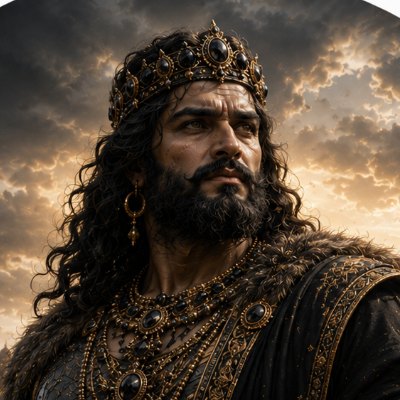
About
Kalayavana — King of the Yavanas and Catalyst of the Yadava Migration to Dvaraka
Kalayavana · Kala-Yavana · The Black Yavana · The Sinister Greek · Ranchhodrai's Pursuer
Kalayavana was a king of the Yavanas — the foreigners or barbarians of the northwestern and Himalayan frontiers — whose invasion of Mathura during the Dvapara Yuga stands as one of the most consequential geopolitical events in the life of Krishna, the eighth avatar of Vishnu and scion of the Vrishni branch of the Yadava clan. Born through a divine boon obtained by the brahmin Gargya following a severe twelve-year austerity, Kalayavana was endowed from birth with exceptional martial power and invincibility against the princes of Mathura. Raised as the adopted son of a childless Yavana king, he ultimately ascended to the throne of the Yavanas and, acting in concert with Jarasandha — the powerful king of Magadha — marched his vast forces against Mathura. His invasion forced Krishna to relocate the entire Yadava population to the newly constructed island city of Dvaraka, and his death came not through any Yadava warrior's hand but through the supernatural gaze of the sleeping king Muchukunda, a Solar dynasty monarch of the Treta Yuga. The principal sources narrating his story are the Harivamsha (Vishnu Parva, chapters 35 and 58), the Vishnu Purana (Book Five, chapter 23), the Bhagavata Purana (Canto Ten, chapters 50 and 51), and the Brahmanda Purana (chapter 14).
✦ The Name
The name Kalayavana is a Sanskrit compound of two elements. The first, Kala, carries a range of meanings that are all simultaneously applicable to this figure: it denotes Time in its absolute and all-consuming sense, the dark colour black, and by extension Death — for Kala is one of the names applied to Yama, the god of death. The second element, Yavana, is an ancient Sanskrit term whose primary reference is to foreigners or outsiders, applied in the Puranic and epic literature most commonly to peoples of the northwest — Greeks, Ionians, and related western peoples — and more broadly to any barbarian or Mlechchha community outside Vedic civilisation. The compound thus signifies the Black Yavana or the Death-bringer among the Yavanas, and both senses are deliberately evoked: his dark complexion at birth (which the Vishnu Purana attributes directly to Gargya's austere diet of iron dust) and his role as an instrument of destruction against the Yadavas. Wikipedia renders the name as Sinister Greek, capturing the ominous dimension. The name Kalayavana is also given to him upon adoption in the Yavana king's city, as recorded in the Harivamsha, where the darkness of his complexion and his Yavana upbringing together determine the compound epithet.
✦ Lineage
- Biological Father: Gargya — a Brahmin ascetic of the Garga gotra, descended from the sage Garga (son of Bhavanmanyu, also called Manyu) through Garga's son Shini, whose descendants bore the clan designations Gargya and Shainya. Although born of Kshatriya stock, the Garga-Shini line had by this point adopted Brahmin status, as the Vishnu Purana (Book IV, Chapter XIX) explicitly records. Gargya served as the preceptor of both the Andhaka and Vrishni Yadava clans, as the Harivamsha (Vishnu Parva, Chapter 58) states. He was publicly shamed in an assembly of Yadavas — mocked as sexually impotent, described in the Brahmanda Purana (Chapter 14.46) as being called impotent by his own brother-in-law before the Yadava gathering — and departed in fury to perform twelve years of severe austerity directed at Mahadeva. The Vishnu Purana's narrative section and the Harivamsha both record that during this penance he consumed only iron filings or iron dust, which darkened his complexion to an iron-black hue and gave his son the name Kalayavana, meaning "the dark-complexioned Yavana." At the conclusion of the penance Mahadeva granted him a boon that he would father a son capable of destroying the Yadava race. This Gargya is entirely distinct from Garga of Mathura, the Yadava kulaguru who presided over the naming ceremony of Krishna and Balarama in their infancy, as the Vishnu Purana (Book V, Chapter VI) identifies that figure separately.
- Mother: The texts give variant accounts. The Harivamsha (Vishnu Parva, chapter 58) states that Gargya, by the command of Shiva, begot Kalayavana upon an Apsara who had assumed the form of a woman and lived with him; one recension names this Apsara as Gopali. The Vishnu Purana states instead that the childless Yavana king befriended Gargya and that Gargya fathered the child through the Yavana king's own wife. The Brahmanda Purana (chapter 14) offers yet another account, in which a woman named Vruka-Devi tested Gargya's virility, his failure leading to the Yadava insult; in this version Gargya later unions with an Apsara sent by Indra. The three accounts agree on the miraculous and purpose-driven nature of the birth but differ substantially on the identity of the mother.
- Adoptive Father: An unnamed childless king of the Yavanas. All three principal sources agree that this Yavana monarch, having no son of his own, raised the infant Kalayavana in his palace, placed him upon his throne, and thereafter retired to the forest. The Harivamsha states Kalayavana formally became king of the Yavanas only after the adoptive father's death.
✦ The Birth of Kalayavana: Gargya's Penance and Shiva's Boon
The precipitating event behind Kalayavana's very existence was an act of public humiliation. In an assembly of the Yadavas, the brahmin Gargya was mocked for impotence — the Vishnu Purana identifies his mocker as a man named Syala, while the Brahmanda Purana specifies the name Vruka-Devi in a somewhat different telling. The assembled Yadavas laughed at his expense, and the insult burned deeply enough to set the entire subsequent chain of events in motion. Gargya departed from Mathura and repaired to the shore of the sea — the Vishnu Purana says the western sea, while other recensions indicate the southern ocean — where he undertook an austerity of twelve years' duration. During this period he subsisted entirely upon iron dust or iron sand, a detail preserved consistently across the Vishnu Purana, Harivamsha, and Brahmanda Purana. This prolonged and extreme tapasya eventually propitiated Mahadeva, who appeared and granted Gargya the boon he sought: a son of extraordinary martial power, invincible against the Yadava princes, who would become a terror to the clan that had humiliated him.
The child born of this boon was dark in complexion — a darkness attributed by the Vishnu Purana directly to Gargya's years of consuming iron, which had stained his own body an iron-black hue. The Harivamsha records that the child was raised in the inner apartments of the childless Yavana king who had befriended Gargya, growing up as a prince among the Yavana people. Upon the death of his adoptive father, Kalayavana assumed the kingship of the Yavanas. The Vishnu Purana and Harivamsha further identify him as a partial incarnation of Krodha, the personification of Wrath — a detail which frames his entire existence as the embodiment of destructive anger redirected outward against the Yadavas.
✦ The Alliance with Jarasandha and the Invasion of Mathura
Jarasandha, the king of Magadha and father-in-law of the slain Kamsa, had launched repeated attacks against Mathura following Krishna's killing of Kamsa. The Bhagavata Purana records that just as Jarasandha's eighteenth assault was about to commence, the sage Narada brought word of Kalayavana to the battlefield, and Kalayavana arrived with a massive force of Mlechchha and barbarian soldiers. Separately, the Vishnu Purana narrates that Kalayavana, inflated with pride in his own prowess, asked Narada which warriors on earth were the mightiest; Narada named the Yadavas, and Kalayavana immediately mobilised his forces against Mathura. In this account the role of Narada is one of information rather than instigation by Jarasandha.
The size of Kalayavana's army is given differently across the sources. The Bhagavata Purana (Canto Ten, chapter 50) states that he besieged Mathura with thirty million barbarian soldiers. The Harivamsha (Adi Parva, chapter 35) records a force of one akshauhini, a traditional military unit. The Vishnu Purana speaks of many myriads of Mlechchhas and barbarians mobilised with a full complement of elephants, cavalry, chariots, and infantry, without specifying an exact number. Whatever the precise figure, all sources agree that the assembled force was formidable and far exceeded what the already war-weakened Yadavas could safely engage. The Harivamsha records that a confederation of numerous Mlechchha kings — including the Shaka, Tushara, Darada, Parada, Tangana, Khasha, and Pahlava peoples — had come under Kalayavana's banner by the time of the invasion.
✦ The Foundation of Dvaraka and the Yadava Migration
Confronted with simultaneous threats from Jarasandha and Kalayavana, Krishna reasoned through the strategic situation with care. The Yadavas were already diminished by their long conflict with Magadha, while Kalayavana's forces were fresh and unblooded. A direct engagement with Kalayavana would further weaken the Yadavas, leaving them vulnerable to a subsequent assault by Jarasandha — or vice versa. The solution Krishna arrived at was the construction of a new, virtually impregnable city that could be defended even by women, and to which the entire Yadava population could be safely relocated before either enemy engaged them in open battle. The Vishnu Purana records that Krishna obtained a stretch of coastal land twelve furlongs from the ocean and there built the city of Dvaraka, surrounded by high ramparts, beautified with gardens and water reservoirs, and filled with houses and buildings. All the inhabitants of Mathura were then conducted thither. The Harivamsha records that this decision was taken in a council of the Vrishnis and Andhakas presided over by Krishna, while the Vishnu Purana presents it as Krishna's own individual resolve.
✦ The Pursuit and the Cave of Muchukunda
Once the people of Mathura had been safely installed in Dvaraka, Krishna returned to the now-empty city and went out to meet Kalayavana. The Bhagavata Purana (Canto Ten, chapter 51) provides the most detailed account of what followed. Kalayavana saw Krishna emerge from Mathura unarmed, and reasoning that a man who went on foot without weapons must be met on equal terms, he set aside his own weapons and pursued Krishna on foot. Krishna turned his back and began to run. As Kalayavana chased him, he hurled insults at Krishna, mocking him for fleeing from battle — an act unfitting, in the Yavana's view, for a man born into the Yadu dynasty. Yet at each stride Krishna appeared to be almost within reach, only to remain just beyond Kalayavana's grasp. In this way, Krishna drew the Yavana king a great distance away from his army and toward a mountain cave. The Bhagavata Purana states that Kalayavana's inability to seize Krishna was itself a consequence of the pursuer's accumulated sins not yet being exhausted. The epithet Ranchod — meaning one who has abandoned the battlefield, derived from the words ran (war) and chod (to leave) — became attached to Krishna as a result of this episode and is still employed as a devotional name, particularly in Gujarat.
Krishna entered the cave, and Kalayavana followed. Within the cave lay a man in deep slumber — King Muchukunda, son of the Solar dynasty king Mandhata and thus a descendant of the ancient Ikshvaku lineage. Muchukunda had, in an earlier cosmic age, fought long and strenuously on behalf of the devas against the asuras. When the gods eventually acquired Kartikeya, son of Shiva, as their commander and no longer required Muchukunda's protection, they expressed their gratitude and offered him any boon short of liberation, which lay beyond their power to grant. Muchukunda, exhausted beyond all measure, asked for uninterrupted sleep, with the further condition — given in the Harivamsha — that whosoever disturbed his sleep would be instantly burned to ashes by the fire of his gaze. The gods assented, and Muchukunda entered the cave to sleep.
In the darkness of the cave, Kalayavana saw a figure lying on the ground. Assuming it to be Krishna feigning sleep, he kicked the figure hard. Muchukunda, aroused from his long sleep, opened his eyes and looked around. The moment his gaze fell upon Kalayavana, a fire arose from within the Yavana king's body and reduced him to ashes in an instant. The Harivamsha uses the simile of lightning destroying a dry tree to describe the speed and totality of the destruction. Having used Muchukunda's ancient boon as the instrument of Kalayavana's death — without any Yadava warrior delivering the blow — Krishna emerged and presented himself to the awakened king, who recognised him and praised him at length. Krishna told Muchukunda who he was and offered him a boon; Muchukunda, understanding the futility of material existence, asked only to be allowed to take shelter of Krishna's lotus feet. Krishna then advised him to undertake penance to cleanse his accumulated earthly karma before attaining final liberation.
✦ Textual Variants and Inconsistencies
Several significant variants exist across the primary sources. The identity of the father presents the first major discrepancy. The Vishnu Purana and Harivamsha name Gargya — a brahmin descended from the sage Garga — as the biological father. The Brahmanda Purana (chapter 14) likewise uses the name Gargya, though with a somewhat different account of the original insult. No primary source names the father simply as Garga. The conflation of Gargya with the Garga who served as priest at Krishna's naming ceremony is a common popular error; the texts treat these as distinct individuals.
The identity of Kalayavana's mother varies significantly. The Harivamsha (Vishnu Parva, chapter 58) identifies her as an Apsara who took human form and lived with Gargya as his wife, one recension giving her name as Gopali. The Vishnu Purana presents a different account: it states that the childless Yavana king befriended Gargya and that Gargya fathered the child through the Yavana king's wife, so that the boy was born of a mortal Yavana woman. The Brahmanda Purana's version introduces the woman Vruka-Devi as the one who initially tested and insulted Gargya, and later mentions an Apsara sent by Indra as the mother. These three accounts cannot be reconciled, and each reflects a different strand of the tradition.
The size of the invading army differs between sources. The Bhagavata Purana (Canto Ten, chapter 50) gives the figure of thirty million barbarian soldiers. The Harivamsha (Adi Parva, chapter 35) records one akshauhini of soldiers. The Vishnu Purana speaks only of many myriads of Mlechchhas without a precise number.
The mechanism of the decision to build Dvaraka and relocate the Yadavas also differs between texts. The Harivamsha presents it as a collective decision taken by the Vrishni and Andhaka clans in a council led by Krishna. The Vishnu Purana presents it as Krishna's own private strategic reasoning, with no council depicted. The Bhagavata Purana's account is comparatively brief on this point.
The Mahabharata itself (Sabha Parva) contains a passage in which Krishna explains that he and the Yadavas fled Mathura through fear of Jarasandha, without any mention of Kalayavana as a separate cause of the migration. The Vishnu Purana's own commentators note that the Mahabharata's Sabha Parva gives only an oblique reference to Kalayavana through the mention of Bhagadatta the Yavana king, a feudatory, without narrating the siege directly. The elaborate narrative of Kalayavana's birth, invasion, and death in the cave thus appears primarily as a Puranic elaboration found in the Harivamsha, Vishnu Purana, and Bhagavata Purana, with the Mahabharata treating the episode more briefly.
The nature of Muchukunda's boon is described slightly differently in the Harivamsha and the Bhagavata Purana. The Harivamsha records Muchukunda himself declaring that whoever woke him would be burned by the fire of his eyes, and the gods assenting. The Bhagavata Purana attributes the boon more simply to the gods granting Muchukunda undisturbed sleep and indicating that any disturber would suffer destruction. The core mechanism — incinerating gaze — is consistent across all accounts.
✦ Theological and Philosophical Significance
Kalayavana serves a precise theological function in the Krishna narrative cycle. His boon of invincibility against any Yadava warrior creates a narrative problem that cannot be resolved by direct martial means — no Yadava, not even Krishna himself, could kill him in straightforward combat. The resolution of this problem through the indirect mechanism of Muchukunda's gaze demonstrates a recurring Puranic theological principle: that divine providence works through the accumulated karma and ancient boons of other righteous figures, not only through the direct intervention of the avatar. Krishna does not kill Kalayavana; he arranges the circumstances through which Kalayavana's own aggression destroys him. This is presented as a form of cosmic justice in which the Yavana king, whose entire existence was rooted in the wrath and humiliation of another, meets his end as the direct consequence of his own impulsive violence — kicking what he mistakes for a sleeping enemy.
The episode also serves the tradition's explanation for why Krishna bears the epithet Ranchod — one who abandoned the battlefield. Far from being a term of dishonour in its devotional usage, the name encodes the teaching that the protection of one's people and the working out of dharma may require the deliberate sacrifice of personal reputation. The Bhagavata Purana frames the entire episode as a demonstration of Krishna's incomprehensibility: Kalayavana chases one whom the greatest yogis cannot attain through meditation, and he cannot even lay a hand upon him.
The identification of Kalayavana as a partial incarnation of Krodha — Wrath personified — given in both the Vishnu Purana and Harivamsha, places him within the Puranic taxonomy of demonic or adharmic forces that must be eliminated to reduce the burden of unrighteousness upon the earth, one of the stated purposes of Vishnu's avatar as Krishna.
✦ Connection to the Wider Genealogy
Kalayavana's paternal lineage connects him, through Gargya, to the ancient Bharadvaja line of brahmin sages — one of the most prominent of the Vedic gotra lineages, tracing descent through Bharadvaja Barhaspatya. His biological father Gargya is identified as a brahmin of this descent who had assumed the role of a preceptor among the Vrishni and Andhaka clans of Mathura before his humiliation and departure. On his adoptive side, Kalayavana is integrated into the Yavana royal line, a lineage which both the Vishnu Purana and Harivamsha trace, in a broader genealogical note, to the sons of King Yayati — the ancient Lunar dynasty monarch who distributed his kingdoms among his sons, with certain branches eventually settling in the northwestern and Himalayan frontier regions and becoming ancestors of the Yavana peoples. The instrument of his death, Muchukunda, belongs to the Solar dynasty (Suryavamsha) as a son of Mandhata, who was himself a celebrated emperor of that line and an ancestor in the lineage that eventually produced Rama of the Ramayana tradition.
✦ References
Primary Sources
- Harivamsha, Adi Parva, Chapter 35 — Gives an early genealogical mention of Kalayavana's birth and the decision of the Vrishnis and Andhakas to migrate from Mathura to Dvaraka in response to his invasion with one akshauhini of soldiers.
- Harivamsha, Vishnu Parva, Chapter 58 — Provides the most detailed Harivamsha account of Gargya's penance, Shiva's boon, the Apsara mother (named Gopali in some recensions), Kalayavana's growth in the Yavana king's household, his ascension to the throne, Narada's direction of him toward the Yadavas, the invasion of Mathura, the cave episode, and Muchukunda's destruction of Kalayavana by his gaze.
- Vishnu Purana, Book Five, Chapter 23 — Narrates the insult by Syala, Gargya's twelve-year austerity, Mahadeva's boon, the begetting of the child through the Yavana king's wife, the dark complexion attributed to iron-dust diet, Kalayavana's identification as a partial incarnation of Krodha, the invasion, Krishna's construction of Dvaraka, the cave pursuit, and Muchukunda's destruction of Kalayavana; includes a commentator's note on the Mahabharata's comparatively sparse treatment of Kalayavana.
- Bhagavata Purana, Canto Ten, Chapters 50–51 — Provides the most theologically elaborated account, framing Kalayavana's arrival as coinciding with Jarasandha's eighteenth assault; gives the figure of thirty million barbarian soldiers; narrates the unarmed pursuit by Kalayavana, his taunting of Krishna with the Ranchod insult, the cave encounter, Muchukunda's identity as son of Mandhata, the destruction of Kalayavana, and the subsequent dialogue between Muchukunda and Krishna.
- Brahmanda Purana, Chapter 14 (verse 46 onwards) — Offers a variant birth account introducing Vruka-Devi and an Apsara sent by Indra; identifies Gargya as the father and describes his diet of iron filings during his penance as the source of his dark complexion.
- Mahabharata, Sabha Parva — Contains an oblique reference to the Yadava flight from Mathura in a speech by Krishna describing Jarasandha's power, without narrating the Kalayavana episode in detail; also mentions Bhagadatta the Yavana king as a feudatory of Jarasandha, which the Vishnu Purana's commentators connect to Kalayavana's circle.
Secondary and Reference Works
- Wikipedia, "Kalayavana" — Provides a summary of accounts from the Brahmanda Purana, Vishnu Purana, and Harivamsha with source citations; notes the literal translation of the name and records the army size of thirty million from the Bhagavata Purana.
- Wikipedia, "Muchukunda" — Summarises Muchukunda's identity as son of Mandhata, his service to the devas, and his role in the destruction of Kalayavana, with reference to both Bhagavata Purana and Mahabharata accounts.
- Wikipedia, "Garga (sage)" — Clarifies the distinction between the various figures named Garga and Gargya in Puranic literature, confirming that Gargya the father of Kalayavana is a separate figure from the Garga who served as priest in Krishna's Yadava household.
- Wisdomlib.org, Harivamsha Purana (Dutt translation), Chapters 35 and 58 — Provides accessible English prose translations of the relevant Harivamsha chapters narrating Kalayavana's birth and the cave episode.
- Wisdomlib.org, Vishnu Purana (Wilson translation), Chapter 23 — Provides the English translation of the Vishnu Purana account of Kalayavana's birth and death, including the commentator's footnote on textual differences between the Harivamsha, Vishnu Purana, and Mahabharata.
- Wisdomlib.org, Bhagavata Purana, Canto 10, Chapter 51 — Provides the English translation of the Bhagavata Purana account of Kalayavana's pursuit of Krishna and his destruction by Muchukunda's gaze.
- Mahabharata-resources.org, Harivamsha (Geeta Press recension) — Provides an annotated translation of the Geeta Press Harivamsha text on Kalayavana, with cross-referential footnotes comparing variant readings between the Harivamsha and Vishnu Purana on key narrative points including the identity of the mother and the dynamics of the cave encounter.
- Wisdomlib.org, "Gargya" definition — Confirms Gargya's identification across Puranic sources as a pupil of Bhaskala who was ridiculed as impotent and subsequently performed penance for Mahadeva; identifies his fathering of Kalayavana on a Yavana woman as the relevant entry.