
About
Mahavirya — Son of Manyu, Progenitor of a Brahmin-Attaining Kshatriya Line
Mahavirya · Mahaveerya · Mahavira · Son of Manyu · Son of Vitatha's Line
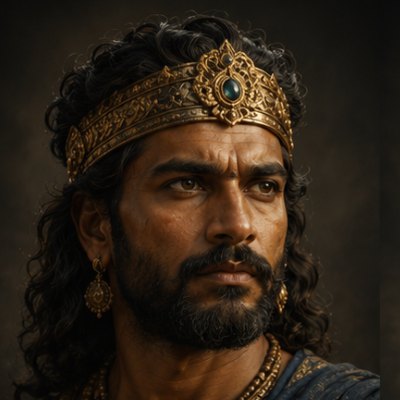
Mahavirya is a king of the Puru branch of the Lunar dynasty, recorded in the Bhagavata Purana (Canto Nine, chapter 21) and the Vishnu Purana (Book Four, chapter 19) as one of the principal sons of Manyu — also known as Bhumanyu — who was himself the son of Vitatha, the adoptive name of Bharadvaja in the royal line of the emperor Bharata Daushyanti. Mahavirya is genealogically significant as the ancestor of a branch of the Puru line whose descendants attained brahmin status despite their kshatriya birth — a transition that the Bhagavata Purana records with the same measured observation it applies to the Garga-Shini-Gargya branch among his siblings. His son Duritakshaya had three sons, Trayyaruni, Kavi, and Puskararuni, all of whom the Bhagavata Purana identifies as having reached the position of brahmins. Beyond this genealogical record, no narrative episodes, epithets, marriages, or individual accomplishments are ascribed to Mahavirya in any primary source.
✦ The Name
The Sanskrit name Mahavirya is a compound of maha, meaning great, and virya, meaning valour, heroic energy, or virile power. The compound signifies one of great heroic energy or great martial valour, a name entirely consistent with the kshatriya identity of the Puru royal lineage to which he belongs. The name Mahavira — one of great heroism — which appears in variant transliterations of the same name, is distinct from the Jain tirthankara bearing that name, though the Sanskrit root is identical.
✦ Lineage
- Father: Manyu (also called Bhumanyu) — a king of the Puru line and the son of Vitatha (Bharadvaja adopted by Bharata Daushyanti).
- Siblings: Brihatkshatra, Jaya (Bhagavata Purana only), Nara, and Garga — the other sons of Manyu. The Vishnu Purana and Matsya Purana name Mahavirya alongside Brihatkshatra, Nara, and Garga as the four sons, without including Jaya.
- Son: Duritakshaya — confirmed across the Bhagavata Purana (9.21.19–20) and the Wisdomlib Purana Index as the son of Mahavirya. The name Duritakshaya means one in whom sins or difficulties are destroyed — durita signifying difficulty or sin, and kshaya meaning destruction or cessation — which the Bhagavata Purana's commentators have noted as indicative of a spiritually elevated character that enabled the brahminical transition in his descendants.
- Grandsons through Duritakshaya: Trayyaruni, Kavi, and Puskararuni — the three sons of Duritakshaya, all confirmed in the Bhagavata Purana (9.21.19–20) and Wisdomlib Purana Index. All three attained brahmin status despite their kshatriya birth, a transition the Bhagavata Purana records explicitly as a notable feature of this lineage branch.
✦ The Varna Transition in Mahavirya's Lineage
The Bhagavata Purana (9.21.19–20) notes explicitly that although Duritakshaya's sons Trayyaruni, Kavi, and Puskararuni were born in a dynasty of kshatriyas, they attained the position of brahmins. This is recorded without further narrative elaboration — the text simply states the fact and proceeds to the next genealogical statement. The same pattern is noted for the Gargya descendants of Garga (son of Manyu) and for the Ajamidha descendants of Brihatkshatra. The Puranic tradition presents such transitions as reflections of conduct, spiritual attainment, and brahminical qualities overriding birth-based varna identity — a theme that recurs across multiple branches of the Puru genealogy. The name Kavi among the three grandsons — meaning poet or sage, and often applied to inspired brahmin seers — may itself reflect this brahminical reorientation of the lineage.
✦ References
Primary Sources
- Bhagavata Purana, Canto Nine, Chapter 21, verses 1 and 19–20 — Names Mahavirya as one of the sons of Manyu (verse 1) and records that from Mahavirya came Duritakshaya, whose three sons Trayyaruni, Kavi, and Puskararuni attained brahmin status despite their kshatriya origin (verses 19–20).
- Vishnu Purana, Book Four, Chapter 19 — Lists Mahaveerya (Mahavirya) among the sons of Manyu alongside Brihatkshatra, Nara, and Garga; Wilson's footnote at verse 17 confirms the four-son list of this text versus the five-son list of the Bhagavata Purana.
- Matsya Purana — Confirms Mahavirya as one of the sons of Manyu in its Puru dynasty genealogy, consistent with the Vishnu Purana's enumeration.
Secondary and Reference Works
- Wisdomlib.org, "Mahavirya" definition — Identifies Mahavirya as one of the five sons of Manyu (son of Vitatha/Bharadvaja), confirms his son as Duritakshaya, and cites the Bhagavata Purana 9.21.1 as the primary source.
- Wisdomlib.org, "Duritakshaya" definition — Confirms Duritakshaya as son of Mahavirya, names his three sons as Trayyaruni, Kavi, and Puskararuni, and cites Bhagavata Purana 9.21.19–20 as the source for their attainment of brahmin status.
- Wisdomlib.org, Vishnu Purana (Wilson translation), Book Four, Chapter 19 — Provides the English translation and footnotes on the sons of Manyu, noting the variants between the Bhagavata Purana, Vishnu Purana, and Matsya Purana listings.