
About
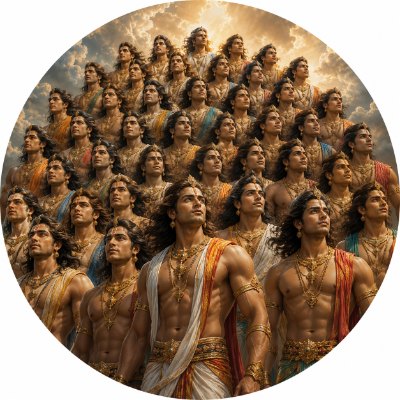
The Forty-Nine Maruts — Divine Host of Storm and Wind
Maruts · Marutagana · Marutvant · Sapta-Marut-Ganas · sons of Rudra and Prsni (Vedic tradition) · sons of Kashyapa and Diti (Puranic tradition)
The Maruts are a collective host of divine beings associated with storms, wind, thunder, lightning, and the atmospheric mid-space in both the Vedic and Puranic traditions. They are among the most frequently celebrated divine groups in the Rig Veda, appearing in over four hundred hymns and commanding thirty-three hymns dedicated exclusively to them. In the oldest Vedic layer they are the sons of Rudra, the fierce primal deity of storms and wilderness, and of Prsni, the divine spotted figure representing the rain-bearing sky. In the later Puranic tradition their origin is reframed within the narrative of the sage Kashyapa and his wife Diti, from whose single foetus the forty-nine Maruts were formed through the intervention of Indra. In the genealogical reference system in which this profile sits, the Maruts are placed under Kashyapa and Diti following the Puranic lineage, with the Vedic Rudra-Prsni tradition fully recorded as the earlier and primary Vedic account. The Maruts are significant to the wider tree through the connection established in the Shiva Purana, Shatarudra Samhita, where Suyasha — the consort of Nandi, lord of the Shiva Ganas — is identified as their daughter, bearing the designation Marut-kanya, meaning daughter of the Maruts.
✦ The Name
The name Marut is explained in both the Puranic texts and in traditional commentary through an etiological derivation from the Sanskrit phrase mā ruda, meaning do not weep or do not cry. According to the Bhagavata Purana and the Vamana Purana, when Indra sliced Diti's foetus into seven pieces within the womb and the fragments cried out in pain, Indra addressed them with this phrase of pacification, and the name Marut arose from that moment of address. This etiological explanation is a post-Vedic construction designed to anchor the name within the narrative of their origin; it does not reflect a pre-Puranic etymology. The word marut in Vedic usage is an independent term for wind or storm force, cognate with related atmospheric vocabulary in the Vedic register, and its use predates the Puranic narrative by many centuries.
The collective designation Marutagana means the troop or host of the Maruts and reflects their character as a unified military-style brotherhood in which no individual member is ranked above or below the others in seniority. The term Marutvant, meaning accompanied by the Maruts or he who has the Maruts with him, is applied principally to Indra in the Rig Veda to designate him in his aspect as the deity who leads and empowers this divine atmospheric vanguard. The designation Sapta-Marut-Ganas, meaning the seven groups of Maruts, reflects the structural organisation of the forty-nine into seven distinct troops of seven, as recorded in the Puranic tradition.
✦ Lineage
- Father (Vedic tradition): Rudra — the primal deity of storms, wilderness, and fierce natural power in the Rig Veda, understood as the earliest form of the deity later known as Shiva. Rudra's fatherhood of the Maruts is established in the Rig Veda and is the oldest recorded account of their origin.
- Mother (Vedic tradition): Prsni — a divine female figure in the Rig Veda associated with the rain-bearing sky, the spotted or dappled appearance of storm clouds, and the generative abundance of rainfall. She is described in Rig Veda VI.66.3 as the great mother who received and nurtured the germ from which the Maruts were born.
- Father (Puranic tradition, genealogical standard for this tree): Kashyapa — one of the seven great sages of the Vedic and Puranic tradition, son of Marichi and grandson of Brahma, and the progenitor of an exceptionally wide range of divine, semi-divine, and demonic beings through his many wives. His union with Diti produces the Daitya line, within which the Puranic origin of the Maruts is located.
- Mother (Puranic tradition): Diti — wife of Kashyapa and mother of the Daityas, the class of beings who stand in perpetual opposition to the Devas in Puranic cosmology. The Maruts originate from a foetus she conceived with the specific intention of producing a son capable of overthrowing Indra.
- Collective companion (Vedic tradition): Rodasi — a divine female figure celebrated in the Rig Veda as the companion who rides upon the golden chariot of the Maruts. She is associated with lightning or the storm cloud and moves in perpetual unison with the Marut host. She is a shared collective companion rather than the individual wife of any single Marut. Her association with the Maruts is established in Rig Veda V.56.8 and I.167.4–5.
- Daughter (per Shiva Purana, Shatarudra Samhita): Suyasha — given in marriage to Nandi, lord of the Shiva Ganas and vehicle of Lord Shiva, by Shiva himself following Nandi's consecration as lord of the Ganas. Suyasha bears the designation Marut-kanya, meaning daughter of the Maruts, in the Shiva Purana account.
✦ The Maruts in the Rig Veda
The Rig Veda is the oldest and most extensive primary source for the Maruts, containing more than four hundred references to them and dedicating thirty-three complete hymns to their praise and invocation. In this earliest layer of the tradition, the Maruts are the sons of Rudra and Prsni, and this parentage is established explicitly and jointly in Rig Veda Mandala VI, Hymn 66, Verse 3, which identifies the host as the offspring of Rudra in his powerful, rain-associated aspect and records that the great mother Prsni received and nurtured the generative principle from which they arose. Both parents are named together in this single verse, making it the most direct and concentrated primary statement of their Vedic genealogy.
In the Rig Vedic hymns the Maruts are depicted as a brotherhood of uniformly young, fierce, and exuberant divine warriors who travel together in golden chariots drawn by speckled deer or ruddy horses. They are adorned with golden helmets and breastplates, carry lightning bolts or axes as weapons, and are described as splitting open storm clouds to release rain upon the earth. Their movement causes the mountains to shake and the earth to tremble. They operate as a collective unit in which no member holds seniority over the others, a feature of their identity that the tradition consistently emphasises and that is reflected in the Puranic account of their simultaneous creation from equally divided portions of a single foetus.
The question of the Maruts' number receives different treatment at different points within the Rig Veda itself. The most common understanding across the hymns presents them as a finite troop without specifying an exact count. Rig Veda Mandala VIII, Hymn 96, Verse 8 employs the Sanskrit phrase tríḥ ṣaṣṭíḥ — literally thrice sixty — producing a figure of one hundred and eighty. This is a poetic hyperbole within the primary text itself, used to convey the overwhelming scale of the storm host aiding Indra in a particular cosmic encounter, rather than a literal enumeration intended as doctrine. The later commentator Sayana, in his medieval exposition of the Rig Veda, interpreted this figure as nine distinct troop divisions of twenty members each, a rationalising gloss that seeks to harmonise the hyperbolic Vedic number with the more structured Puranic account of forty-nine. The two figures are not reconciled in any primary source.
✦ The Puranic Narrative of Origin
The Bhagavata Purana, Book 6, Chapter 18, provides the most complete and structurally detailed account of the Maruts' Puranic origin, with the Vamana Purana, Chapter 46, presenting a closely parallel narrative. Both texts record the same sequence of events and both explicitly preserve the etymological phrase mā ruda as the origin of the name Marut.
The narrative begins with Diti, wife of the sage Kashyapa, who had witnessed the power and dominance of Indra among the Devas and conceived the resolve to produce a son capable of overcoming him. She undertook severe and sustained austerities directed toward this purpose. Indra, aware of the threat gestating within Diti's womb, adopted a strategy of patient service: he presented himself to Diti as a devoted attendant and waited with great care for a moment of ritual impurity or lapse in her observances that would create an opening for intervention. When Diti committed an infraction of the ritual protocols governing her penance — the specific nature of the infraction being recorded in both texts — Indra seized the opportunity. Reducing himself to a minute form, he entered her womb and used his thunderbolt weapon, the Vajra, to slice the single foetus into seven pieces.
The seven pieces cried out in pain within the womb. Indra, confronted with their anguish, addressed them with the pacifying words mā ruda — do not weep — and from this address the name Marut passed into the tradition as the designation for the beings thus created. Indra then divided each of the seven pieces into a further seven fragments, producing forty-nine beings in total. Rather than leaving these beings as potential enemies, Indra elevated all forty-nine to divine status and welcomed them as his own attendants and companions. The forty-nine were thereby organised into seven groups of seven — the Sapta-Marut-Ganas — each group constituting a troop of atmospheric deities associated with distinct aspects of storm and wind.
This narrative accomplishes several theological and cosmological functions simultaneously. It accounts for the structural organisation of the Maruts into seven groups of seven. It explains how a force originally conceived as a threat to the divine order was transformed into one of its most powerful defenders. It provides an etiological myth for the name Marut. And it integrates the Maruts into the Puranic genealogical framework by giving them a defined parentage within the Kashyapa lineage that connects them to the broader cosmological system of the Mahapuranas.
✦ The Ramayana Account
The Valmiki Ramayana carries a full and detailed standalone retelling of the Maruts' origin within the Bala Kanda, narrated by the sage Vishwamitra to Rama across Sargas 46 and 47. Sarga 46 presents the complete setup: Diti's resolve to produce an Indra-slaying son, the commencement of her severe austerities, Indra's decision to neutralise the threat through service rather than open confrontation, and his careful attendance upon Diti while awaiting a breach in her ritual purity. When the breach occurs, Indra enters the womb with the Vajra and performs the first seven cuts, dividing the foetus into seven weeping pieces. Sarga 47 continues with the secondary division of each piece into seven further fragments, Indra's pacification of the fragments with the phrase mā ruda, and the final transformation of the forty-nine portions into the seven troops of divine wind-gods who thereafter serve as Indra's atmospheric vanguard. The Ramayana account is consistent with the Puranic versions in all essential respects and represents the integration of this cosmological narrative into the major epic tradition alongside its presence in the Mahapuranas.
✦ The Maruts as Indra's Companions
Across both the Vedic and Puranic traditions the Maruts serve as the primary divine companions and atmospheric vanguard of Indra, the king of the Devas. In the Rig Veda this relationship is fundamental to Indra's power: when Indra is described in his most celebrated mythological function — the slaying of the drought demon Vritra to release the cosmic waters — the Maruts are consistently present as the force that amplifies and enables his action. The Rig Vedic term Marutvant, designating Indra as the deity who has the Maruts with him, reflects the degree to which Indra's effectiveness in cosmic combat was understood as inseparable from the storm host that attended him. The Maruts are not merely incidental companions in these episodes but are understood as the medium through which Indra's thunderbolt force is atmospherically distributed and expressed.
The Puranic narrative of their origin deepens this relationship by making the Maruts' very existence a product of Indra's own intervention. Having created them through the division of Diti's foetus, Indra is both the agent of their birth and the deity they serve — a relationship that the tradition presents not as a paradox but as a demonstration of Indra's cosmic resourcefulness in transforming a threat into a source of power.
✦ Symbolic and Philosophical Significance
The Shatapatha Brahmana, at section 9.3.1.25, provides the earliest classical textual basis for an allegorical reading of the Maruts as forces operating within the human body rather than solely in the external atmosphere. In this passage the Brahmana literature draws a correspondence between the atmospheric groupings of the Marut host and the internal vital breaths and bodily currents. This correlation, in which the organised wind forces of the cosmos are mapped onto the organised vital forces of the human system, represents an early form of the macrocosm-microcosm reasoning that characterises much of the later Vedantic and Yogic philosophical tradition. The systematic development of this correspondence into a detailed framework mapping the forty-nine Maruts onto specific pranic sub-currents and chakra-associated vital airs belongs to later medieval and early modern esoteric commentary, particularly within the Kriya Yoga tradition, and is not found as an explicit system in the principal Upanishads.
✦ Textual Variants and Inconsistencies
On parentage: The two accounts of the Maruts' origin — the Vedic tradition of Rudra and Prsni, and the Puranic tradition of Kashyapa and Diti — are irreconcilable and reflect two entirely distinct phases and frameworks of the tradition. The Rig Vedic account, being the oldest, presents the Maruts as elemental storm forces generated directly from the cosmic pairing of the primal storm deity and the rain-bearing sky. The Puranic account reframes them within the systematic genealogical and narrative structure of the Kashyapa lineage, which the Puranas use to account for the origin of a very large number of divine, semi-divine, and demonic beings. No primary source attempts to harmonise these two accounts. In the genealogical reference system of this tree the Puranic Kashyapa-Diti lineage is followed as the structural standard, while the Vedic Rudra-Prsni account is recorded here as the older and primary Vedic tradition.
On number: The Rig Veda does not fix the number of the Maruts at forty-nine or at any single consistent figure. The poetic figure of one hundred and eighty in Rig Veda VIII.96.8 is a hyperbolic expression of their vast atmospheric power in a specific context. The figure of forty-nine, organised as seven groups of seven, is a Puranic systematisation. These two numerical traditions are not reconciled in any primary source, and Sayana's medieval commentary that interprets the Vedic figure as nine groups of twenty represents a subsequent rationalising effort rather than a primary textual resolution.
On Rodasi: Rodasi is attested in the Rig Veda as the collective companion of the Maruts and is understood in that tradition as riding with them on their chariot, representing the lightning stroke or the storm cloud that moves with the wind host. She is not assigned as the individual wife of any single Marut in the Rig Veda. Later commentarial and Puranic traditions that seek to individualise the Maruts and their relationships do not produce a consistent account of Rodasi's relationship to particular members of the group, and the Rig Vedic understanding of her as a shared collective companion remains the most clearly attested position.
✦ Connection to the Wider Genealogy
Within the genealogical reference system in which this profile sits, the Maruts occupy a position in the Kashyapa-Diti line of the Puranic cosmological genealogy. Their significance to the adjacent Shilada lineage tree arises through Suyasha, their daughter as recorded in the Shiva Purana, Shatarudra Samhita, who was given in marriage to Nandi by Shiva himself following Nandi's consecration as lord of the Ganas. Through Suyasha's designation as Marut-kanya the storm deity host of the Vedic and Puranic tradition is brought into direct genealogical connection with the Shaiva devotional lineage descending through Vishwamitra — Shalanka — Shilada — Nandi.
✦ References
Primary Sources
- Rig Veda, Mandala VI, Hymn 66, Verse 3: The primary Vedic statement of the Maruts' parentage, naming both Rudra and Prsni together as the father and mother of the Marut host within a single verse.
- Rig Veda, Mandala VIII, Hymn 96, Verse 8: Uses the phrase tríḥ ṣaṣṭíḥ — thrice sixty — as a poetic hyperbole for the scale of the Marut host aiding Indra. Primary textual basis for the number one hundred and eighty, with Sayana's later commentary interpreting it as nine groups of twenty.
- Rig Veda, Mandala V, Hymn 56, Verse 8 and Mandala I, Hymn 167, Verses 4–5: Primary Vedic sources establishing Rodasi as the collective companion who rides with the Maruts on their golden chariot.
- Bhagavata Purana, Book 6, Chapter 18: The most complete and structurally detailed Puranic account of the Maruts' origin through Diti, Indra's division of the foetus, the phrase mā ruda, and the organisation of the forty-nine into seven groups of seven.
- Vamana Purana, Chapter 46: Parallel Puranic account of the Maruts' origin, closely consistent with the Bhagavata Purana narrative and preserving the etymological phrase mā ruda as primary text.
- Valmiki Ramayana, Bala Kanda, Sargas 46–47: Full standalone retelling of the Maruts' origin narrated by Vishwamitra to Rama, covering Diti's penance, Indra's entry into the womb, the seven cuts, the secondary division into forty-nine, and the transformation of the fragments into the seven divine wind troops.
- Shiva Purana, Shatarudra Samhita, Chapter 7: Identifies Suyasha, given in marriage to Nandi by Shiva, as the daughter of the Maruts, establishing the genealogical connection between the Marut host and the Shilada lineage tree.
- Shatapatha Brahmana, 9.3.1.25: The earliest classical textual basis for the allegorical correspondence between the atmospheric Marut groupings and the internal vital breaths of the human body.
Secondary and Reference Sources
- Wikipedia, "Maruts": Provides a summary of the Vedic and Puranic traditions regarding the Maruts' parentage, number, and role, and records the Rig Vedic figure of tríḥ ṣaṣṭíḥ alongside the Puranic figure of forty-nine.
- Wisdomlib.org, Rig Veda English Translation, Mandala VIII, Hymn 96: Provides the translation and context for the tríḥ ṣaṣṭíḥ reference and notes Sayana's commentarial interpretation.
- Wisdomlib.org, Puranic Encyclopaedia, "Maruts": Aggregates references to the Maruts across Puranic texts and provides cross-references for the cutting myth and its parallel accounts.
- Sacred-texts.com, Rig Veda, Mandala VI, Hymn 66: English translation of the hymn used for cross-verification of the Rudra-Prsni parentage statement in Verse 3.
- Sanskritdocuments.org, Valmiki Ramayana, Bala Kanda, Sarga 46: Sanskrit text of the Ramayana account used for cross-verification of the narrative details of Diti's penance and Indra's intervention.
- Rigvedaanalysis.wordpress.com, "The Birth of the Maruts": Secondary analysis of the Rig Vedic hymns relating to the Maruts' parentage and the co-occurrence of Rudra and Prsni in Mandala VI, Hymn 66.