
About
Duritakshaya — King of the Puru-Bharata Line, Son of Mahavirya and Father of Three Brahmin Sages
Duritakshaya · Urukshaya · Urukshat · Durbhakshaya · Durukshaya
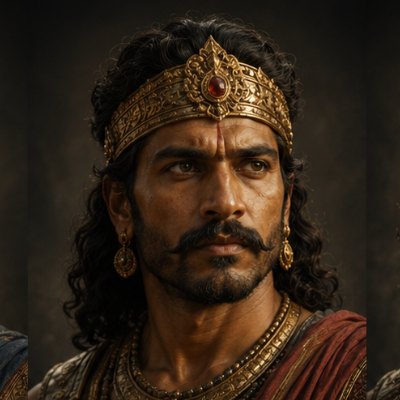
Duritakshaya is a king in the Puru-Bharata dynastic succession, son of Mahavirya — one of the five principal sons of Bhavanmanyu (Manyu), who was the son of Vitatha (Bharadvaja as adopted by King Bharata Daushyanti). He is the father of three sons — Trayyaruni, Kavi, and Pushkararuni — all of whom abandoned the Kshatriya status of their paternal line and adopted Brahmin standing, continuing the pattern of Kshatriya-to-Brahmin transition that the Vishnu Purana records for several branches of the Vitatha descent. His primary attestation is in the Bhagavata Purana (Skandha IX, Chapter 21, verses 19–20) and the Vishnu Purana (Book IV, Chapter XIX), though the two texts give his name differently. His textual presence is genealogical rather than narrative — no independent episode is attached to him in any primary source — and this profile is proportionally brief in honest reflection of that limited base.
✦ The Name and Textual Variants
The name Duritakshaya is a Sanskrit compound of durita (sin, wickedness, or difficulty) and kshaya (destruction, cessation, or decay), yielding the meaning "destroyer of sin" or "one in whom wickedness is extinguished." This is the form used in the Bhagavata Purana (Skandha IX, Chapter 21) and adopted as the standard in the Wisdomlib Puranic glossary.
The Vishnu Purana (Book IV, Chapter XIX) names the son of Mahavirya as Urukshaya — a compound of uru (wide, great, or excellent) and kshaya (dwelling, abode, or destruction), meaning "of great abode" or "great destroyer." The Vayu Purana gives the name as Durbhakshaya, and the Matsya Purana gives it as Urukshat. The Wisdomlib Duritakshaya entry records the cross-reference "see Durukshaya" confirming these are all names applied to the same individual in different Puranic redactions. This variation in name across four major Puranas is the principal textual inconsistency concerning this figure and is recorded here as the honest state of the primary source record.
✦ Lineage
- Father: Mahavirya — one of the five principal sons of Bhavanmanyu (Manyu), who was himself the son of Vitatha (the sage Bharadvaja in his capacity as adopted son of King Bharata Daushyanti). Mahavirya's brothers included Brihatkshatra, Nara, Garga, and Jaya according to the Bhagavata Purana's enumeration of Manyu's sons.
- Paternal grandfather: Bhavanmanyu (Manyu) — son of Vitatha-Bharadvaja, the central figure in the Puru-Bharata royal succession following Bharata's adoption of the sage Bharadvaja.
- Son (eldest): Trayyaruni — a Kshatriya by birth who adopted Brahmin standing; his primary significance in this lineage tree is as the father through whose line the Trayyaruni-descended tradition continued. A separate and distinct king named Trayyaruna of the Solar dynasty must not be confused with this figure.
- Son: Kavi — a Kshatriya by birth who adopted Brahmin standing; the Matsya Purana's footnote in the Vishnu Purana records that from Kavi descended three principal Brahmin lineage branches — the Gargas, the Sankritis, and the Kavyas.
- Son: Pushkararuni — a Kshatriya by birth who adopted Brahmin standing; no independent narrative is attached to this figure in any primary source located.
✦ The Kshatriya-to-Brahmin Transition
The Vishnu Purana (Book IV, Chapter XIX) states explicitly that all three sons of this figure — Trayyaruni, Pushkararuni, and Kavi — became Brahmins. The Wisdomlib entry for Duritakshaya records that he himself "attained Brahmanagati," meaning he achieved the state or path of Brahminhood, suggesting that the transition may have begun in his own generation rather than only in his sons'. This is consistent with a broader pattern in the Vitatha-descended lineage: the Vishnu Purana records the same Kshatriya-to-Brahmin transition for the Garga-Shini descendants (the Gargyas and Shainyas) in the same genealogical chapter, noting that no reason is given by the text, and that the commentator says it was "from some cause." The tradition does not provide a specific precipitating event for the transition in Duritakshaya's branch either.
✦ Connection to the Wider Genealogy
Duritakshaya occupies a lateral position in the Vitatha-descended lineage tree — he is in the Mahavirya branch of Manyu's sons, which runs parallel to the Garga branch (leading to Shini, Gargya, and Kalayavana) and the Nara branch (leading to Sankriti, Ruchiradhi, and Rantideva). Through his son Kavi he is the progenitor of the Kavya Brahmin lineage tradition noted in the Matsya Purana. Through his sons Trayyaruni and Pushkararuni he is the ancestor of Brahmin families descending from this Puru-Bharata trunk. Upward through Mahavirya and Manyu he connects to Vitatha (Bharadvaja) and through him to both the Brihaspati-Angirasa sage lineage and the Puru-Bharata royal lineage of Bharata Daushyanti.
✦ References
Primary Sources
- Bhagavata Purana, Skandha IX, Chapter 21, verses 19–20: The principal source naming Duritakshaya as the son of Mahavirya and the father of Trayyaruni, Kavi, and Pushkararuni.
- Vishnu Purana, Book IV, Chapter XIX (Sacred-texts.com): Names the same figure as Urukshaya, son of Mahavirya, father of Trayyaruni, Pushkararuni, and Kavi, all of whom became Brahmins; the footnote apparatus identifies Durbhakshaya (Vayu Purana) and Urukshat (Matsya Purana) as variant names for the same figure.
- Vayu Purana: Names the figure as Durbhakshaya in the parallel dynastic genealogy, confirmed through the Vishnu Purana's footnote apparatus.
- Matsya Purana: Names the figure as Urukshat and records the three chief branches of the Kavyas descending from his son Kavi, confirmed through the Vishnu Purana's footnote apparatus.
Secondary and Reference Sources
- Wisdomlib.org, "Duritakshaya: 6 definitions": Aggregates the Bhagavata Purana reference as the primary citation and records the cross-reference to Durukshaya confirming the identity of the figure across different Puranic name forms.