
About
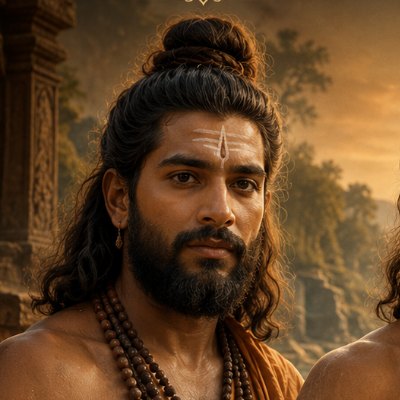
Trayyaruni — Son of Duritakshaya, Kshatriya Turned Brahmin of the Puru-Bharata Line
Trayyaruni · Trayaruni · Trayyaruna · Traiyyaruni
Trayyaruni is the eldest of three sons of Duritakshaya (also called Urukshaya or Durbhakshaya), who was the son of Mahavirya, one of the principal sons of Bhavanmanyu (Manyu). He is attested in the Bhagavata Purana (Skandha IX, Chapter 21, verses 19–20) and the Vishnu Purana (Book IV, Chapter XIX) as a member of the Puru-Bharata dynastic line who, along with his brothers Kavi and Pushkararuni, abandoned Kshatriya status and adopted Brahmin standing. His textual presence in the primary sources is almost entirely genealogical. He must be carefully distinguished from a wholly separate and more narratively prominent figure of the same name — or a very similar name — in the Solar Ikshvaku dynasty, discussed in the note below.
✦ The Name
The name Trayyaruni is a compound of trayya or traya (three, or of the three Vedas) and aruni (reddish, dawn-hued, or a descendant of Aruna), and may carry the sense of "the reddish-hued one of the three Vedas" or "the three-Veda-born." The name aruni also echoes the celebrated sage Aruni of the Chandogya Upanishad tradition, but no textual connection between this Trayyaruni and that Aruni is established in the primary sources. The name appears in variant spellings across the Puranas — Trayyaruni in the Bhagavata Purana, Trayyaruna in the Vishnu Purana's chapter heading, and Trayaruni in several secondary compilations.
✦ Lineage
- Father: Duritakshaya (also called Urukshaya, Durbhakshaya, or Urukshat in different Puranas) — son of Mahavirya, son of Bhavanmanyu (Manyu), son of Vitatha (Bharadvaja as adopted son of Bharata Daushyanti).
- Brothers: Kavi — from whom descended the Kavya Brahmin lineage branches including the Gargas, Sankritis, and Kavyas per the Matsya Purana; and Pushkararuni — attested genealogically without independent narrative.
- Son (in the Solar dynasty account — a different Trayyaruna entirely): Satyavrata, also known as Trishanku — but this belongs to the Solar Ikshvaku Trayyaruna, not to the Puru-Bharata Trayyaruni of this profile. See the note below.
✦ Note on the Homonymous Trayyaruna of the Solar Dynasty
The Puranic tradition preserves a second and far more narratively developed figure named Trayyaruna — sometimes spelled Trayaruni — who belongs to the Solar Ikshvaku dynasty as a descendant of Purukutsa and the father of the king Satyavrata (also called Trishanku). This Solar Trayyaruna is attested in the Vishnu Purana (Book IV, Chapter III), the Harivamsha (Chapter 12), the Brahma Purana, and the Vayu Purana. The relevant passage in the Vishnu Purana states the Solar line as: Tridhanvan — Trayyaruna — Satyavrata (Trishanku). The narrative attached to this Solar Trayyaruna concerns the conduct of his son Satyavrata: having banished the boy for repeatedly violating dharmic conduct — seizing another man's bride during her wedding ceremony — Trayyaruna accepted the advice of his purohita Vasishtha and expelled Satyavrata from the kingdom. Trayyaruna subsequently retired to the forest, leaving the kingdom without a ruler and precipitating a twelve-year drought. This is a substantial narrative recorded across multiple primary sources.
The Puru-Bharata Trayyaruni profiled here — son of Duritakshaya, brother of Kavi and Pushkararuni — is an entirely distinct figure. The two share a similar name but belong to different dynastic traditions (Lunar Puru-Bharata versus Solar Ikshvaku), different genealogical positions, and different textual contexts. No narrative of a son named Satyavrata or of a royal banishment episode is associated with the Puru-Bharata Trayyaruni in any primary source. Users of this reference system should take care not to conflate the two figures.
✦ The Kshatriya-to-Brahmin Transition
The Vishnu Purana (Book IV, Chapter XIX) states that all three sons of Duritakshaya-Urukshaya — Trayyaruni, Pushkararuni, and Kavi — became Brahmins. The text provides no specific reason for this transition, and the commentator cited in Wilson's translation notes it was "from some cause" without specifying what that cause was. This is consistent with the broader pattern of Kshatriya-to-Brahmin transitions that the Vishnu Purana records for other branches of the Vitatha-descended line, including the Gargya and Shainya descendants of Garga and Shini.
✦ References
Primary Sources
- Bhagavata Purana, Skandha IX, Chapter 21, verses 19–20: Names Trayyaruni as the first-listed son of Duritakshaya (Mahavirya's son) and records the adoption of Brahmin standing by all three sons.
- Vishnu Purana, Book IV, Chapter XIX (Sacred-texts.com): Names Trayyaruni (as Trayyaruna) alongside Pushkararuni and Kavi as sons of Urukshaya (Mahavirya's son), all of whom became Brahmins.
- Vishnu Purana, Book IV, Chapter III (Sacred-texts.com): The source for the Solar dynasty Trayyaruna — father of Satyavrata (Trishanku) — cited here only to establish the distinction between the two figures.
- Harivamsha, Chapter 12 (Wisdomlib): The source for the Solar Trayyaruna's role as father of Satyavrata, cited here to establish the distinction.
- Brahma Purana and Vayu Purana: Both contain the narrative of the Solar Trayyaruna and Satyavrata, cited here only to establish the distinction between the two figures.
Secondary and Reference Sources
- Wisdomlib.org, "Duritakshaya: 6 definitions": Confirms Trayyaruni as the first-named son of Duritakshaya with the Bhagavata Purana citation.
- Wisdomlib.org, "Satyavrata: Significance and symbolism": Confirms the Solar Trayyaruna as a distinct figure and father of Satyavrata (Trishanku), cited to establish the homonym distinction.