
About
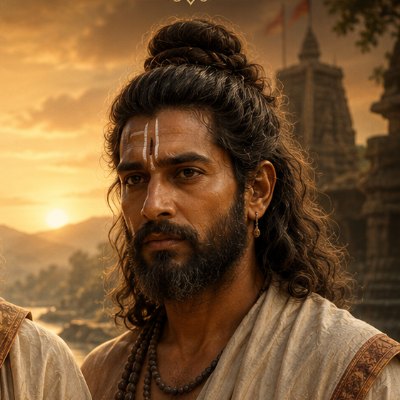
Pushkararuni — Son of Duritakshaya, Kshatriya Turned Brahmin of the Puru-Bharata Line
Pushkararuni · Puskararuni · Pushkararuna
Pushkararuni is the third of three sons of Duritakshaya (also called Urukshaya or Durbhakshaya), who was the son of Mahavirya, one of the principal sons of Bhavanmanyu (Manyu) in the Puru-Bharata dynastic succession. He is attested in the Bhagavata Purana (Skandha IX, Chapter 21, verses 19–20) and the Vishnu Purana (Book IV, Chapter XIX) alongside his brothers Trayyaruni and Kavi as members of the Puru-Bharata descent who adopted Brahmin standing despite their Kshatriya birth. No independent narrative episode is attached to Pushkararuni in any primary source located, and this profile is proportionally brief in honest reflection of that extremely limited textual base.
✦ The Name
The name Pushkararuni is a compound of pushkara and aruni. Pushkara in Sanskrit carries several meanings: a lotus flower, a sacred lake or pond (most famously the pilgrimage site of Pushkar in Rajasthan), a blue lotus specifically, or a type of drum. The suffix aruni means reddish, dawn-coloured, or "descendant of Aruna." The compound could thus mean "the reddish-lotus one," "the one of the sacred lake and dawn hue," or "the lotus-born descendant of Aruna." The primary sources do not elaborate on the etymology of this name or offer a specific meaning in the context of this figure's biography.
✦ Lineage
- Father: Duritakshaya (also called Urukshaya, Durbhakshaya, or Urukshat in different Puranas) — son of Mahavirya, son of Bhavanmanyu (Manyu), son of Vitatha (Bharadvaja as adopted son of Bharata Daushyanti).
- Brothers: Trayyaruni — eldest brother, Kshatriya-turned-Brahmin of the Puru-Bharata line, to be distinguished from the Solar Ikshvaku Trayyaruna who was the father of Satyavrata (Trishanku); and Kavi — middle brother, Kshatriya-turned-Brahmin from whom descended the Gargas, Sankritis, and Kavyas per the Matsya Purana.
✦ The Kshatriya-to-Brahmin Transition
As with his brothers and with other branches of the Vitatha descent, Pushkararuni is recorded as having adopted Brahmin status despite Kshatriya birth. The Vishnu Purana's record is explicit and consistent on this point for all three sons of Duritakshaya-Urukshaya. No reason is given in any primary source for this transition, and the Vishnu Purana's own commentator notes only that it occurred "from some cause." This honest acknowledgement of the textual silence is the appropriate position to maintain in this profile as well.
✦ Connection to the Wider Genealogy
Pushkararuni occupies a terminal position in the Mahavirya-Duritakshaya branch of the Manyu descent in this genealogical reference series. No descendants are named for him in any primary source, making him a leaf-node in the current state of the lineage tree. Upward through Duritakshaya and Mahavirya he connects to Manyu, Vitatha, Bharata Daushyanti, and the Puru-Chandravamsha royal trunk. His brothers' lines — Trayyaruni's continuation and Kavi's Brahmin-lineage branches — extend the descent further, but Pushkararuni's own branch is not traced beyond his generation in the available primary sources.
✦ References
Primary Sources
- Bhagavata Purana, Skandha IX, Chapter 21, verses 19–20: The primary source naming Pushkararuni as one of three sons of Duritakshaya (Mahavirya's son) who adopted Brahmin standing.
- Vishnu Purana, Book IV, Chapter XIX (Sacred-texts.com): Names Pushkararuni (as Pushkararuni) alongside Trayyaruni and Kavi as sons of Urukshaya (Mahavirya's son), all of whom became Brahmins.
Secondary and Reference Sources
- Wisdomlib.org, "Duritakshaya: 6 definitions": Confirms Pushkararuni as the third-named son of Duritakshaya alongside Trayyaruni and Kavi, with the Bhagavata Purana IX.21.19-20 citation.
- Wisdomlib.org, "Pushkararuni" (referenced within the Duritakshaya full-text list): Listed as a searchable term linking to the same Bhagavata Purana genealogical passage.