
About
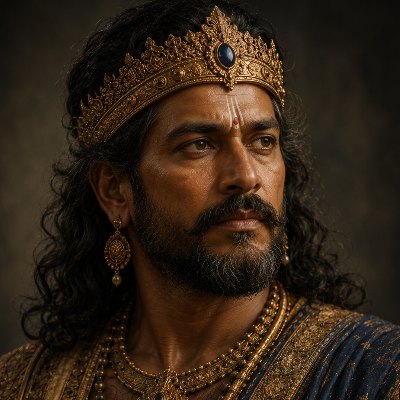
Rantideva — King of the Puru Line, Exemplar of Selfless Generosity
Rantideva · Rantideva Sankriti · Son of Sankrti · Charmanvati's Creator · The Compassionate King
Rantideva is a king of the Puru branch of the Lunar dynasty, celebrated across the Puranic and epic traditions as the supreme embodiment of selfless generosity, extreme austerity willingly undertaken, and the perception of Vishnu's presence in every being. He is recorded in the Bhagavata Purana (Canto Nine, chapter 21, verses 2–18), the Vishnu Purana (Book Four, chapter 19), the Mahabharata (Drona Parva, chapter 65; Shanti Parva, chapter 29; Anushasana Parva, chapter 66), and in the classical poet Kalidasa's Megha Duta as the king whose vast sacrificial activity caused the river Charmanvati — the modern Chambal — to come into being from the accumulated secretions of the animals offered at his yajnas. His lineage places him in the Puru royal tradition as the younger son of Sankrti, who was the son of Nara, one of the five principal sons of Manyu (Bhumanyu), who was the son of Vitatha — the name given to Bharadvaja upon his adoption by the emperor Bharata Daushyanti. The Bhagavata Purana declares that the fame of Rantideva resonates not only in human society but among the gods themselves, and the text narrates the episode of his forty-eight-day fast as one of the most concentrated expressions of universal compassion in the entire Puranic corpus.
✦ The Name
The Sanskrit name Rantideva is a compound of ranti and deva. Ranti derives from the root ram meaning to delight, rest, or take pleasure, with the suffix indicating an agent — one who delights or brings delight. Deva means god, divine being, or one of shining nature. The compound thus signifies one who is a god of delight or one in whom divine joy dwells — a name that the tradition reads as prophetic of his character: a king in whom the divine quality of boundless giving and the joy of service to all beings was supremely manifested. In some secondary sources the compound is rendered as one who finds delight in the divine or one who makes even the gods rejoice.
✦ Lineage
- Father: Sankrti — son of Nara, one of the five principal sons of Manyu (Bhumanyu) of the Puru-Bharadvaja line of the Lunar dynasty. Sankrti is recorded as the father of both Ruciradhi (the elder son) and Rantideva (the younger).
- Elder Brother: Ruciradhi (also named Guru in the Bhagavata Purana, Gurudhi in the Matsya Purana, and Guruvira in the Vayu Purana) — the elder son of Sankrti, for whom no narrative episodes are recorded in any primary source.
- Dynasty: Puru branch of the Chandravamsha (Lunar dynasty), descending through Vitatha (Bharadvaja) — Manyu — Nara — Sankrti — Rantideva.
✦ Character and Conduct as a King
The Bhagavata Purana (9.21.3–5) establishes the foundational principle of Rantideva's life: he never endeavoured to accumulate wealth by his own enterprise. Whatever arrived to him by the arrangement of providence he accepted as sufficient, and of this he freely gave to all who came seeking. The Mahabharata's Drona Parva (chapter 65) amplifies the scale of his generosity, describing a royal household in which two hundred thousand cooks worked continuously to distribute excellent food to brahmin guests arriving by day and by night. All the utensils and articles of Rantideva's household, the Mahabharata records, were of gold. The sacrificial yajnas he performed were of immense scale, with countless animals coming voluntarily to be offered, and the king distributed his entire wealth of nishkas — gold coins — without remainder to the brahmins who came to him. The text records that those who witnessed his establishment declared it rivalled even the treasury of Kubera, the god of wealth.
✦ The Forty-Eight-Day Fast and the Four Guests
The Bhagavata Purana (9.21.3–18) narrates the episode for which Rantideva is most celebrated. By the progressive depletion of his wealth through continuous giving, Rantideva and his family eventually arrived at a state of extreme poverty and privation. Having given away everything, they endured forty-eight days without food or water — the Bhagavata Purana records that the king himself did not even drink during this entire period, and that his family shivered from hunger and thirst yet Rantideva remained composed throughout. On the forty-ninth morning, by what appeared to be the workings of providence, a meal arrived: food made with ghee and milk and water sufficient for the five members of the household.
When Rantideva and his family, trembling from their long deprivation, were about to eat, a brahmin guest arrived. The Bhagavata Purana records that Rantideva perceived the Supreme Godhead's presence in the guest and received him with faith and respect, offering him a portion of the food. After the brahmin departed, the family divided the remainder and was again about to eat when a shudra appeared. Rantideva gave a portion to the shudra as well. The remnant was divided again, and before Rantideva could eat his share, another guest arrived — accompanied by dogs — and Rantideva gave the remainder of the food to this guest and his animals without reservation. Now only a vessel of water remained, sufficient to sustain one person's life. When Rantideva raised it to his lips, a fourth person arrived, described as a chandala, who was in desperate thirst and asked for water. Rantideva gave the water to this guest as well.
The Bhagavata Purana then records the words Rantideva spoke at this moment — paraphrased as his declaration that he sought from the Lord neither the eight mystic perfections, nor liberation, nor even the supreme abode, but only that he might dwell within the hearts of all beings and take upon himself their sufferings so that no creature in the world would endure sorrow. Having spoken thus and given away the last water, Rantideva stood empty-handed, having himself eaten and drunk nothing for forty-eight days plus the morning of the forty-ninth day. The Bhagavata Purana records that at this moment the assembled gods and all who had followed the principles of Rantideva's life were entirely purified and became steadfast devotees of Narayana, attaining the highest yoga. The four figures who had appeared as guests are identified in later popular retellings and some secondary sources as the Trimurti — Brahma, Vishnu, and Shiva — testing Rantideva's resolve, though the Bhagavata Purana's own narration does not explicitly name the four guests as the Trimurti in these verses; it attributes the entire episode to the working of divine grace and Rantideva's own selfless perception of the divine in all beings.
✦ The Charmanvati River
The Mahabharata's Drona Parva (chapter 65, Sacred Texts translation) provides the tradition of the Charmanvati river's origin. At the sacrifices of Rantideva, animals came voluntarily in such vast numbers that the secretions flowing from the heaps of skins accumulated at the sacrifice formed a continuous stream that became a river — named Charmanvati, meaning the river of hides or leather, because of the hides accumulated there. This river is identified in the tradition with the modern Chambal river of central India. The Wikipedia article on the Charmanvati confirms that the Mahabharata references Rantideva's sacrifices in connection with this river at three distinct locations: Drona Parva (7.65), Shanti Parva (12.29), and Anushasana Parva (13.66). Kalidasa's Megha Duta also preserves the same tradition, as noted by the Vishnu Purana's Wilson translation.
✦ Rantideva in the Mahabharata
The Mahabharata's Drona Parva narrates Rantideva's fame in the context of a speech by Narada to Srinjaya — identifying Rantideva by the clan designation "son of Srinjaya" in the Sacred Texts translation, which reflects a broader lineage or clan affiliation rather than his individual patronymic of Sankrti. The text records that Rantideva distributed food of the quality of amrita to brahmin guests around the clock, gave away all wealth earned by righteous means, had studied the Vedas, conquered his enemies in fair fight, performed sacrifices under rigid vows, and incessantly gave bright gold nishkas to the brahmins until not even a remnant of his gold remained. The passage concludes with the observation that even so, Rantideva fell prey to death — Narada's point being that all mortals, however great their virtue and generosity, are subject to time and death, and that only devotion to Vishnu provides enduring protection. The Anushasana Parva (13.66) further references him as a king of extraordinary sacrifice and austerity.
✦ Theological and Philosophical Significance
Within the theological framework of the Bhagavata Purana, Rantideva exemplifies the Vaishnava principle that the supreme form of devotion to Vishnu is not ritual worship or austerity performed for personal liberation, but the perception of Narayana's presence in every being and the consequent willingness to sacrifice one's own comfort — even one's life — for the welfare of all. The Bhagavata Purana verse in which Rantideva articulates his sole desire — to dwell within all beings and absorb their suffering rather than attain personal liberation — is one of the most frequently cited statements of universal compassion in the entire Puranic tradition and is used in Vaishnava philosophical commentary to illustrate the selflessness of pure bhakti. The Dharmawiki summarises this significance as demonstrating that true atithi-seva — service to guests and all who come — conducted without pride of being a donor and without expectation of any return, is itself the highest spiritual practice. The Bhagavata Purana further records that all who followed the principles of Rantideva's life became attached to Narayana and attained the position of the best of yogis, establishing the episode as a model of liberation through compassionate action rather than personal accumulation of merit.
✦ References
Primary Sources
- Bhagavata Purana, Canto Nine, Chapter 21, verses 2–18 — The primary and most detailed source for Rantideva's narrative; names him as the son of Sankrti and younger brother of Guru (verse 2); declares his fame in both human and divine worlds; narrates the forty-eight-day fast, the four guests, and the declaration of universal compassion; records the liberation of all who followed his principles (verses 3–18).
- Vishnu Purana, Book Four, Chapter 19 — Lists Rantideva as the son of Ruciradhi (Sankrti's son) and records his fame; Wilson's footnote at verse 18 notes the Bhagavata Purana's extended narrative and the Megha Duta's preservation of the Charmanvati legend; Wilson's footnote at verse 22 notes the three clan branches: Gargas, Sankritis, and Kavyas.
- Mahabharata, Drona Parva, Chapter 65 (Sacred Texts: Section LXVII) — Narrates Rantideva's vast sacrificial activity, his two hundred thousand cooks, his gold household, his incessant giving of nishkas, and the origin of the Charmanvati river from the secretions of sacrificial animals; part of Narada's address to Srinjaya on the fate of all mortal kings.
- Mahabharata, Shanti Parva, Chapter 29 — References Rantideva among the sixteen celebrated maharajas narrated by Narada to Yudhishthira after the Kurukshetra war; associates him with the Charmanvati river.
- Mahabharata, Anushasana Parva, Chapter 66 — A further reference to Rantideva as a king of extraordinary sacrifice; one of the three Mahabharata locations confirmed by the Wikipedia article on Charmanvati.
- Kalidasa, Megha Duta — Preserves the tradition of the Charmanvati river's origin in the sacrifices of Rantideva; noted in the Vishnu Purana Wilson translation footnote 18.
Secondary and Reference Works
- Wikipedia, "Rantideva" — Summarises the Bhagavata Purana and Mahabharata narratives; records the Trimurti-testing tradition found in popular and devotional retellings; identifies Guru as his sibling; notes his attainment of moksha.
- Wikipedia, "Charmanvati" — Confirms that the Mahabharata references Rantideva's sacrifices in connection with the Charmanvati at three locations (Drona Parva 7.65, Shanti Parva 12.29, Anushasana Parva 13.66); identifies the river with the modern Chambal.
- Dharmawiki, "Rantideva" — Provides a detailed summary of the Bhagavata Purana episode (Skanda 9, Adhyaya 21) including the Sanskrit verse 9.21.4 and the lineage Bharadvaja — Manyu — Nara — Samkriti — Rantideva; discusses his significance as a model of atithi-seva.
- Wisdomlib.org, "Rantideva" definition — Consolidates references from the Bhagavata Purana and Puranic Encyclopaedia; confirms Sankrti as father; summarises the narrative of generosity; notes his recognition as a Mahayogi.
- Vedabase.io, Srimad Bhagavatam 9.21 (ISKCON translation) — Provides the full English translation of verses 3–18 narrating the forty-eight-day fast and the four-guest episode, including the verse recording Rantideva's declaration of universal compassion and the liberation of his followers.
- Sacred Texts Archive, Mahabharata Drona Parva Section LXVII — Provides the direct English translation of the Drona Parva passage on Rantideva including the two hundred thousand cooks, the golden household, and the Charmanvati origin statement.
- JKYog India, "The Glory of Shakuntala's Son Bharat and the Compassion of King Rantideva" — Provides a summary of the Bhagavata Purana Canto Nine narrative of Rantideva's fast and generosity, including Rantideva's declaration that he sought only to dwell in all beings and absorb their suffering.