
About
Hiranyavarman — King of Dasharna, Father-in-Law of Shikhandi
Hiranyavarman · King of Dasharna
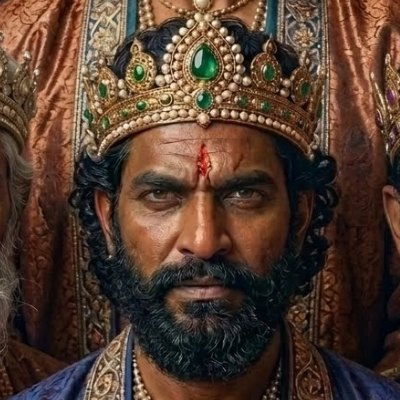
Hiranyavarman is recorded in the Mahabharata's account of Shikhandi's early life as the King of Dasharna, a kingdom of ancient India, and the father of the princess whom King Drupada of Panchala gave in marriage to his child Shikhandini — at that time being raised as a prince, though born female. Hiranyavarman's role in the narrative is confined to a single but consequential episode: the discovery, through his daughter, that her husband Shikhandini was not biologically male, and his resulting outrage and preparation for war against Panchala, a crisis that was resolved only through Shikhandini's exchange of sex with the Yaksha Sthunakarna. Hiranyavarman's textual presence is limited to this episode, and no further independent narrative, genealogy, or characterisation is attributed to him in the primary sources.
✦ The Name
The name Hiranyavarman is a Sanskrit compound of hiranya, meaning gold, and varman, meaning armour or protection, together meaning he whose protection is golden or golden-armoured, a name of the type commonly borne by Kshatriya kings in the epic tradition, conveying both wealth and martial strength. The kingdom of Dasharna, over which he is recorded as ruling, is identified in the geography of the Mahabharata as a region of ancient India associated with the wider Kshatriya political landscape within which Panchala, Drupada's kingdom, was also situated.
✦ Lineage
- Daughter: An unnamed princess in the primary text of the Udyoga Parva, given in marriage to Shikhandini, the child of King Drupada of Panchala, who was being raised as a prince despite having been born female. Within this database, this daughter is identified by the name Hiranyamani, a patronymic-style designation reflecting her father's name, adopted as a naming convention rather than as an independently attested name found in the Mahabharata itself.
- Son-in-law: Shikhandi (also Shikhandin, natally Shikhandini) — son of King Drupada of Panchala and his queen Prishati, and brother of Dhrishtadyumna, the supreme commander of the Pandava armies, and of Draupadi, the shared wife of the five Pandava brothers. Shikhandi was born female and became male through an exchange of sex with the Yaksha Sthunakarna, an exchange made permanent by a curse of the god Kubera. In the majority of Mahabharata recensions, Shikhandi is identified as the reincarnation of Amba, eldest daughter of the King of Kashi, reborn for the specific purpose of bringing about the death of Bhishma, which he accomplished on the tenth day of the Kurukshetra War.
✦ The Discovery and the Crisis with Panchala
The Mahabharata records that King Drupada, having received a divine assurance from Shiva that his daughter Shikhandini would in due course become male, raised the child entirely as a boy, concealing the natal female identity from the wider world. When Shikhandini reached the age of marriage, Drupada arranged a formal wedding with the daughter of Hiranyavarman, King of Dasharna. In the course of the marriage, Hiranyavarman's daughter became aware that her husband was not biologically male and reported this to her father. Hiranyavarman, outraged at what he understood to be a deception practised upon his daughter and his kingdom, sent envoys to Panchala to confirm the matter and began preparations for war against Drupada's kingdom in response.
Drupada, for his part, maintained before all parties that Shikhandini was male, even as the crisis with Dasharna intensified. Shikhandini, distressed at the war her circumstances had provoked, withdrew into a forest associated with the Yaksha Sthunakarna, where she obtained a temporary exchange of sex with the Yaksha, returning to Drupada's court as a man in full biological fact. Drupada then invited Hiranyavarman's envoys, who were women sent specifically for this purpose, to verify Shikhandi's manhood; they did so, and the crisis between the two kingdoms was resolved without war. The exchange of sex, intended by Sthunakarna to be temporary, was subsequently made permanent through the god Kubera's curse upon the Yaksha, fixing Shikhandi's male identity for the remainder of his life.
✦ Connection to the Wider Genealogy
Hiranyavarman, as King of Dasharna, is connected to the Panchala royal house through his daughter's marriage to Shikhandi, the son of King Drupada. Through this marriage, Hiranyavarman became, by alliance, connected to the wider Panchala family that included Dhrishtadyumna, commander of the Pandava armies, and Draupadi, wife of the five Pandava brothers, situating his kingdom of Dasharna within the broader web of political alliances surrounding the Panchala throne in the period leading up to the Kurukshetra War.
✦ References
- Primary Sources
- Mahabharata, Udyoga Parva, Ambopakhyana chapter — Primary source for Hiranyavarman's identity as King of Dasharna, the marriage of his daughter to Shikhandini, the discovery of Shikhandini's natal sex, and Hiranyavarman's resulting preparations for war against Panchala.
- Secondary Sources
- Wikipedia, entry on Shikhandi — Secondary reference consolidating the narrative of Shikhandini's marriage to Hiranyavarman's daughter and the resulting crisis between Dasharna and Panchala.
- Vyasa Mahabharata Online Encyclopedia, entry on Shikhandin — Secondary reference confirming the sequence of events surrounding the marriage and the sex-exchange episode that resolved the resulting crisis.