
About
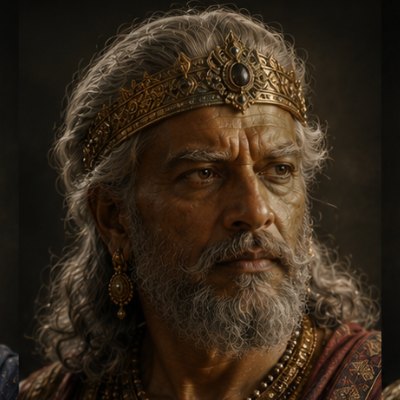
Dharmaratha — Pious King of Anga and Father of Romapada
Dharmaratha · King of Anga · Son of Diviratha
Dharmaratha was a king of the Anga dynasty, son of Diviratha and father of Chitraratha, who bore the celebrated epithet Romapada. He stands as a significant generational figure in the Anga royal succession — the monarch who preceded the dynasty's most narratively prominent pre-Karna ruler. The primary sources credit Dharmaratha with great religious merit and the performance of major Vedic sacrifices, though the detailed narrative of his reign is not elaborated at length in the surviving texts. He appears in the Vishnu Purana, the Bhagavata Purana, and the Harivamsha Purana, all three of which agree on his position in the dynastic sequence.
✦ The Name
The name Dharmaratha is a compound of dharma (righteousness, sacred duty, cosmic order) and ratha (chariot), yielding the meaning one whose chariot is dharma or one who rides upon righteousness. It is a profoundly auspicious royal name in the Kshatriya tradition, implying a monarch whose power is grounded in righteous conduct and sacred law. The Harivamsha Purana explicitly characterises him as equal to Indra in prowess, a standard honorific for kings of exceptional virtue and martial excellence.
✦ Lineage
- Father: Diviratha, king of Anga, son of Para (also known as Khalapana or Dadhivahana across the textual traditions), who was himself the direct son of the dynasty's founder King Anga
- Son: Chitraratha, also known as Romapada and as Dasharatha of Anga, a king celebrated for his close friendship with Dasharatha of Ayodhya and his adoption of Princess Shanta
✦ Character and Reign
The Harivamsha Purana describes Dharmaratha as a deeply learned monarch comparable in might to the king of the gods. He is associated in the textual record with the performance of significant Vedic rites, a hallmark of righteous kingship in the Puranic framework. The Harivamsha records that Citraratha, his son, went on to celebrate a yajna on the sacred mount Vishnupada and drank soma juice in the company of Indra — a prestige that reflects the religious culture Dharmaratha helped establish in the Anga royal house. Beyond these characterisations, the primary sources do not narrate specific military campaigns, legal pronouncements, or administrative acts attributed to Dharmaratha's reign individually.
✦ Significance in the Dynastic Sequence
Dharmaratha's most significant function in the genealogical tradition is as the direct progenitor of Romapada, whose reign marks the Anga dynasty's most prominent intersection with the narrative of the Ramayana. It is through Dharmaratha's son that the adoption of Princess Shanta, the arrival of the sage Rishyashringa, and the consequent connection to the Ayodhya royal house all come about. Dharmaratha thus represents the last generation of the unbroken biological Anga succession before the dynasty's lineage becomes entangled with the broader inter-dynastic events of the Itihasa tradition.
✦ Connection to the Wider Genealogy
Dharmaratha stands fourth in the direct succession of the Anga dynasty: Anga → Para/Khalapana/Dadhivahana → Diviratha → Dharmaratha → Chitraratha-Romapada. The dynasty itself belongs to the Chandravamsha, the Lunar Dynasty, through the line of Yayati's son Anu, descending through Titikshu, Rushadratha, Homa, Sutapa, and Bali, from whose wife the sage Dirghatama fathered Anga and his five brothers. From Dharmaratha the line continues through Romapada to Chaturanga, Prithulaksha, Champa, and the long succession of kings culminating in Adhiratha and Karna.
✦ References
- Vishnu Purana, Book 4, Chapter 18: Places Dharmaratha in the sequence Divaratha → Dharmaratha → Chitraratha; foundational primary source for the Anga dynastic list
- Bhagavata Purana, Canto 9, Chapter 23, verses 6–7: Confirms the sequence Diviratha → Dharmaratha → Citraratha (Romapada); agrees with the Vishnu Purana on his position
- Harivamsha Purana, Adi Parva, Chapter 31, verses 43–45: Describes Dharmaratha as equal to Indra in prowess; records his son Citraratha's soma-drinking ceremony on mount Vishnupada; primary source for the characterisation of the king's religious stature
- Wisdomlib — Harivamsha Purana (Dutt translation), Chapter 31: Secondary source providing English translation with verse-level detail for the Anga succession
- Ancientvoice — Vishnu Purana (vp:anga): Secondary source confirming the Vishnu Purana 4.18 dynastic sequence