
About
The Ashes of Kamadeva — Sacred Residue and Cosmic Origin Point of the Bhanda Lineage
Manmatha Bhasma · Kama Bhasma · Smara Bhasma · Ananga Bhasma
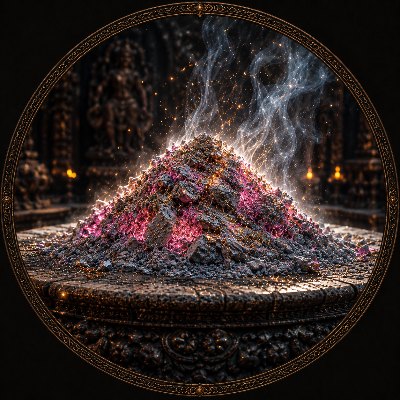
The ashes of Kamadeva — the god of desire, also known as Manmatha, Smara, and Ananga — constitute the origin point of an entire demonic lineage unique in the Hindu Puranic tradition. Unlike the established ancestral lineages of the Daityas or Danavas, this origin is elemental and accidental: it proceeds not from cosmic genealogy but from the physical residue left behind when Shiva, the great ascetic, destroyed the god of desire with fire from his third eye. The Lalitopakhyana, embedded within the Brahmanda Purana and narrated as a dialogue between the sage Agastya and the divine sage Hayagriva, records that from these ashes were produced Bhandasura and, separately from the remaining portions of the same ash, his two brothers Vishukra and Vishanga, as well as the wider demonic army that formed his following. As a genealogical root node, the ashes of Kamadeva represent not a living being but a cosmological event — the moment at which suppressed cosmic desire, destroyed but not annihilated, took on new and destructive form.
✦ The Destruction of Kamadeva
The event that produced the ashes belongs to a narrative preceding the Lalitopakhyana's central story but essential to it. After the death of Sati — Shiva's first wife who self-immolated at the sacrifice of her father Daksha — Shiva withdrew into profound, inconsolable meditation. The gods of the universe, facing the threat of the demon Tarakasura who could only be killed by the son of Shiva, needed Shiva to emerge from his grief and enter into union with Parvati, the daughter of the mountain king Himavan and the reincarnation of Sati. Kamadeva, the god of desire and love, was sent by the gods to pierce Shiva's meditation with his flower-tipped arrows of desire. Kamadeva succeeded in disturbing Shiva's concentration; Shiva, enraged at the interruption of his austerity, opened his third eye and released a beam of fire that reduced Kamadeva instantly to ash. Kamadeva's wife Rati was left widowed and bereft. The god of desire was gone, and the universe entered a condition of diminished fertility and desire — referred to in the tradition as Kama-pralaya — that would later be replicated and deepened by Bhandasura's reign.
✦ The Sacred and Dangerous Nature of the Ash
The ashes of Kamadeva were not ordinary combustion residue. In Shaiva theology, ash — vibhuti — carries a sacred significance as the final form of what has been offered to or consumed by divine fire. The ash of Kamadeva in particular was charged with a unique and volatile concentration of energies: it was the residue of the god of desire, a cosmic principle of extraordinary power, incinerated by the equally extraordinary power of Shiva's anger. The two energies — desire and the wrath of the great ascetic — combined within the ash produced a substance of exceptional potency, capable of giving rise to a being who embodied neither pure desire in its generative form nor pure asceticism in its transcendent form, but their distorted, destructive intersection.
✦ What Emerged from the Ash
The Lalitopakhyana records two distinct but related processes of emergence from the ash. First, the Shivagana Chitrakarma gathered the ash and fashioned it into a figure resembling Kamadeva, which came to life when brought near Shiva and received life from his gaze; this figure became Bhandasura. Second, from the remaining portions of the same ash — described in the primary text as the remnants of the ash of Manmatha — two further beings emerged spontaneously: Vishukra and Vishanga, who became the brothers of Bhandasura. Additionally, the text records that thousands of Rakshasas were also born from the ash of Manmatha and became the foundational army of Bhandasura's forces.
The ash of Kamadeva thus functions in the Lalitopakhyana not merely as the origin of one being but as a generative source from which an entire demonic cohort emerged. Its use as a genealogical root node in a lineage system captures this accurately: it is the single point of origin from which the entire Bhanda lineage descended.
✦ Theological Significance
The Lalitopakhyana's account of the ash as an origin point carries a precise theological logic. In the Shakta framework in which the text operates, desire — Kama — is a cosmic principle that cannot simply be destroyed; it can only be transformed or redirected. When Shiva burned Kamadeva, he did not eliminate desire from the universe but suppressed its generative, benevolent form. The ash retained the energy of Kama in a form that was now without its proper direction or purpose, and from that directionless energy arose beings whose defining characteristic was the suppression of the very principle that gave rise to them: Bhandasura's reign is consistently described as a cosmic cessation of desire, fertility, and joy — a negation of Kama's original function. The Lalita Sahasranama preserves this theological structure explicitly in the name Haranetragni-sandagdha-kama-sanjeevanaushadhih — she who is the life-giving medicine to Kama who was burned by Shiva's eye — which frames the Goddess's intervention as the restoration of what had been distorted at the moment of Kamadeva's incineration.
✦ Resolution: The Resurrection of Kamadeva
The Lalitopakhyana records that following the destruction of Bhandasura by the goddess Lalita Tripura Sundari, she cast a compassionate glance upon the remaining ash — the very material from which the demonic lineage had emerged — and from it Kamadeva was resurrected in a pure, luminous spiritual form. This restoration is described in some accounts as the emergence of Ananga, the bodiless form of Kama in a spiritualised rather than material manifestation. The destruction of what arose from the ash by the goddess thus completed a cosmic cycle: the ash produced a destructive force that perverted Kama's function, and the destruction of that force allowed Kama to be restored in a higher form.
✦ References
Primary Sources
- Brahmanda Purana, Lalitopakhyana (Lalita Mahatmya), Chapters 21–30 — The primary source for the entire narrative: the destruction of Kamadeva by Shiva's third eye, Chitrakarma's fashioning of a figure from the ash, the emergence of Vishukra and Vishanga from the remaining ash, and the emergence of thousands of Rakshasas from the same material; narrated as a dialogue between Agastya and Hayagriva.
- Lalita Sahasranama (embedded within the Brahmanda Purana, Lalitopakhyana) — The thousand names of Lalita, several of which directly encode the theological significance of Kamadeva's destruction and the ash's generative role: Haranetragni-sandagdha-kama-sanjeevanaushadhih; Bhandasura-vadhodyukta-shakti-sena-samanvita; Bhandatendra-nishoodini.
- Tripura Rahasya, Jnana Khanda — An independent Sanskrit text that also records the battle between Lalita and Bhandasura and thus attests the broader narrative of which the ash's significance forms the origin.
Modern and Secondary Reference Works
- Wisdomlib — Lalitopakhyana (Lalita Mahatmya), English Translation (wisdomlib.org/hinduism/book/lalitopakhyana-lalita-mahatmya) — Provides the English translation of the Brahmanda Purana's Lalitopakhyana section; the principal reference for verifying the primary text account of the ash's generative role.
- Lalitopakhyana Synopsis (srilalithatripurasundari.wordpress.com) — An encyclopaedic synopsis of the Lalitopakhyana compiled by Udaya Bhaaskar Bulusu; provides verse-by-verse summaries including the specific statement that Vishukra and Vishanga emerged from the remnants of Manmatha's ash, and that thousands of Rakshasas also arose from the same source.
- Lalitopakhyana Summary (omshivashakti.wordpress.com) — A parallel summary of the same text confirming the two-stage emergence: Bhandasura's formation by Chitrakarma from the ash, and the subsequent emergence of Vishukra, Vishanga, and the demonic army from the remaining ash.