
About
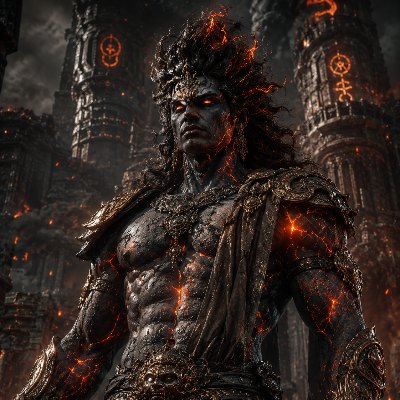
Bhandasura — Asura Emperor Born from the Ashes of Kamadeva and Cosmic Adversary of Lalita Tripura Sundari
Bhandasura · Bhanda · Bhand · Bhandatendra · Manmatha Bhasma Sambhava
Bhandasura is the principal antagonist of the Lalitopakhyana, the narrative centrepiece of the Brahmanda Purana's final section, and the cosmic adversary whose tyranny directly caused the manifestation of the supreme goddess Lalita Tripura Sundari. He has no biological parentage in the conventional sense: he arose from the ashes of Kamadeva, the god of desire, after Shiva incinerated Kamadeva with fire from his third eye for disturbing his meditation. Fashioned from that ash by the Shivagana Chitrakarma and brought to life by the proximity of Shiva himself, Bhandasura obtained immense boons through subsequent austerities, established an asura empire that plunged the three worlds into a condition of universal sterility and joylessness, and was ultimately destroyed by Lalita Tripura Sundari through the Mahakameshvarastra. He is a figure of the Shakta Puranic tradition, appearing primarily in the Brahmanda Purana, with the battle also attested in the Tripura Rahasya (Jnana Khanda), and his significance is preserved in multiple names of the Lalita Sahasranama.
✦ The Name
The name Bhanda was not chosen but exclaimed. When the boy formed from Kamadeva's ash was brought before Shiva and came to life, Lord Brahma — witnessing the situation with a mixture of alarm and dismay at what this new being might mean for the cosmic order — cried out the word Bhanda repeatedly. The Lalitopakhyana preserves this as an exclamation of shame or disbelief — Bhanda carrying the sense of shame, disgrace, or deadly bondage in this context. One summary also records the reading that Brahma's exclamation meant something closer to it must be a joke, suggesting that the naming reflects Brahma's incredulity at what Shiva's gaze had brought to life. In either interpretation, the name is not a blessing but a reaction — an involuntary verbal response that became the permanent identifier of the being. The suffix asura, denoting a demon or a being of power in opposition to the devas, was appended to form the full name Bhandasura.
✦ Origin and Lineage
- Origin: The ashes of Kamadeva — the concentrated residue of the god of desire, charged with the combined energies of Kama and Shiva's third-eye fire. The Shivagana Chitrakarma formed this ash into a figure and brought it before Shiva; Shiva's proximity animated the figure. The Lalitopakhyana consistently identifies Chitrakarma as the agent of formation.
- Brothers: Vishukra and Vishanga — produced from the remaining ash of Kamadeva. In the primary Lalitopakhyana text, they are described as arising independently from the ash after Bhandasura's own emergence. A parallel account found in secondary compilations states that Bhandasura generated Vishukra from his right shoulder and Vishanga from his left shoulder. Both accounts are attested; the former belongs to the primary text and the latter to secondary summaries.
- Sister: Dhumini — generated by Bhandasura from his own heart. She is consistently described as emerging from Bhandasura's heart rather than from the original ash, making her a creation of the second degree within the lineage.
- Wives: Four wives, unnamed in the primary text as individually identified beings.
- Sons: Thirty sons by his four wives, all of whom grew into powerful commanders and all of whom were killed by Bala Tripurasundari — the nine-year-old daughter of Lalita — during the great war.
- Daughter: One daughter named Rashmiprabha — attested in secondary compilations of the Lalitopakhyana narrative. Her role beyond this mention is not elaborated in the sources consulted.
✦ The Boons of Shiva
After his formation and initial animation, Chitrakarma gave the boy the upadesha — the initiatory teaching — of the Shatarudriya Mahamantra and instructed him to perform austerities directed at Shiva. The boy did so with exceptional intensity. Shiva appeared and granted him two principal boons. The first was that any being who engaged him in combat would immediately forfeit half of their strength and masculinity, which would be transferred directly to Bhandasura — a unique and functionally insurmountable advantage that made him invincible to any warrior of masculine energy. The second was the promise of undisputed sovereignty over the three worlds for sixty thousand years, free from obstruction. Some accounts also include immunity from binding by any weapon as a component of the boon. These grants collectively made Bhandasura the effective master of the universe for the duration of his reign.
✦ The Reign and Shunyaka Nagara
Bhandasura summoned Maya — the divine architect of the asuras — and commissioned the construction of his capital city on the Mahendra Hills. This city was named Shunyaka Nagara — the City of Emptiness — a name of precise theological significance: the city whose emperor was the embodiment of suppressed and distorted desire was named for the void. Under Bhandasura's rule, the three worlds entered a state analogous to the original Kama-pralaya: desire, procreation, joy, and creative vitality withered across the universe. The devas, driven from their domains and unable to resist his boon, retreated into concealment and devoted themselves to worship of the goddess Parashakti, waiting in silence for the duration of Bhandasura's prescribed dominion.
✦ The Manifestation of Lalita and the War
As the sixty-thousand-year dominion neared its end, the devas — guided by the sage Narada — performed a great Maha Yajna. From the sacrificial fire arose Lalita Tripura Sundari, the supreme goddess of the Shakta tradition, fully armed and accompanied by her vast Shakti Sena — an all-female army of divine warriors. The war between Bhandasura's three-hundred-akshauhini army and the Shakti Sena unfolded over four days of increasingly intense battle.
The early phases saw Lalita's commanders — Sampatkari, Ashvarudha, Matangi, and Varahi — systematically destroying Bhandasura's generals. Bala Tripurasundari, the nine-year-old form of the goddess manifested as Lalita's daughter, killed all thirty of Bhandasura's sons in a single engagement. Vishukra and Vishanga were killed by the goddess's commanders. Bhandasura deployed increasingly extreme measures including the Maha-Asurastra — a weapon that revived the spirits of all the demons Vishnu had previously killed — which Lalita countered by manifesting Vishnu's ten avatars from her own being. Bhandasura also deployed a magical yantra of obstruction prepared by Vishukra, which paralysed the Shakti army; this was neutralised by Mahaganesha, who manifested from the goddess's smile.
✦ Death and Its Cosmic Consequence
Stripped of his brothers, sons, generals, and demonic allies, Bhandasura faced Lalita Tripura Sundari directly in personal combat. His boon of siphoning masculine strength was ineffective against her — she was the supreme feminine consciousness itself, and the boon's operative condition had no purchase against one who was not constituted by masculine energy. Lalita unleashed the Mahakameshvarastra — the weapon of the supreme lord of desire — which vaporised Bhandasura and simultaneously erased his capital Shunyaka back into nothingness, precisely as the city's name had always indicated was its ultimate condition. Following this destruction, the goddess directed a compassionate gaze upon the remaining ash, from which Kamadeva — the cosmic principle whose destruction had originally produced Bhandasura — was restored in a purified, spiritual form.
✦ Theological Significance
Bhandasura functions in the Lalitopakhyana as the embodiment of a specific theological concept: the distortion of desire when it is suppressed by force rather than transcended through wisdom. Kamadeva in his proper form was a generative and benevolent cosmic principle; his destruction by Shiva's wrath produced a being whose existence was defined by the negation of everything Kama originally sustained. The name Bhand — shame, bondage — placed upon him by Brahma encodes this function: he represents the condition of cosmic life when desire is reduced to bondage and shame rather than being liberated or sublimated. The Lalita Sahasranama encodes his significance in several of its names, most directly Bhandasura-vadhodyukta-shakti-sena-samanvita — she who is accompanied by the Shakti army intent on slaying Bhandasura — and Bhandatendra-nishoodini — the destroyer of Bhanda's fierce host.
✦ Textual Variant: The Agent of Creation
The primary Lalitopakhyana text, as represented in the Lalitopakhyana synopsis and the Vedadhara summary, consistently names Chitrakarma — a commander of one of the Rudra Ganas — as the Shivagana who gathered Kamadeva's ash, fashioned it into a figure, and brought it before Shiva. One modern secondary compilation attributes the fashioning of the ash-figure to Ganesha. This variant is not supported by the primary text sources consulted and appears to be an interpolation in a secondary summary.
✦ References
Primary Sources
- Brahmanda Purana, Lalitopakhyana (Lalita Mahatmya), Chapters 21–30 — The sole primary source for all details of Bhandasura's origin, boons, reign, family, war, and death.
- Lalita Sahasranama (within the Lalitopakhyana) — Encodes Bhandasura's theological role in several of the thousand names of Lalita, including the three names cited in the body text.
- Tripura Rahasya, Jnana Khanda — An independent attestation of the battle between Lalita and Bhandasura, confirming the narrative's presence in more than one primary scriptural source.
Modern and Secondary Reference Works
- Wikipedia — Bhandasura article (en.wikipedia.org/wiki/Bhandasura) — Confirms the primary narrative and attests the four-day war between Bhandasura and Lalita.
- HandWiki — Bhandasura article (handwiki.org/wiki/Biology:Bhandasura) — Provides a detailed account of the family, boons, and the war, including the deaths of Vishukra and Vishanga; confirms the daughter Rashmiprabha and the thirty sons.
- TheAum — Bhandasura dictionary entry (theaum.org) — Confirms Dhumini born from Bhandasura's heart, the four wives, thirty sons, one daughter named Rashmiprabha, and Shonithapura as the city name in one recension.
- Lalitopakhyana Synopsis (srilalithatripurasundari.wordpress.com) — Primary narrative summary with verse numbers; confirms Vishukra and Vishanga born from the ash of Manmatha rather than from Bhandasura's shoulders.
- Vedadhara / Ramaswamy Sastry — Sree Lalitopakhyanam (ramaswamysastry.blogspot.com) — A detailed Sanskrit-grounded summary confirming Chitrakarma as the Shivagana who created Bhandasura; confirms the Shatarudriya Mantra upadesha and the specific wording of the boon.