
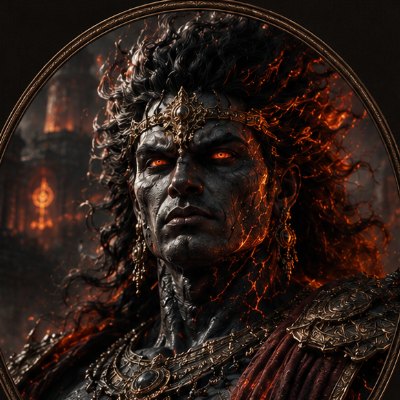
About
Vishukra — Prime Minister of Bhandasura and Master of Mystical Obstruction
Vishukra · Visukra · Vishukracharya · Manmatha Bhasma Sambhava
Vishukra was an asura who served as the prime minister of Bhandasura, the demonic emperor of the Shunyaka Nagara, and one of the principal commanders in the great war between Bhandasura's forces and the army of the goddess Lalita Tripura Sundari. His origin, like that of his brother Vishanga and his sovereign Bhandasura, lay in the ashes of Kamadeva — the god of desire burned by Shiva's third eye. The primary Lalitopakhyana text records that both Vishukra and Vishanga were born from the remnants of the ash of Manmatha that remained after Bhandasura himself had emerged. A parallel secondary account states that Bhandasura generated Vishukra specifically from his right shoulder. Vishukra is remembered in the Lalita tradition above all for his creation and deployment of the Jaya-Vighna-Yantra — a magical diagram of obstruction that he secretly installed in the Goddess's camp, temporarily incapacitating her entire army. He was killed in the course of the war. His story is preserved in the Brahmanda Purana's Lalitopakhyana and encoded in the Lalita Sahasranama.
✦ The Name
The name Vishukra is a Sanskrit compound whose components suggest divergent etymological readings. Vi is a common prefix denoting separation, distinction, or intensification. Shukra refers to brightness, purity, the planet Venus, and most prominently to Shukracharya — the divine preceptor of the asuras who is the guru of the entire demonic lineage in the broader Puranic tradition. The compound Vishukra may thus signify one who is beyond or surpassing Shukra, or one who embodies Shukra's qualities in an intensified or separate form. The role Vishukra plays in the Lalitopakhyana — serving as the strategic and occult intelligence of Bhandasura's court, analogous to the function Shukracharya performs for the asuras at large — makes the Shukracharya resonance of the name particularly apt. The Lalitopakhyana notes that Shukracharya himself arrived at the birth-site of the ash-born demons and took on the role of their guru, initiating them into daily rituals, which creates a direct narrative link between the two figures.
✦ Lineage
- Origin: The ashes of Kamadeva (Manmatha). The primary Lalitopakhyana text states that Vishukra and Vishanga arose from the remnants of Manmatha's ash after Bhandasura had emerged. A secondary account attributes his emergence specifically to Bhandasura's right shoulder.
- Brother: Vishanga — fellow asura born from the same ash, appointed as military commander of Bhandasura's forces.
- Sovereign: Bhandasura — the asura emperor for whom Vishukra served as prime minister and chief strategic adviser.
- Sister (by extension of the lineage): Dhumini — created by Bhandasura from his heart; related to Vishukra through their shared service to and origin connection with Bhandasura.
✦ Role in the War
Vishukra's defining contribution to the war against Lalita was neither martial nor straightforwardly military but occult. After Bala Tripurasundari had killed all thirty of Bhandasura's sons and the war had swung decisively in the goddess's favour, Vishukra — described as having been driven to frenzy by grief and desperation — devised and created the Jaya-Vighna-Yantra, a magical diagram of obstruction intended to halt the goddess's campaign entirely. He worshipped this yantra with elaborate nocturnal rituals and then secretly installed it within the camp of Lalita's army. The yantra worked with devastating effectiveness: the entire Shakti Sena was immediately afflicted with eight specific incapacitations — lassitude, meanness, depression, slumber, asthenia, forgetfulness, inattention, and indifference. Lalita's warriors abandoned their weapons; her army ceased to function. Only Lalita herself, Bala Tripurasundari, Mahakameshvara (Shiva in his aspect as Lalita's consort), Matangi, and Varahi remained unaffected.
Lalita smiled at the situation and directed her gaze at Mahakameshvara, from whose combined attention Mahaganesha manifested — the elephant-headed deity in a ten-armed form accompanied by the goddesses Siddhi and Lakshmi. Mahaganesha entered the goddess's camp, located the hidden Jaya-Vighna-Yantra, and destroyed it — in one account by crushing it with his powerful teeth and scattering the powder — thereby neutralising its effect and restoring the Shakti army to full capacity. The army then pressed forward against Vishukra's forces.
Vishukra also deployed a Tarsha-Astra — a weapon inducing intense thirst upon the enemy forces. The goddess's commander Dandanatha countered this by calling upon the liquor sea carried within her chariot to quench her army's thirst, neutralising the weapon's effect. Vishukra's army of thirty akshauhinis was subsequently destroyed by Mahaganesha's forces.
✦ Death
The sources present a textual variant on the precise circumstances of Vishukra's death. The HandWiki account states that Vishukra was killed by Varahi — the goddess who served as the military commander of Lalita's army. TheAum account states that Dandini — another name for Varahi/Dandanatha — killed Vishukra, while Manthrini (Matangi) killed Vishanga. The Scribd account of the Lalitopakhyana states that Vishukra was killed by Mantrini's Brahmasirashtra weapon. The primary narrative sequence across sources agrees that Vishukra was killed after his yantra was destroyed and his forces routed, and that his death preceded Bhandasura's final direct confrontation with Lalita.
✦ Significance in the Sri Vidya Tradition
The episode of the Jaya-Vighna-Yantra is theologically significant within the Sri Vidya tradition because it provides the narrative occasion for the first appearance of Mahaganesha in his ten-armed form — the same Ganesha who is subsequently granted the boon by Lalita that he shall be worshipped first among the devas. Vishukra's act of deploying the obstruction yantra thus inadvertently produced the theophany that established Ganesha's primacy in the worship order of the Sri Vidya tradition. This inversion — a demonic act of obstruction producing a divine blessing for all subsequent worship — is a characteristically Puranic structural element, and Vishukra's role in it gives him an importance within the tradition that exceeds his purely military narrative.
✦ References
Primary Sources
- Brahmanda Purana, Lalitopakhyana, Chapters 21–30 — The primary source for Vishukra's origin from Manmatha's ash, his role as prime minister, his creation and deployment of the Jaya-Vighna-Yantra, his Tarsha-Astra, and his death.
- Lalita Sahasranama — Encodes the war's events, including the battle against Bhandasura's host, within which Vishukra's role is implicitly present.
Modern and Secondary Reference Works
- HandWiki — Bhandasura article (handwiki.org/wiki/Biology:Bhandasura) — Confirms Vishukra's death at Varahi's hands and describes the Jaya-Vighna-Yantra episode and its resolution by Mahaganesha.
- Kameshvari Ma, Medium — Ganapati in Shri Vidya (medium.com) — Provides the most detailed account of the Jaya-Vighna-Yantra episode including the eight specific incapacitations of the Shakti army, Ganesha's manifestation from the goddess's smile, and the theological significance for the Sri Vidya tradition.
- Scribd — LalitOpakhyana Through Lalitha Sahasranama (Glimpses) (scribd.com) — Records that Vishukra deployed the Tarsha-Astra and was killed by Mantrini's Brahmasirashtra; provides the detail on Dandanatha countering the thirst weapon with the liquor sea.
- TheAum — Bhandasura dictionary entry (theaum.org) — Confirms that Dandini killed Vishukra and Manthrini killed Vishanga; provides the sequence of Vishukra's military actions after the deaths of Bhandasura's sons.
- Lalitopakhyana Synopsis (srilalithatripurasundari.wordpress.com) — Confirms Vishukra born from the ash of Manmatha; records his role as the senior military figure after Bhandasura.
- Vedadhara / Ramaswamy Sastry — Sree Lalitopakhyanam (ramaswamysastry.blogspot.com) — Records that Vishukra was created from Bhandasura's right shoulder; provides the account of his thirty-akshauhini army's destruction by Ganesha's forces.