
About
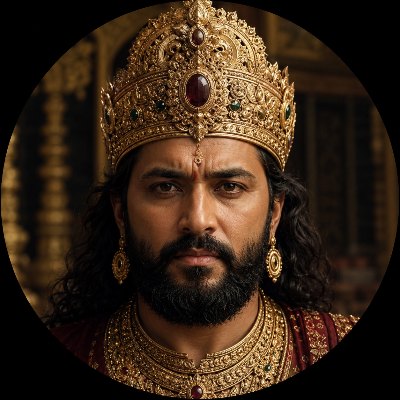
Marutta — Universal Emperor of the Dishta Line and Performer of the Most Celebrated Sacrifice in the Puranic Tradition
Marutta · Marut · Avikshita · Chakravarti · Suryavanshi
Marutta is the most celebrated king of the Dishta sub-line of the solar dynasty and one of the most distinguished emperors in the entire Puranic genealogical tradition. He is recorded in the Bhagavata Purana, the Vishnu Purana, the Vayu Purana, the Markandeya Purana, the Mahabharata, and the Aitareya Brahmana as the son of Avikshit and the father of Narishyanta, the eldest of his eighteen sons. Avikshit was himself the son of Karandhama, who was the son of Khaninetra, descending through the successive kings of the Dishta line from Nabhaga — the son of Dishta and grandson of Vaivasvata Manu, the seventh Manu and progenitor of the current human race. Marutta is celebrated above all for the extraordinary sacrifice he performed, for which the sage Samvarta son of Angiras served as the officiating priest. This sacrifice is described as unparalleled: all its implements and utensils were of pure gold, Indra was inebriated with the Soma libations, the Marut gods served food, and the entire assembly of gods attended as guests. The Markandeya Purana devotes four full cantos to his exploits, and the Mahabharata's Ashvamedha Parva preserves an independent narrative of his search for a suitable priest and his eventual engagement of Samvarta. He is described as a universal monarch whose dominion extended over the seven continents, whose power surpassed even that of Indra in sacrificial glory, and who reigned for eighty-five thousand years according to the Markandeya Purana's reckoning. After relinquishing his throne and retiring to the forest he was killed by Vapushmat, a king who had harboured enmity since the time of his son Narishyanta's reign; his death in the forest was subsequently avenged by his grandson Dama.
✦ The Name
The name Marutta is connected in the Puranic tradition to the Maruts, the divine storm-wind gods of the Vedic pantheon, who are associated with Indra and with the forces of wind, storm, and atmospheric power. The Markandeya Purana records that the name was given through a paternal benediction — Avikshit, when blessing his newborn son, declared words to the effect of may the winds be thine or may the winds be propitious to thee, and the child was accordingly named Marutta. The Vishnu Purana's footnote records this etymology explicitly, citing the Markandeya Purana as its source. The name thus encodes from birth the association with wind-power and divine atmospheric force that is further reflected in the Markandeya Purana's account of the Marut gods serving food at Marutta's sacrifice. The epithet Chakravarti, meaning universal emperor or one whose wheel of sovereignty rolls unchecked, is applied to Marutta across the primary sources. The patronymic Avikshita, meaning son of Avikshit, is also used in several passages to refer to him.
✦ Lineage
- Paternal line in summary: Vivasvan the sun-god → Vaivasvata Manu → Dishta → Nabhaga (Nabhanedishta) → Bhalandana → Vatsapriti → Pramshu → Pramati → Khanitra → Cakshusha → Vivimshati → Rambha → Khaninetra → Karandhama → Avikshit → Marutta.
- Father: Avikshit — son of Karandhama and Shubhvrata; a warrior of exceptional prowess who performed a hundred horse sacrifices and was honoured by Brihaspati; whose long arc of defeat, captivity, disillusionment, paternal stratagem, forest rescue of Vaishalini, Gandharva marriage, and ultimate renunciation of the throne is the most developed individual royal narrative in the Dishta sub-line outside of Marutta's own. Avikshit relinquished the succession to Marutta rather than reign himself, consistent with the vow he had made following his battlefield disgrace. Avikshit is treated in a separate profile.
- Mother: Vaishalini — also known as Sudati Vaishalini and Bhamini; daughter of King Vishala of Vidisha; the figure whose steadfast devotion to Avikshit through years of forest austerity and divine prophecy led ultimately to her union with him in the Gandharva world and the birth of Marutta there.
- Paternal grandmother: Shubhvrata, also referred to as Veera — wife of Karandhama; the Markandeya Purana records that during Marutta's reign she sent him a message through a hermit, advising him to administer justice in response to the troubling of sages by Nagas in his realm.
- Sons: The Markandeya Purana records that Marutta had eighteen sons, of whom Narishyanta was the eldest and succeeded to the throne after Marutta's abdication and retirement to the forest. The Bhagavata Purana at Skandha IX, Chapter 2, verse 29 names the son of Marutta as Dama. The Wisdomlib entry on Marutta reconciles these two accounts by identifying Narishyanta as an intermediate king between Marutta and Dama — Marutta abdicated in favour of Narishyanta, and Narishyanta in turn abdicated in favour of Dama. The Vishnu Purana's footnote confirms this succession, noting that Dama's bride Sumana was rescued by him from rivals at a svayamvara.
✦ The Ascent to the Throne and the Early Reign
The Markandeya Purana records that after Marutta's birth in the Gandharva world, Avikshit returned with Vaishalini to Karandhama's palace and presented the infant to his father. Karandhama, now old, wished to retire to the forest and sought to install Avikshit as king, but Avikshit refused, declaring that the shame of his earlier defeat remained with him and that a man who had been unable to protect himself could not protect his subjects. Finding Avikshit immovable in his resolve, Karandhama installed Marutta directly as king. Avikshit then retired to the forest and performed austerities for a thousand years, while Vaishalini went to live at the hermitage of the sage Bhargava. Marutta grew up having mastered all the scriptures and all forms of weaponry, and upon ascending the throne established himself as a universal monarch. The Markandeya Purana describes his sovereignty as extending over the seven continents, his discus as unresisted in its course through all regions of the cosmos, and his reign as one of unparalleled prosperity in which even the earth under his protection came to rival the celestial realm of the thirty gods in splendour.
✦ The Rejection by Brihaspati and the Encounter with Narada
When Marutta resolved to perform a great sacrifice, he approached Brihaspati — the divine preceptor of the gods and son of Angiras — to serve as the officiating priest. The Mahabharata's Ashvamedha Parva records this episode in considerable narrative detail. Brihaspati refused, declaring that having served as the priest of the immortal gods he could not act as a sacrificial priest for mortal men. Marutta was deeply shaken by this rejection, interpreting Brihaspati's refusal as a sign of divine abandonment that constituted a form of contamination. While returning from Brihaspati's presence in a state of profound distress and anxiety, he encountered the divine sage Narada. Narada, perceiving Marutta's despondency, enquired about his condition and upon hearing the reason directed Marutta to seek out Samvarta, a son of the same Angiras and the brother of Brihaspati, who was wandering the earth in a renunciate state. Narada described Samvarta as a great yogin and treasure-house of austerities, noting that he could be recognised by his naked wandering.
✦ The Sacrifice of Marutta
Marutta found Samvarta and engaged him as the officiating priest for his sacrifice. The Bhagavata Purana at Skandha IX, Chapter 2 describes Samvarta as the great yogin son of Angiras who engaged Marutta in the performance of the sacrifice. The Markandeya Purana's Canto CXXIX describes the sacrifice in terms of extraordinary splendour: Marutta reigned as a universal monarch with Samvarta as his priest, was celebrated as a great sacrificer and an exceptionally generous benefactor to brahmanas, and surpassed even the king of the gods in sacrificial glory through declarations of a hundred sacrifices. The Vishnu Purana records the verse that became proverbial in the tradition — that there was never seen on earth a sacrifice equal to Marutta's, that all its implements and utensils were of gold, that Indra was intoxicated with the Soma libations, that the brahmanas were enriched with magnificent donations, and that the winds of heaven encompassed the rite as guards. The Bhagavata Purana confirms that Indra became inebriated with Soma, that the brahmanas were oversatisfied with their sacrificial gifts, that the Marut gods served food, and that the Vishvadevas — the universal gods as a collective — served as members of the sacrificial assembly. The Aitareya Brahmana, one of the oldest stratum of sources to record this tradition, preserves the verse: the Maruts were the servers and the Vishvadevas were the assembly-members at Marutta's sacrifice. The Vayu Purana adds that Brihaspati was so jealous of the splendour of the rite and so aggrieved by Samvarta's preeminence that a great quarrel arose between the two brothers. The Markandeya Purana records that Marutta's sacrifice was also troubled by the Nagas who were distressing the sages in the realm, and that his grandmother Veera sent a hermit to advise him to administer justice and secure peace for the rishis. The preparation of the sacrificial vessels is described in the Mahabharata summary as having involved thousands of golden vessels crafted on Mount Meru, and the sacrifice itself was held on a golden hill near the sacrificial ground.
✦ The Translation to Heaven and the Death in the Forest
The Vayu Purana records that at the conclusion of the sacrificial proceedings, Samvarta conducted Marutta together with his kindred and friends bodily to heaven — a remarkable account of physical translation to the divine realm as the culmination of a sacrificial act. The Vishnu Purana's footnote records this tradition, noting that Brihaspati, anticipating the consequences of such a translation for the cosmic order, became so angry at Samvarta that a major conflict arose between the brothers. Separately, the Markandeya Purana records that after his long reign Marutta abdicated the throne and retired to the forest in the vanaprastha mode. The Vishnu Purana's footnote further records that while Marutta had retired into the forest, he was killed there by Vapushmat, a king who had harboured enmity arising from an earlier episode connected with the reign of Marutta's son Narishyanta. The killing of the retired Marutta by Vapushmat was subsequently avenged by Marutta's grandson Dama, who slew Vapushmat and, in an act of fierce piety recorded in the Vishnu Purana, made the obsequial offering to his grandfather from the slain enemy's flesh, feeding the remainder to brahmanas of Rakshasa origin. These two accounts — the translation to heaven through Samvarta's sacrifice and the death in the forest at Vapushmat's hands — represent variant traditions that different Puranic sources preserve without explicit reconciliation.
✦ Textual Variants and Inconsistencies
The most significant textual inconsistency in the Marutta tradition concerns his son and successor. The Bhagavata Purana at IX.2.29 names Dama directly as the son of Marutta, while the Markandeya Purana records that Marutta had eighteen sons of whom Narishyanta was the eldest and his immediate successor, with Dama appearing as Narishyanta's son rather than Marutta's direct son. The Wisdomlib entry on Narishyanta, drawing on the Markandeya Purana, confirms that Narishyanta was Marutta's son and Dama's father. The Vishnu Purana's footnote is consistent with this three-generation sequence, describing a story about Dama that makes him the avenger of Marutta's death — which would fit better genealogically if Narishyanta intervened between them. This inconsistency is a genuine variance between the Bhagavata Purana and the Markandeya Purana rather than a scribal error, and both accounts are preserved here as the primary sources give them. A further variant concerns the manner of Marutta's departure from mortal life — the Vayu Purana's account of bodily translation to heaven through Samvarta and the Markandeya Purana's account of death in the forest at Vapushmat's hands represent two distinct traditions that are not reconciled in the available primary sources. Additionally, the Wisdomlib entry notes one tradition in which Marutta, being issueless, adopted Dushkanta of the Paurava line, making Pururava's line the continuation — this is a variant found in a separate Puranic context and is not consistent with the mainstream accounts of the Dishta line succession.
✦ Connection to the Wider Genealogy
Marutta stands as the most celebrated figure of the entire Dishta sub-line of the solar dynasty. He is the culmination of a succession running from Vaivasvata Manu through fifteen generations of kings — from Dishta through Nabhaga, Bhalandana, Vatsapriti, Pramshu, Pramati, Khanitra, Cakshusha, Vivimshati, Rambha, Khaninetra, Karandhama, and Avikshit. Through his son or grandson Dama, and through Dama's line continuing through Rajyavardhana, Sudhriti, Nara, Kevala, Vegavan, Budha, and Trinabindu, the succession reached the figure from whom one of the most theologically significant genealogical connections in the entire Puranic tradition was established: Trinabindu's daughter Ilavila became the wife of the sage Vishrava and the mother of Kubera, the lord of wealth and guardian of the northern quarter, whose divine parentage and cosmic role in the Puranic and Ramayana traditions made the Dishta sub-line, through Marutta and his descendants, a dynasty of extraordinary consequence in the broader sacred genealogical record.
✦ References
- Bhagavata Purana, Skandha IX, Chapter 2, verses 26–29: Confirms Marutta as the son of Avikshit and records the engagement of Samvarta son of Angiras as the sacrificial officiant; names Dama as Marutta's son and successor in the Dishta line.
- Vishnu Purana, Book IV, Chapter I: Records the proverbial verse on Marutta's unparalleled sacrifice with golden utensils, Indra's inebriation, and the brahmanas' enrichment; records Marutta's bodily translation to heaven via Samvarta; records the killing of the retired Marutta by Vapushmat and Dama's revenge; notes the Markandeya Purana's etymology of the name and the eighty-five thousand year reign.
- Markandeya Purana, Cantos CXXVIII–CXXXI: Primary narrative source for Marutta's exploits; records the birth and naming, Avikshit's renunciation and Marutta's ascent to the throne, the universal sovereignty, Samvarta as his priest, the splendour of the sacrifice, the Naga disturbance and Veera's message, and the subsequent succession through Narishyanta to Dama.
- Mahabharata, Ashvamedha Parva, Section VI: Preserves the narrative of Marutta's approach to Brihaspati for priestly services, Brihaspati's refusal, the encounter with Narada, and Narada's direction to seek Samvarta; provides the most detailed account of the episode preceding the sacrifice.
- Mahabharata, Shanti Parva, Chapter 29, verse 18: Cites the verse from the Aitareya Brahmana attesting that the Maruts served as food-servers and the Vishvadevas as assembly-members at Marutta's sacrifice; repeated at Drona Parva, Chapter 55, verses 43–44.
- Aitareya Brahmana, VIII.21.14: The oldest stratum of primary attestation for Marutta's sacrifice, preserving the verse about the Maruts and Vishvadevas at the sacrificial assembly; also attested at Shatapatha Brahmana XIII.5.4.6.
- Vayu Purana, Chapter 65, verse 101: Records Samvarta's role as Marutta's sacrificial priest and the tradition of Marutta being taken bodily to heaven with his kindred and friends through the power of the sacrifice.
- Wisdomlib, definitions of Marutta, Samvarta, and Narishyanta: Secondary references compiling primary source citations and cross-referencing the variant genealogical accounts of Marutta's sons across the Bhagavata Purana and Markandeya Purana.
- Markandeya Purana blog (markandeyapurana.blogspot.com), Marut Ascends the Throne entry: Translation of the relevant Markandeya Purana passage consulted for the narrative of Avikshit's final renunciation, Marutta's installation as king, and Avikshit's retirement to the forest.
- Vettam Mani, Puranic Encyclopaedia: Secondary reference compiling the Puranic entries on Marutta with citations across primary sources; notes the variant tradition of adoption from the Paurava line.
- V. S. Agrawala, Matsya Purana — A Study: Modern secondary work on solar dynasty genealogies; consulted for contextualisation of Marutta's position as the culminating figure of the Dishta sub-line and his connections to the broader solar dynastic tradition.