
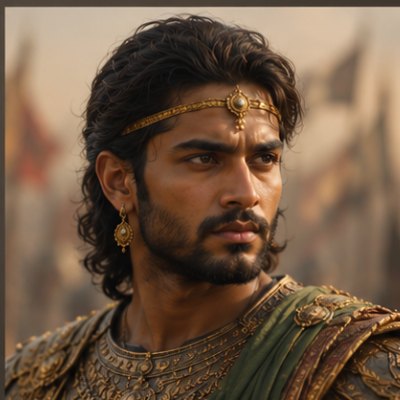
About
Dhrishtaketu — Panchala Prince, Son of Dhrishtadyumna, and Warrior of the Kurukshetra War
Dhrishtaketu · Dhrishtadyumnaja · Parshata · Panchalya
Dhrishtaketu was a prince of the Panchala kingdom and one of the four warrior sons of Dhrishtadyumna — the fire-born prince and commander-in-chief of the Pandava army — and a grandson of King Drupada of Southern Panchala. He fought in the Pandava forces during the Kurukshetra war and is recorded in the primary texts as having fallen in battle. His name is shared by at least one other significant figure in the Mahabharata — a king of Chedi — and care is required in distinguishing the two. His lineage, military role, and death are recorded in the Mahabharata, principally in the Drona Parva and the Karna Parva, though the primary texts are limited in the individual narrative detail they preserve about him.
✦ The Name
The name Dhrishtaketu is a compound of dhrishta, meaning bold or fearless, and ketu, meaning banner, sign, or distinguishing mark. The name thus carries the sense of one whose banner is boldness, or one who is marked out by his fearlessness — a name in keeping with the martial character of the Panchala royal line. The clan epithet Parshata, deriving from the ancestor Prishat, is shared by all male members of the Panchala royal family of this generation.
✦ Lineage
- Father: Dhrishtadyumna, prince of Panchala and commander-in-chief of the Pandava army, born from the sacred fire of Drupada's Putrakameshti Yajna and destined from birth to slay Drona.
- Paternal grandfather: Drupada, king of Southern Panchala, whose enmity with Drona drove the sacrifice that produced Dhrishtadyumna and Draupadi.
- Paternal aunt: Draupadi, also called Krishnaa and Panchali, twin sister of Dhrishtadyumna, who became the common wife of the five Pandava brothers — Yudhishthira, Bhima, Arjuna, Nakula, and Sahadeva.
- Paternal uncles: Shikhandi, a Panchala prince who fought at Kurukshetra and brought about the fall of Bhishma; and Satyajit, a Panchala warrior on the Pandava side.
- Brothers: Kshatradharman, Kshatravarman, and Kshatranjaya — all of whom fought and died in the Kurukshetra war, the first three falling to Drona.
✦ Military Training
Like his brothers, Dhrishtaketu is associated in the Drona Parva with the period of pre-war martial training in which the sons of Dhrishtadyumna observed strict ascetic discipline and studied advanced weaponry. The text connects this training with Bhishma, the grand-patriarch of the Kuru line and the foremost warrior of his generation, indicating that these Panchala princes received instruction of the highest calibre before taking the field at Kurukshetra.
✦ Role in the Kurukshetra War and Death
Dhrishtaketu served as a chariot-warrior in the Pandava army during the Kurukshetra war. Unlike his three brothers, who are all recorded as having been killed by Drona during the period of Drona's command, the textual record concerning Dhrishtaketu's death points toward a different antagonist. The Karna Parva, which covers the seventeenth day of battle fought under the command of Karna as the Kaurava general, contains references to engagements in which Dhrishtaketu fell in combat with Karna. Karna — the eldest son of Kunti and thus a half-brother of the Pandavas, fighting on the Kaurava side — was among the most formidable warriors of the war and is the named slayer of numerous Pandava champions during his day of command. The specific circumstances of the duel between Dhrishtaketu and Karna are not elaborated in extensive detail in the primary text, but the encounter is recorded as a direct combat engagement.
✦ Textual Variants and Inconsistencies
The name Dhrishtaketu is borne by more than one figure in the Mahabharata, and the distinction between them is significant. The most prominent other bearer of this name is Dhrishtaketu of Chedi — the son of Shishupala, king of the Chedi kingdom, who fought on the Pandava side in the Kurukshetra war. Shishupala was himself killed by Krishna before the war began, and his son Dhrishtaketu of Chedi subsequently aligned with the Pandavas and commanded one of their akshauhinis. This Dhrishtaketu of Chedi is a distinct individual from Dhrishtaketu the son of Dhrishtadyumna, and the two must not be conflated. Some references in secondary literature and in less careful recensions of the text may blur this distinction, but the Critical Edition and the Puranic Encyclopaedia treat them as separate persons.
Additionally, some manuscript traditions and regional retellings vary on whether Dhrishtaketu the son of Dhrishtadyumna was killed by Karna in the Karna Parva or during an earlier phase of the war. The Drona Parva lists him among the sons of Dhrishtadyumna in a context that groups them with warriors who fell during Drona's command, while other passages associate his death with Karna. These variant placements reflect the complexity of the Mahabharata's day-by-day casualty records across different recensions, and the Critical Edition does not fully harmonise them.
✦ References
- Primary Sources
- Mahabharata, Drona Parva, Section 10 (Critical Edition, BORI): Names Dhrishtaketu among the sons of Dhrishtadyumna and records his participation in the war alongside his brothers.
- Mahabharata, Karna Parva (Critical Edition, BORI): Records engagements on the seventeenth day of battle in which Dhrishtaketu is named among the warriors who fell in combat with Karna.
- Mahabharata, Adi Parva (Critical Edition, BORI): Provides the foundational narrative of the Panchala royal lineage within which Dhrishtaketu's family position is established.
- Secondary Sources
- Vettam Mani, Puranic Encyclopaedia (Motilal Banarsidass, 1975): Distinguishes between Dhrishtaketu son of Dhrishtadyumna and Dhrishtaketu of Chedi son of Shishupala, and records the former's participation and death in the Kurukshetra war.
- Alf Hiltebeitel, The Ritual of Battle: Krishna in the Mahabharata (Cornell University Press, 1976): Provides context for the generational structure of the war's casualties and the narrative function of the younger Panchala princes within the epic's larger framework.