
About
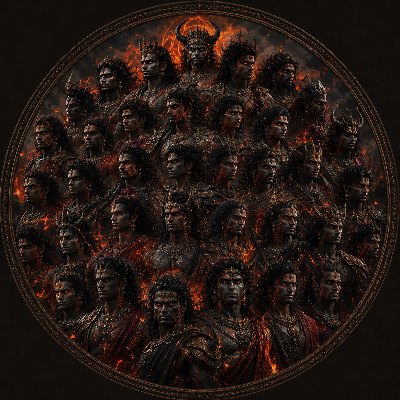
The Thirty Sons of Bhandasura — Commanders of the Asura Army, Slain by Bala Tripurasundari
Bhandasura Putras · Bhandaputras · Chaturbahu to Upamaya
The thirty sons of Bhandasura were the asura commanders born to the four wives of Bhandasura, the demonic emperor of Shunyaka Nagara. All thirty grew into powerful battlefield generals and formed a significant portion of the military command structure of their father's three-hundred-akshauhini army in the war against the goddess Lalita Tripura Sundari. All thirty were killed in a single dramatic engagement by Bala Tripurasundari — the nine-year-old daughter of the goddess Lalita — an event of such theological significance that it is commemorated in the seventy-fourth name of the Lalita Sahasranama, Bhandaputra-vadhodhyukta-bala-vikrama-nandhita, meaning she who is delighted by the heroic deeds of Bala in slaying the sons of Bhandasura. The Lalita Sahasranama commentary identifies the thirty sons by the range of their names, from Chaturbahu to Upamaya. Their collective destruction marked the beginning of the decisive phase of the war and precipitated the frenzied desperation of Vishukra that led to the Jaya-Vighna-Yantra episode.
✦ Lineage
- Father: Bhandasura — asura emperor of Shunyaka Nagara, generated from the ashes of Kamadeva, sovereign of the three worlds for sixty thousand years.
- Mothers: Four wives of Bhandasura — unnamed in the primary text as individually identified beings, collectively the mothers of all thirty sons.
- Paternal uncles: Vishukra and Vishanga — generated from the ash of Manmatha, serving as prime minister and military commander of Bhandasura's forces.
- Paternal aunt: Dhumini — generated by Bhandasura from his heart.
- Cousins: The ten sons of Dhumini, who participated in the later phases of the war.
- Sister: Rashmiprabha — the one daughter of Bhandasura, attested in secondary compilations.
✦ Identity and Names
The Lalita Sahasranama commentary identifies the thirty sons collectively by the first and last names in the sequence — Chaturbahu and Upamaya — with the twenty-eight sons between them named in the primary source but not individually elaborated in the sources consulted for this profile. Chaturbahu — meaning four-armed — and Upamaya — meaning one who is comparable or who has attained a comparison — are the outer markers of the complete list. The individual identities, specialisations, and combat roles of the sons between these two are not elaborated in the secondary sources available, though their collective designation as devastating battlefield generals is consistent across all accounts. One secondary source records the number as three hundred rather than thirty; the Lalita Sahasranama commentary, which names the sons and is the most authoritative secondary source on this point, gives the number as thirty.
✦ The Death of All Thirty by Bala Tripurasundari
The destruction of Bhandasura's thirty sons was accomplished by Bala Tripurasundari, the nine-year-old daughter of Lalita — sometimes understood as the child-form of the goddess herself. The Lalitopakhyana records that despite Lalita's maternal caution — the goddess initially advised her daughter not to enter the battlefield — Bala prevailed upon her mother and insisted on participating. She then engaged all thirty sons of Bhandasura and destroyed them in a single encounter. This act, accomplished by a nine-year-old girl against thirty battlefield commanders, is presented in the tradition as a demonstration of the supreme feminine power even in its most tender and youthful form.
The deaths of the thirty sons had immediate strategic and psychological consequences. Bhandasura lost his entire next generation of military commanders in one engagement. Vishukra, the prime minister, was driven to extremity by the loss and in his desperation devised the Jaya-Vighna-Yantra — his most potent and dangerous occult weapon — as a direct response to the deaths of his nephews. The thirty sons' destruction thus functions as the pivot of the war's narrative arc, the moment at which the goddess's campaign moved from conventional military engagement to a cosmic confrontation that forced Bhandasura to deploy his most extreme resources and ultimately to face Lalita himself.
✦ Significance in the Sri Vidya Tradition
The commemoration of the thirty sons' destruction in the Lalita Sahasranama — specifically in the name Bhandaputra-vadhodhyukta-bala-vikrama-nandhita — ensures that this episode is ritually recalled in every recitation of the thousand names of the Goddess. The association of this name with Bala Tripurasundari carries additional significance in the Sri Vidya initiation tradition, where the Bala mantra is consistently the first mantra given to initiates. The tradition holds that siddhi in the Bala mantra opens the door to the higher attainments of Sri Vidya practice. The death of the Bhandaputras by Bala is thus not only a narrative event but a foundation of the Sri Vidya initiatory sequence — the first victory of the goddess's youngest and smallest form establishing the power that all subsequent practice invokes.
✦ Textual Variant: Thirty or Three Hundred Sons
A variant in one secondary source — the Medium account of the Ganapati episode — gives the number of sons killed as three hundred rather than thirty. The Lalita Sahasranama commentary, which names the sons from Chaturbahu to Upamaya and is drawn directly from the primary scriptural source, gives the number as thirty. The number thirty is the dominant and most consistently attested figure across the Lalitopakhyana secondary sources consulted and is used throughout this profile.
✦ References
Primary Sources
- Brahmanda Purana, Lalitopakhyana, Chapters 21–30 — Primary source for the birth of the thirty sons, their role as battlefield generals, and their killing by Bala Tripurasundari.
- Lalita Sahasranama, Name 74: Bhandaputra-vadhodhyukta-bala-vikrama-nandhita — The principal scriptural commemoration of the thirty sons' deaths, embedded within the thousand names of the Goddess; the commentary on this name identifies the sons from Chaturbahu to Upamaya and confirms the number as thirty.
Modern and Secondary Reference Works
- Srilalithatripurasundari.wordpress.com — Commentary on Bhandaputra-vadhodhyuktha-bala-vikrama-nandhita — Provides the fullest available secondary account of the thirty sons, naming them from Chaturbahu to Upamaya, confirming that Bala prevailed upon her mother to fight despite Lalita's reluctance, and describing all thirty sons' destruction in a single encounter.
- HandWiki — Bhandasura article (handwiki.org/wiki/Biology:Bhandasura) — Confirms that Bala Tripurasundari killed all thirty of Bhandasura's sons as a discrete war event.
- TheAum — Bhandasura dictionary entry (theaum.org) — Confirms the thirty sons and records that Bala successfully killed them.
- Kameshvari Ma, Medium — Ganapati in Shri Vidya (medium.com) — Provides the variant number of three hundred sons; this source's account is noted as a textual variant against the thirty attested in the Lalita Sahasranama commentary.
- Vedadhara / Ramaswamy Sastry — Sree Lalitopakhyanam (ramaswamysastry.blogspot.com) — Confirms that Dhumini's ten sons joined the battle in the phase following the deaths of Bhandasura's sons, providing the timeline context for the thirty sons' deaths.