
About
Avikshit — King of the Dishta Line, Son of Karandhama, and Father of Marutta
Avikshit · Aviksit · Avikshita · Avikshitasya · Suryavanshi
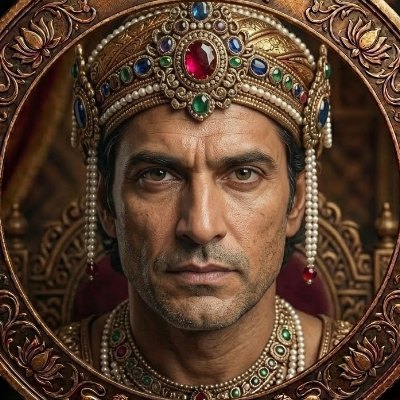
Avikshit is a king of the Dishta sub-line of the solar dynasty, recorded in the Bhagavata Purana, the Vishnu Purana, and the Markandeya Purana as the son of Karandhama and the father of Marutta, the celebrated emperor whose sacrifice is described across multiple primary sources as the most magnificent ever performed. Karandhama was himself the son of Khaninetra, who was the son of Rambha, descending through the successive kings of the Dishta line from Nabhaga — the son of Dishta and grandson of Vaivasvata Manu, the seventh Manu and progenitor of the current human race. Avikshit is the most narratively prominent figure of the Dishta line after Marutta himself. The Markandeya Purana devotes six full cantos to his exploits — Cantos CXXII through CXXVII — a scope of narrative treatment second only to Marutta's four cantos within this segment of the text. He is described as a warrior of exceptional prowess, a performer of a hundred horse sacrifices honoured even by the divine preceptor Brihaspati, a king who married eight wives, and a figure whose deep disillusionment following a battlefield defeat and his subsequent elaborate path back to marriage and fatherhood constitute one of the most psychologically developed royal narratives in the Markandeya Purana. The Vishnu Purana confirms the core arc of his story in its compressed account, noting his capture by confederate kings, his rescue by Karandhama, his vow of renunciation, and his ultimate relinquishment of the kingdom to his son Marutta.
✦ The Name
The name Avikshit is of Sanskrit formation. The prefix a carries a negating or intensifying sense, and vikshita derives from a root meaning seen, examined, perceived, or looked upon. The compound thus carries the sense of one not to be slighted, one who is beyond ordinary perception, or one who cannot be disregarded. Some interpretations render it as one who is unseen or unexamined, implying a quality of subtlety or inwardness. The name is not common in the broader Puranic corpus, making disambiguation from other figures straightforward in this instance. The dynastic epithets Suryavanshi, meaning one of the solar race, apply to Avikshit by virtue of his descent from Vaivasvata Manu through Dishta and the successive kings of the line.
✦ Lineage
- Paternal line in summary: Vivasvan the sun-god → Vaivasvata Manu → Dishta → Nabhaga (Nabhanedishta) → Bhalandana → Vatsapriti → Pramshu → Pramati → Khanitra → Cakshusha → Vivimshati → Rambha → Khaninetra → Karandhama → Avikshit.
- Father: Karandhama — son of Khaninetra; originally named Balasva; acquired the name Karandhama through a supernatural military victory; celebrated as a just and compassionate king; husband of Shubhvrata, also referred to as Veera, daughter of King Veerachandra; known for his rescue of Avikshit from captivity following the prince's defeat at the svayamvara of Vaishalini. Karandhama is treated in a separate profile.
- Mother: Shubhvrata, also referred to as Veera — daughter of King Veerachandra or Viryachandra; known for her steadfast composure at the news of Avikshit's defeat, her declaration that her son had fought honourably against an adharmic coalition, and her performance of the Kimichhak Vrata, a demanding ritual observance whose conditions were ultimately used by Karandhama to extract from Avikshit a promise to marry and produce an heir.
- Wives: Seven wives obtained through separate svayamvaras — Vara, daughter of Hemadharma; Gauri, daughter of Sudeva; Subhadra, daughter of Bali; Leelavati, daughter of Veera; Nibha, daughter of Veerabhadra; Manyavati, daughter of Bhima; and Kumudvati, daughter of Dambha. An eighth wife, Vaishalini — also known as Sudati Vaishalini and Bhamini — daughter of King Vishala of Vidisha, who is the central figure in the most dramatic episode of Avikshit's narrative. The Wisdomlib entry on Avikshit also names Mudati as a wife offered by King Vishala after Avikshit's rescue; the Markandeya Purana's blog translation identifies Mudati and Vaishalini as the same person — the princess of Vishala who was the object of contention at the svayamvara.
- Son: Marutta — the celebrated emperor of the Dishta line, whose sacrifice conducted by the sage Samvarta son of Angiras is described across the Bhagavata Purana, Vishnu Purana, Vayu Purana, Markandeya Purana, Mahabharata, and Aitareya Brahmana as the most magnificent ever performed; his utensils were of gold, Indra was inebriated with Soma, and the Marut gods served food at the sacrifice. Marutta is treated in a separate profile.
✦ Education and Early Distinctions
The Markandeya Purana records that at Avikshit's birth the palace astrologers examined the planetary positions and declared them exceptionally auspicious, predicting that the prince would grow to be a great warrior king of remarkable qualities. The prince was sent to the hermitage of the son of the sage Kanva — a celebrated centre of Vedic learning in the tradition — where he received comprehensive education in the Vedas, in martial sciences, and in the full range of weapons and their deployment. He emerged from this education described as handsome, intelligent, brave, and compassionate, a combination of qualities consistent with the ideal Kshatriya hero of the Puranic tradition. Following his education, Avikshit proceeded to attend and win at multiple svayamvaras, taking seven princesses as wives in succession through this means. The Wisdomlib encyclopaedia entry notes that he was honoured even by Brihaspati, the divine preceptor of the gods, having performed a hundred horse sacrifices — an extraordinary ritual achievement placing him among the most accomplished sacrificers of the solar tradition.
✦ The Svayamvara of Vaishalini, the Defeat, and the Captivity
The pivotal episode of Avikshit's narrative begins with his attendance at the svayamvara of Vaishalini — also called Sudati Vaishalini and Bhamini — the daughter of King Vishala of the city of Vidisha. When Vaishalini declined to choose Avikshit at the ceremony, he forcibly abducted her, defeating the assembled kings who attempted to stop him. The defeated kings were deeply shamed by the fact that one man had overpowered all of them simultaneously. Setting aside their individual rivalries, they formed a coalition and launched a combined assault on Avikshit. A ferocious battle ensued. Avikshit fought alone against the combined armies of many kings and princes, killing large numbers of them, but was eventually overwhelmed by sheer numbers, severely wounded, and made captive. Both Avikshit and Vaishalini were brought to King Vishala at Vidisha. Vishala instructed Vaishalini to select another husband from among the assembled kings, but she refused to choose any of them. The astrologers counselled the king that the present time was inauspicious for the wedding and that the marriage should be postponed. Avikshit was held in captivity while Vaishalini, unwilling to accept any other husband, maintained her determination to marry only Avikshit.
✦ The Rescue by Karandhama and the Vow of Renunciation
When news of his son's defeat and captivity reached Karandhama, he consulted his advisors and resolved to march on Vishala with his full army. A terrible battle lasting three days was fought. Karandhama prevailed entirely. Avikshit was freed from captivity and King Vishala, acknowledging defeat, came to Karandhama bearing gifts and offered his daughter's hand to Avikshit. However, Avikshit was seized by profound disillusionment at his defeat and captivity. He declared that he could never accept a woman who had witnessed his humiliation as his wife, and that he had resolved to renounce the world entirely. King Vishala pressed Avikshit to reconsider; Vaishalini herself declared that she would accept only Avikshit as her husband, reasoning that he had in fact fought honourably and had been overcome only through the adharmic combined assault of many kings against one — a manner of war not sanctioned by the code of righteous battle. Avikshit refused all entreaties, including his father Karandhama's own request. Karandhama, seeing that argument was futile, returned to his kingdom. Avikshit accompanied his father home but maintained his vow of celibacy and his refusal to accept the succession. Vaishalini, committed to Avikshit alone, retired to the forest and undertook three months of severe austerity, growing extremely weak in the process. When the gods sent an envoy to persuade her to cease her penance, the envoy informed her that she would become the mother of a mighty universal emperor — a prophecy whose fulfilment required that Avikshit be brought to marriage by another means.
✦ The Kimichhak Vrata and the Promise Extracted by Karandhama
The Markandeya Purana records an ingenious stratagem employed by Karandhama to overcome his son's vow of celibacy. Veera, Karandhama's wife and Avikshit's mother, undertook the performance of a demanding ritual observance called the Kimichhak Vrata. This particular vow had an unusual and binding characteristic: any request made during the course of its performance had to be fulfilled without exception, as failure to do so would forfeit all the spiritual merit accumulated through the entire austerity. While Veera was engaged in this vow, Karandhama seized his opportunity. Avikshit arrived at the scene where his mother's ritual was being conducted. When the attending priest announced, in accordance with the vow's requirements, that any demand made at that moment would be fulfilled, Avikshit gave his assurance before anyone else could speak. Karandhama, who had been waiting for precisely this moment, immediately stated his demand: that he wished for a grandson, which was impossible unless Avikshit agreed to marry. Avikshit, bound by the word he had already given in the context of his mother's sacred vow, attempted to explain the impossibility, but ultimately relented rather than dishonour his commitment. He agreed to marry and to produce an heir.
✦ The Rescue of Vaishalini and the Gandharva Marriage
Having given his promise, Avikshit subsequently went out on a hunting expedition. During this hunt he encountered Vaishalini — who had by this time, through the merit of her austerity, been transformed in some versions of the narrative into a figure associated with the Gandharva realm — beset by a demon. Avikshit slew the demon and rescued her. This encounter, in which Avikshit came to her aid in the forest, satisfied the divine promise that had been given to Vaishalini during her penance that she would become a mother without choosing any husband other than Avikshit. The Markandeya Purana records that Avikshit and Vaishalini were united in marriage in the Gandharva world, and that their son Marutta was born there. Avikshit subsequently returned from the Gandharva realm but, in keeping with the vow he had made after his original defeat, relinquished the royal succession in favour of Marutta. The Vishnu Purana confirms this sequence in compressed form, noting that Avikshit and the princess were ultimately espoused but that Avikshit kept his other vow and relinquished his succession in favour of his son, who succeeded to the kingdoms of both Karandhama and Vishala.
✦ Textual Variants and Inconsistencies
The Bhagavata Purana and Vishnu Purana name Avikshit as the son of Karandhama and the father of Marutta without providing the full narrative detail preserved in the Markandeya Purana. The Vishnu Purana's compressed account at Book IV, Chapter I confirms the core arc — capture by confederate rivals, rescue by Karandhama, ultimate union with the princess, and relinquishment of succession — and is consistent with the Markandeya Purana's more expanded account. The Wisdomlib entry notes seven named wives and Vaishalini as the eighth, while the Markandeya Purana blog translation renders Vaishalini and Mudati as the same person with different names — Sudati Vaishalini and Mudati both referring to the princess of Vishala. This is a naming variant within the same source tradition rather than a contradiction between independent primary texts. The Markandeya Purana's Canto CXXIX footnote notes that Marutta's father is referred to as Avikshit in some manuscript traditions and as Avikshita in others, and that the Poona edition reads Avaikshatasya — these are orthographic variants of the same name rather than references to distinct figures.
✦ Connection to the Wider Genealogy
Avikshit stands two generations before the most celebrated figure of the entire Dishta sub-line. Through his son Marutta, and through Marutta's succession of descendants — Dama, Rajyavardhana, Sudhriti, Nara, Kevala, Vegavan, Budha, and Trinabindu — the line ultimately connected to the parentage of Kubera, the lord of wealth, whose mother Ilavila was the daughter of Trinabindu and wife of the sage Vishrava. Avikshit succeeded to the kingdoms of both his father Karandhama and of Vishala, the father of Vaishalini, making him the ruler of an expanded territory that Marutta then inherited. The Markandeya Purana presents Avikshit as a figure of genuine psychological complexity — a warrior of outstanding achievement whose profound disillusionment at a single defeat led to a long arc of renunciation, divine intervention, an elaborate parental stratagem, a forest rescue, and ultimately the production of the son who would become the greatest sacrificer of his age. His narrative constitutes the most developed individual royal biography in the Dishta sub-line outside of Marutta's own.
✦ References
- Bhagavata Purana, Skandha IX, Chapter 2, verse 26: Names Avikshit as the son of Karandhama and confirms his position in the Dishta succession leading to Marutta.
- Vishnu Purana, Book IV, Chapter I: Confirms Avikshit in the Dishta succession; records in compressed form his capture by confederate rivals, rescue by Karandhama, vow never to marry or reign, ultimate union with the princess of Vishala, and relinquishment of succession to Marutta who inherited the kingdoms of both Karandhama and Vishala.
- Markandeya Purana, Cantos CXXII–CXXVII: Primary narrative source for the full arc of Avikshit's exploits; devotes six cantos to his birth with auspicious omens, education at Kanva's hermitage, seven marriages by svayamvara, the abduction and svayamvara episode with Vaishalini, the battle and defeat, the captivity, Karandhama's rescue, the vow of renunciation, Vaishalini's forest austerity and the divine prophecy, the Kimichhak Vrata stratagem, the forest rescue of Vaishalini from a demon, the Gandharva marriage, the birth of Marutta, and the relinquishment of the kingdom.
- Wisdomlib, definition of Avikshit: Secondary reference drawing on the Markandeya Purana and Bhagavata Purana; confirms the seven named wives, the hundred horse sacrifices, and the honour from Brihaspati; provides cross-references to primary passages.
- Markandeya Purana blog (markandeyapurana.blogspot.com), entries on Aveekshit: Translations of the relevant Markandeya Purana cantos consulted for narrative details of the Kimichhak Vrata episode, the defeat and captivity, the liberation and disenchantment, and the promise to marry.
- Vettam Mani, Puranic Encyclopaedia: Secondary reference compiling the Puranic entries on Avikshit with citations to primary sources and notes on his position in the Dishta sub-line.
- V. S. Agrawala, Matsya Purana — A Study: Modern secondary work on solar dynasty genealogies; consulted for contextualisation of Avikshit's position within the broader Dishta sub-line and the variant name-forms across primary sources.