
About
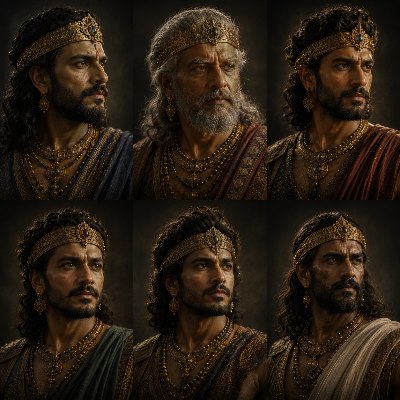
The Intermediate Kings of the Dishta Line — Dama to Budha
Dama · Rajyavardhana · Sudhriti · Nara · Kevala · Bandhumat · Vegavat · Budha
This profile covers eight successive kings of the Solar dynasty (Suryavamsha), belonging to the Dishta branch of the line descending from Vaivasvata Manu, the progenitor of the present age. These kings form the genealogical bridge between Narishyanta — the eldest son of the celebrated emperor Marutta, himself descended through Dishta, Nabhanedishta, Bhalandana, Vatsapriti, Pramshu, Pramati, Khanitra, Cakshusha, Vivimshati, Rambha, Khaninetra, Karandhama, and Avikshit — and the significant king Trinabindu, whose daughter Manini married the sage Pulastya and became the mother of the great sage Vishrava. The eight kings are attested in the genealogical lists of the Bhagavata Purana, the Vishnu Purana, and the Harivamsa, but the primary sources record no narrative episodes, epithets, or individual deeds for any of them beyond their position in the dynastic sequence. This profile therefore presents them collectively, as the primary sources themselves treat them — as a succession of royal names linking two better-documented reigns.
✦ The Dynastic Sequence
- Dama: Son of Narishyanta, himself the eldest son of Marutta. Dama inherited the kingdom of the Dishta Solar line from his father and passed it to his son Rajyavardhana. No narrative episodes are recorded for him in any primary source.
- Rajyavardhana: Son of Dama. His name carries the meaning of one who augments or expands the kingdom — rajya meaning kingdom and vardhana meaning growth or increase — though no specific campaigns or territorial expansions are attributed to him in the texts. He was succeeded by his son Sudhriti.
- Sudhriti: Son of Rajyavardhana. His name suggests firm or well-established resolve — su meaning good or well, and dhriti meaning steadiness or resolution. No individual episodes are recorded. He was succeeded by his son Nara.
- Nara: Son of Sudhriti. The name Nara is among the most common in Sanskrit nomenclature, meaning man or human being, and appears frequently across Puranic king-lists. No narrative material specific to this figure is recorded. He was succeeded by his son Kevala.
- Kevala: Son of Nara. His name carries the meaning of alone, pure, or absolute in Sanskrit. No individual narrative episodes are recorded in the primary sources. He was succeeded by his son Bandhumat.
- Bandhumat: Son of Kevala. His name means one who possesses kinsmen or one endowed with relations — bandhu meaning kinsman or friend, and mat indicating possession. No narrative material is recorded beyond his position in the sequence. He was succeeded by his son Vegavat.
- Vegavat: Son of Bandhumat. His name means one possessed of speed or swiftness — vega meaning speed or force, and vat indicating possession. No individual episodes are recorded in the primary sources. He was succeeded by his son Budha.
- Budha: Son of Vegavat. His name means the wise one or the awakened one in Sanskrit — the same root as the epithet of the Buddha, though this figure is entirely distinct from any Buddhist tradition and belongs purely to the Solar dynastic sequence of the Puranas. No narrative episodes are recorded. He was succeeded by his son Trinabindu, who becomes the next significant figure in the lineage.
✦ Textual Variants and Recension Differences
The genealogical lists of the Vishnu Purana, Bhagavata Purana, and Harivamsa show minor but consistent variation in this portion of the Dishta lineage. Some recensions present a shorter sequence between Kevala and Trinabindu, omitting one or more of the names Bandhumat, Vegavat, and Budha, or placing them in a slightly different order. No recension introduces narrative episodes for any of these figures. The sequence as presented in this profile follows the most complete attested list. Where a shorter list is given in a specific text, the omitted names should be understood as a recension variant rather than a contradiction, since the overall dynastic continuity from Narishyanta to Trinabindu is consistent across all major sources.
✦ Dynastic Significance
Although the primary sources preserve no individual deeds for these eight kings, their collective function in the Puranic genealogical record is significant. They form the unbroken chain of Solar dynastic succession through which the royal legacy of Marutta — one of the most celebrated kings of the Puranic tradition — was transmitted across generations to Trinabindu. It is through Trinabindu that this line acquires renewed narrative significance, for his daughter Manini's marriage to the sage Pulastya and the birth of the sage Vishrava from that union draws the Dishta Solar lineage into direct genealogical connection with the lineage of Kubera and, through Vishrava's subsequent unions, with Ravana, Kumbhakarna, Vibhishana, and Surpanakha. The eight intermediate kings are thus the generational bridge across which this connection was carried.
✦ Connection to the Wider Genealogy
The full dynastic chain running through these eight kings connects two major genealogical nodes. Upward, the line ascends through Narishyanta, Marutta, Avikshit, Karandhama, Khaninetra, Rambha, Vivimshati, Cakshusha, Khanitra, Pramati, Pramshu, Vatsapriti, Bhalandana, Nabhanedishta, Dishta, and Vaivasvata Manu — the progenitor of the present age. Downward, the line descends through Trinabindu to Manini, whose union with the sage Pulastya produced the sage Vishrava, whose own unions produced Kubera, Ravana, Kumbhakarna, Vibhishana, and Surpanakha — figures who stand at the centre of the Ramayana tradition.
✦ References
- Primary Sources
- Bhagavata Purana, Skandha 9 — principal genealogical source for the sequence from Dama through to Trinabindu in the Dishta Solar line; records each king by name as son of the preceding king
- Vishnu Purana, Book 4 — parallel genealogical list for the same sequence; minor recension variants in the names between Kevala and Trinabindu noted against this source
- Harivamsa — supplementary Solar dynastic genealogy; provides a third recension of this sequence against which variants are identified
- Secondary Sources
- Vettam Mani, Puranic Encyclopaedia (1975), Motilal Banarsidass — reference work consulted for individual name entries and cross-referencing of recension variants across the Puranic king-lists
- Wisdomlib — genealogical concept entries for the Dishta Solar line — secondary reference aggregating Puranic textual material on this dynastic sequence