
About
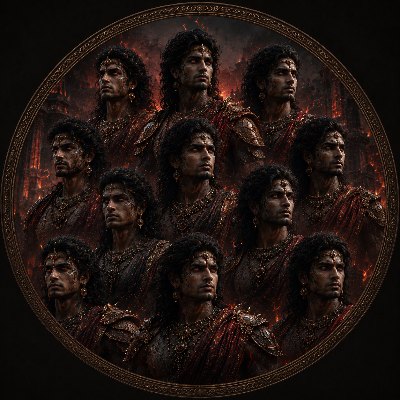
The Ten Sons of Dhumini — Nephews of Bhandasura and Commanders in the War Against Lalita Tripura Sundari
Dhumini Putras · Bhandasura Bhaginey as · Ulukajith · Purushena · Vishena · Kuntishena · Kurushaka · Malada · Karusha · Mangala · Drughana · Kollata
The ten sons of Dhumini were the nephews of Bhandasura, the asura emperor of Shunyaka Nagara, and the grandsons — through the female line — of the ashes of Kamadeva from which the entire Bhanda lineage descended. They were born to Dhumini, the sister of Bhandasura whom he had generated from his own heart, and were trained personally by Bhandasura himself in the arts of war. Their names, preserved in the Vedadhara summary of the Lalitopakhyana drawn from the Brahmanda Purana, are Ulukajith, Purushena, Vishena, Kuntishena, Kurushaka, Malada, Karusha, Mangala, Drughana, and Kollata. They entered the war against the Shakti Sena of Lalita Tripura Sundari in the later phase of the great battle, deployed by Bhandasura as part of a reorganised force led by his brothers Vishukra and Vishanga, following the destruction of the Jaya-Vighna-Yantra by Mahaganesha and the rout of Vishukra's initial army. Each of the ten was matched against a specific commander from the army of the Goddess. Their individual fates are not elaborated in the sources beyond the engagement itself, though the overall course of the war ended in the complete destruction of Bhandasura and his forces. They appear in the Brahmanda Purana's Lalitopakhyana and are among the named figures of that text's account of the war.
✦ The Names
The ten names preserved in the Vedadhara Lalitopakhyana account carry etymological meanings consistent with the martial and demonic register of the Bhanda lineage. Ulukajith — meaning one who conquers the owl or one who is victorious over Uluka — may carry the sense of one who overcomes a figure of dark wisdom, Uluka being associated in Sanskrit usage with owl-related names and occasionally with the name of Shakuni in some textual contexts. Purushena — meaning one who commands a male army, or one whose army is constituted by purushas — reflects a martial identity. Vishena suggests one connected with Vishena, a form implying poison or pervasion. Kuntishena — one whose army carries the kunti, a type of lance or spear — identifies a warrior by his troops' armament. Kurushaka may derive from Kurusha, a variant form connected with Kuruksha or a short form of a Kurukshetra-adjacent naming convention. Malada carries associations with the malada region or with malada in the sense of the residue of impurity. Karusha is connected with the Karusha people or territory — a name with geographic Puranic resonances. Mangala — meaning auspicious or the planet Mars — is paradoxically a name of positive valence applied to a demonic figure. Drughana carries the sense of destroying a fraud or breaking a deceit, from the root druh — to harm or deceive — and ghana — to strike or destroy. Kollata is a geographic name associated with the Kollata region.
✦ Lineage
- Mother: Dhumini — sister of Bhandasura, generated by him from his own heart; her name means smoke and places her within the fire-residue symbolic register of the entire lineage.
- Uncle: Bhandasura — asura emperor of Shunyaka Nagara, the primary figure of the lineage generated from the ashes of Kamadeva, and the personal military trainer of the ten sons.
- Great-uncles: Vishukra — prime minister of Bhandasura, born from the ash of Manmatha or from Bhandasura's right shoulder; and Vishanga — military commander of Bhandasura's forces, born from the same ash or from Bhandasura's left shoulder.
- Cousins: The thirty sons of Bhandasura — born to Bhandasura's four wives, all killed by Bala Tripurasundari prior to the deployment of Dhumini's sons in the later phase of the war. Also Rashmiprabha, the one daughter of Bhandasura.
- Ultimate origin: The ashes of Kamadeva — the charged residue of the god of desire incinerated by Shiva's third eye — from which Bhandasura and the core of the lineage arose, and through Dhumini's generation from Bhandasura's heart, the secondary source from which the ten sons descended.
✦ Training Under Bhandasura
The Vedadhara account of the Lalitopakhyana specifically records that Dhumini's ten sons had been trained directly by Bhandasura himself — a distinction that set them apart from the general demonic army and from the thirty sons of Bhandasura, who were his own progeny but whose individual training is not separately noted. The ten nephews' training under Bhandasura personally made them an elite cadre within the asura forces, warriors whose martial formation bore the direct imprint of the most powerful being in the three worlds at the time. It is this distinction that made them suitable reinforcements for the reorganised army at a critical phase of the war, when Vishukra and Vishanga led four hundred akshauhinis back into battle following the defeat and flight of Vishukra's initial thirty-akshauhini force.
✦ Deployment in the War
Following the destruction of the Jaya-Vighna-Yantra by Mahaganesha, the rout of Vishukra's army, and Vishukra's temporary flight back to Shunyaka Nagara, Bhandasura reorganised his forces. The Vedadhara summary records that Vishukra and Vishanga were dispatched with a combined force of four hundred akshauhinis, and that Dhumini's ten sons — trained directly by Bhandasura — joined this formation. The combination of the two principal brothers and the ten elite nephews in a single reinforced wave was sufficient to cause concern even among the devas observing the battle from above. The boloji.com summary of the Lalitopakhyana confirms this deployment in the phrase Bhandasura sent both his brothers Vishanga and Vishkura with his ten nephews born of his sister Dhumini into battle.
In the engagement that followed, the ten sons of Dhumini were each paired against a specific commander from the army of the Goddess. The Vedadhara account records each pairing: Ashwaroodha engaged Ulukajith; Sampatkari engaged Purushena; Nakulidevi engaged Vishena; Mahamaya engaged Kuntishena; an unnamed devi engaged Kurushaka; Unmatta Bhairavi engaged Malada; Laghushyama engaged Karusha; Swapneshi engaged Mangala; Vagvadini engaged Drughana; and Chandakali engaged Kollata. This account presents the engagement of Dhumini's ten sons as a carefully matched sequence — each nephew assigned a Shakti-commander as his direct opponent — rather than a general melee. The precision of the pairing suggests a deliberate organisational structure within the Shakti Sena's response to the reorganised asura force.
✦ Individual Opponents from Lalita's Army
- Ulukajith — engaged by Ashwaroodha, the commander of Lalita's cavalry forces, who rode the horse Aprajita.
- Purushena — engaged by Sampatkari, the commander of Lalita's elephant forces, who rode the elephant Ranakolahala.
- Vishena — engaged by Nakulidevi, a Shakti commander whose name associates her with the mongoose, a traditional destroyer of serpentine or poison-associated forces.
- Kuntishena — engaged by Mahamaya, a Shakti associated with the power of cosmic illusion.
- Kurushaka — engaged by an unnamed devi in the Vedadhara account.
- Malada — engaged by Unmatta Bhairavi, a fierce form of Shakti associated with the wild and unrestrained energy of Bhairava.
- Karusha — engaged by Laghushyama, a form of the dark goddess Shyama in her lighter or swifter aspect.
- Mangala — engaged by Swapneshi, a Shakti associated with the power of dream and vision.
- Drughana — engaged by Vagvadini, a Shakti associated with the power of speech and sacred utterance.
- Kollata — engaged by Chandakali, a fierce form of the goddess associated with the wrathful aspect of Kali.
✦ Theological Significance
The ten sons of Dhumini occupy a specific structural position in the Lalitopakhyana's narrative architecture. They enter the war as the final organised deployment of the Bhanda lineage — arriving after the thirty sons of Bhandasura have already been destroyed by Bala Tripurasundari and after Vishukra's occult yantra has already been neutralised by Mahaganesha. Their entry marks the point at which the lineage has exhausted its primary reserves and is drawing on its secondary formations. The fact that Bhandasura himself trained them points to the desperation of the imperial position: the emperor is investing his personal martial inheritance directly into his sister's sons because his own sons are gone.
The matchings between Dhumini's ten sons and the ten Shakti-commanders are also of structural interest within the Sri Vidya tradition. The commanders assigned to them — Ashwaroodha, Sampatkari, Nakulidevi, Unmatta Bhairavi, Chandakali, and others — are figures within the hierarchical system of Lalita's divine court whose associations with specific aspects of the Goddess's power encode a theological response to each of the demonic qualities the sons represent. The engagement of ten nephews by ten Shakti-commanders in individual pairings mirrors the broader structural principle of the Lalitopakhyana, in which every demonic force is countered by a specific divine power that precisely negates it.
✦ Connection to the Wider Genealogy
The ten sons of Dhumini represent the third generational tier of the Bhanda lineage at Shunyaka Nagara. The first tier was constituted by Bhandasura himself and his brothers Vishukra and Vishanga — all generated directly from Kamadeva's ash. The second tier, in the female line, was constituted by Dhumini — generated from Bhandasura's heart. The third tier, constituted by Dhumini's ten sons, descended through the female branch of the ash-lineage and entered the war as the last identifiable family group of the Bhanda house to take the field. Their deployment alongside Vishukra and Vishanga — the generation above them — in the final organised phase of Bhandasura's campaign before his direct confrontation with Lalita makes them the last members of the lineage to be individually named in battle before the war's decisive conclusion.
✦ References
Primary Sources
- Brahmanda Purana, Lalitopakhyana (Lalita Mahatmya), Chapters 21–30 — The primary source for the deployment of Dhumini's ten sons, their training under Bhandasura, and their entry into battle alongside Vishukra and Vishanga in the reorganised asura force.
- Brahmanda Purana, Lalitopakhyana, Chapter 26 (Bhandasura's sons slain) — The chapter within which the war's later engagements, including the deployment of Dhumini's sons, are narrated in sequence following the deaths of Bhandasura's thirty sons.
Modern and Secondary Reference Works
- Vedadhara / Ramaswamy Sastry — Sree Lalitopakhyanam (ramaswamysastry.blogspot.com) — The principal secondary source for all ten names of Dhumini's sons and the specific Shakti-commander opponent assigned to each; provides the most detailed account of the individual pairings available in the sources consulted.
- Boloji.com — The Story of Lalita Devi (boloji.com/articles/1711/the-story-of-lalita-devi) — A summary of the Lalitopakhyana drawn from the Brahmanda Purana confirming the collective deployment of the ten nephews alongside Vishukra and Vishanga; uses the specific phrase ten nephews born of his sister Dhumini.
- Wisdomlib — Lalitopakhyana, Chapter 26: Bhandasura's Sons Slain (wisdomlib.org/hinduism/book/lalitopakhyana-lalita-mahatmya/d/doc362964.html) — Provides the primary-text chapter within which the sons' engagement is narrated; confirms the sequence of events following the deaths of Bhandasura's thirty sons.
- Wisdomlib — Lalitopakhyana, Chapter 29: Slaying of Bhandasura (wisdomlib.org/hinduism/book/lalitopakhyana-lalita-mahatmya/d/doc362967.html) — Confirms that the war's final phase, in which Bhandasura faced Lalita directly, followed the deaths of all his brothers and sons including those of Dhumini's line.
- HandWiki — Bhandasura article (handwiki.org/wiki/Biology:Bhandasura) — Confirms Dhumini as Bhandasura's sister born from his heart and notes the ten nephews within the family structure of the Bhanda house.
- Blushing Unseen — Lalitasahasranama 003: Lalita kills Bhandasura (blushingunseen.blogspot.com) — Provides additional detail on the war's later phases including the Lalitopakhyana primary text's attribution of Vishukra's death to Mantrini and Vishanga's death to Dandanatha, the context within which Dhumini's sons were deployed.