
About
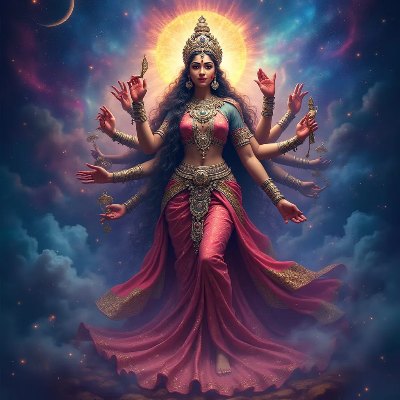
Lalita Tripura Sundari — Supreme Goddess of the Sri Vidya Tradition and Slayer of Bhandasura
Lalita · Tripura Sundari · Shodashi · Rajarajeshvari · Sri Mata · Sri Maharajni · Kameshvari · Kamakshi · Lalitambika · Maha Tripura Sundari · Parabhattarika · Cidagni Kunda Sambhuta
Lalita Tripura Sundari is the supreme goddess of the Sri Vidya tradition within Shaktism, revered as the ultimate expression of divine feminine consciousness and identified in the Lalitopakhyana of the Brahmanda Purana as Adi Parashakti herself — the primordial power from which all creation proceeds. She emerged from the Cidagni Kunda — the sacrificial fire of pure consciousness — in response to the cosmic catastrophe of Bhandasura's sixty-thousand-year reign, which had brought universal sterility, joylessness, and the suppression of desire across the three worlds. Lalita's manifestation was not simply that of a warrior goddess summoned to destroy a demon; it was the direct emergence of supreme consciousness into a form capable of restoring cosmic order, re-establishing the creative principle of Kama that Bhandasura's existence had perverted, and manifesting the eternal divine court described in the Lalita Sahasranama. She is the third among the ten Mahavidyas — the great wisdom goddesses of the Shakta tradition — and her primary scriptural sources include the Brahmanda Purana's Lalitopakhyana, the Lalita Sahasranama embedded within it, the Tripura Rahasya, the Devi Bhagavata Purana, the Vamakeshvara Tantra, the Bahvricha Upanishad, and the Tripura Upanishad.
✦ The Names
The name Lalita derives from the Sanskrit root lal — to play, to sport, to move freely — and means the Playful One, or She Who Plays. The Lalita Sahasranama commentary preserves the understanding that Lalita's cosmic activity — the creation, sustenance, and dissolution of the universe — proceeds not from effort or necessity but from the spontaneous, effortless play of divine consciousness, the lila that is the universe's deepest nature. Tripura Sundari is a compound of tripura — the three cities or the three worlds — and sundari — the beautiful woman. She is thus the beauty of all three worlds, the most beautiful in the entire manifest creation. As Shodashi — from shodasha, sixteen — she is the goddess of sixteen, understood as a sixteen-year-old girl at the peak of beauty and completeness, the embodiment of sixteen types of desire, and the presiding deity of the sixteen-syllable mantra. Rajarajeshvari means the queen of queens, the sovereign above all sovereigns. Kameshvari — she who is the mistress of desire — and Kamakshi — she whose eyes are desire — both evoke the full restoration of Kama's generative power in its highest, most beautiful form: the direct opposite of what Bhandasura, born from Kama's destruction, had represented. Cidagni Kunda Sambhuta — born from the fire-pit of pure consciousness — is among the first names in the Lalita Sahasranama and describes her mode of manifestation.
✦ Manifestation from the Cidagni Kunda
The Lalitopakhyana describes in detail the circumstances of Lalita's emergence. The devas, unable to endure Bhandasura's reign and guided by the sage Narada, performed a great Maha Yajna — a sacrificial fire rite of cosmic scale. The fire that was kindled for this purpose was not an ordinary ritual fire but the Cidagni — the fire of pure awareness, the sacrificial flame constituted by consciousness itself rather than by physical combustion. From the heart of this fire, Lalita Tripura Sundari arose — described as resembling the radiance of a thousand rising suns, clothed in red, adorned with all ornaments, seated on the Sri Chakra Ratha. The Lalita Sahasranama's first verse encodes this moment: the auspicious mother, the great empress, sovereign of the lion-throne, born from the fire of pure consciousness, ever engaged in the work of the devas.
Following her emergence, Brahma contemplated that a woman ruling a kingdom alone was incomplete by the conventions of the cosmic order, and that she required a consort equal to her nature. Since she herself was the embodiment of love and desire in their supreme form, Brahma understood that only Maheshvara — Shiva — could be her consort. From this contemplation Maheshvara manifested in the form of Kameshvara — described as a million times more attractive than the god of desire — and became Lalita's eternal consort. Together they rule from Manidvipa, the island of jewels, and from Sri Nagara, the divine city that is itself an expression of the Sri Chakra.
✦ Divine Relationships
- Consort: Kameshvara — the supreme form of Shiva as the lord of desire, who manifested from Brahma's contemplation after Lalita's emergence from the Cidagni Kunda. He rules alongside her in Manidvipa and is the masculine principle of consciousness to her feminine principle of power — the Shiva to her Shakti in their most exalted, non-dualistic form.
- Daughter: Bala Tripurasundari — the nine-year-old child form of the goddess herself, who manifested during the war to destroy all thirty of Bhandasura's sons in a single engagement.
- Son (manifested): Mahaganesha — the ten-armed, elephant-headed deity who manifested from Lalita's smile in combination with Kameshvara's gaze, during the crisis of Vishukra's Jaya-Vighna-Yantra. Lalita granted Mahaganesha the boon that he would be worshipped first among all the devas — establishing his primacy in the Sri Vidya worship order.
- Prime Minister: Raja Matangi — also called Mantrini or Shyamala, who served as the head of Lalita's divine court, the composer of the Lalita Sahasranama through the eight Vak Devis under her direction, and the commander who killed Vishukra in battle.
- Military Commander: Maha Varahi — also called Dandanatha, who served as the supreme commander of the Shakti Sena and who killed Vishanga in battle.
✦ The Sri Chakra Ratha
Lalita's chariot — the Sri Chakra Ratha, also called the Chakraraja Ratha — is one of the most elaborately described vehicles in the entire Puranic tradition. The Lalitopakhyana records its dimensions and constitution in precise detail: it was made of tejas — pure luminous energy — and was a form of Mount Meru in its structure. It had a width of four yojanas, a height of ten yojanas, nine storeys or landings, four wheels, four horses, and a pennant. The sixty-eighth name of the Lalita Sahasranama — Chakraraja-ratharudha-sarvayudha-parishkrta — identifies the goddess as she who is fully armed with all weapons and rides the Sri Chakra chariot, establishing the chariot as intrinsic to her identity rather than incidental to the war narrative. Matangi rode her own chariot the Geyachakra Ratha; Varahi rode the Kirichakra Ratha — the three chariots together forming the command procession of the divine army.
✦ The War Against Bhandasura and the Destruction of Shunyaka
Lalita's war against Bhandasura is narrated across the central chapters of the Lalitopakhyana. She led the Shakti Sena — the all-female divine army — against Bhandasura's three-hundred-akshauhini force of asuras. The battle unfolded over four days. Lalita's commanders destroyed Bhandasura's generals one by one. Bala Tripurasundari killed all thirty of his sons. Mahaganesha, manifested from Lalita's smile, destroyed Vishukra's Jaya-Vighna-Yantra and restored the incapacitated Shakti army. Vishnu's ten avatars were manifested from Lalita's own being to counter Bhandasura's resurrection of all the demons Vishnu had previously slain. Vishukra and Vishanga — Bhandasura's two principal brothers — were killed by Lalita's commanders.
Stripped of every ally and support, Bhandasura confronted Lalita directly. His boon — that any opponent who fought him would forfeit half their strength and masculinity — was constitutionally incapable of affecting her. She was the supreme feminine consciousness, and the boon's operative condition found no purchase in her nature. Lalita released the Mahakameshvarastra — the weapon of the supreme lord of desire, the weapon whose very name encoded the restoration of what Bhandasura had perverted — and it vaporised Bhandasura along with his capital Shunyaka Nagara, reducing both back to the nothingness the city had always been named for. In an act of supreme compassion following the destruction, Lalita directed her gaze upon the remaining ash and restored Kamadeva — the god of love whose incineration had initiated the entire cosmic episode — in a purified spiritual form.
✦ The Lalita Sahasranama
Following her victory over Bhandasura, the Lalita Sahasranama — the hymn of a thousand names — was composed at the Goddess's own command by the eight Vak Devis: Vasini, Kameshvari, Aruna, Vimala, Jayani, Modini, Sarveshvari, and Kaulini. These eight goddesses of speech are among the attendants of the Goddess within the Sri Chakra and composed the thousand names as a direct act of divine instruction. The Lalita Sahasranama is unique among the major Sahasranamas of the Hindu tradition in containing exactly one thousand names without repetition — a feature understood within the tradition as a reflection of the perfection of its divine authorship. The Sahasranama was subsequently narrated by the sage Hayagriva to Agastya as a dialogue, and this narration forms the frame of the Lalitopakhyana itself.
✦ Iconography and Worship
Lalita Tripura Sundari is depicted as a sixteen-year-old girl of extraordinary beauty, her skin described variously as golden, red, or the colour of the rising sun. She is clad in red silk and adorned with every ornament. She has four arms, each bearing a specific implement of cosmic significance: the pasha — the noose — in one hand, representing attachment; the ankusha — the elephant goad — in another, representing repulsion; the ikshudanda — the sugarcane bow — representing the mind; and five flower-tipped arrows representing the five sense objects. She possesses a third eye on her forehead. She is seated on a lotus throne placed upon a golden seat, or alternatively upon a throne whose legs are the four deities Brahma, Vishnu, Shiva, and Rudra, with the seat formed by Sadashiva — a Tantric iconographic statement of her sovereignty over the male divine. Her symbols are the Sri Yantra — also called the Sri Chakra — which is simultaneously her yantra, her chariot, and her body in its subtle form.
Her primary places of worship include the Tripura Sundari Temple at Udaipur in Tripura, where she is enshrined as one of the fifty-one Shakti Pithas. She is also worshipped as Kamakshi at Kanchipuram and as Kamakhya at Assam in the Shakti Pitha tradition. Her principal festivals are Lalita Jayanti on Magha Purnima and Lalita Panchami, as well as the nine nights of Navaratri. In the Sri Vidya tradition her worship is centred on the Sri Chakra or Sri Yantra — the geometric diagram understood as her living form — and the Panchadashi or Shodashi mantra of fifteen or sixteen syllables.
✦ Theological Significance
Within Shaktism and the Sri Vidya tradition, Lalita Tripura Sundari is not merely the most powerful of the goddesses within a polytheistic hierarchy — she is identified as the ultimate ground of being itself, the supreme consciousness from which all existence arises and into which it dissolves. The Lalitopakhyana identifies her in the Brahmanda Purana as Adi Parashakti in her fullest manifestation. The Tripura Upanishad and the Bahvricha Upanishad place her in the position of the Absolute — the Brahman with qualities — while Tantric and Agamic texts elaborate on her as the Mahavidya who embodies both the path of enjoyment (bhoga) and the path of liberation (moksha) simultaneously: Shodashi Sadhana is described as conferring both the pleasure of the world and the ultimate freedom from it.
The Sri Chakra — her yantra — is the most complex and most highly venerated geometric form in the entire Hindu Tantric tradition, understood as encoding the entire structure of the manifest universe within its nine interlocking triangles, sixteen-petal lotus, eight-petal lotus, three circles, and outer square with four gates. Lalita as Tripura Sundari is thus simultaneously the most beautiful form of the goddess and the most abstract principle of consciousness — her three names (Tripura, Sundari, Lalita) encoding the three planes of existence, the beauty that pervades them, and the playful freedom with which consciousness moves through all three.
✦ References
Primary Sources
- Brahmanda Purana, Lalitopakhyana (Lalita Mahatmya), Chapters 1–40 — The primary narrative source for Lalita's manifestation from the Cidagni Kunda, her form and attributes, the constitution of the Shakti Sena, the war against Bhandasura, and the composition of the Lalita Sahasranama; narrated as a dialogue between Hayagriva and Agastya.
- Lalita Sahasranama (within the Lalitopakhyana) — The thousand names of the Goddess composed by the eight Vak Devis at her command; the most comprehensive single primary-text description of her attributes, iconography, weapons, chariot, abode, genealogy, and cosmic functions. The opening verse Cidagni-kunda-sambhuta devakaryasamudyata encodes her mode of manifestation.
- Tripura Rahasya, Jnana Khanda — An independent Sanskrit text elaborating on the war with Bhandasura and the philosophical dimensions of Lalita's identity as supreme consciousness.
- Devi Bhagavata Purana — Records Lalita Tripura Sundari as a manifestation of the supreme Mahadevi and elaborates on her cosmic sovereignty.
- Vamakeshvara Tantra (Nityashodashikarnava) — A principal Tantric text of the Sri Vidya tradition describing the Goddess's sixteen-syllable mantra, her fifteen Nitya shaktis, and the structure of her divine court.
- Tripura Upanishad and Bahvricha Upanishad — Upanishadic texts identifying Tripura Sundari with the Brahman — the ultimate principle of consciousness — and establishing her within the Vedantic framework as the supreme deity.
Modern and Secondary Reference Works
- Wikipedia — Tripura Sundari article (en.wikipedia.org/wiki/Tripura_Sundari) — Confirms her major names, attributes, abode, consort, weapons, textual sources, and identification as Adi Parashakti in the Lalitopakhyana.
- Wikipedia — Lalita Sahasranama article (en.wikipedia.org/wiki/Lalita_Sahasranama) — Confirms the composition of the Sahasranama by the eight Vak Devis under Lalita's command; describes its structure and uniqueness as a thousand-name hymn without repetition.
- Wisdomlib — Lalitopakhyana (Lalita Mahatmya), English translation (wisdomlib.org/hinduism/book/lalitopakhyana-lalita-mahatmya) — The principal English translation of the primary text, providing chapter-by-chapter access to the narrative of Lalita's emergence and the war.
- Srilalithatripurasundari.wordpress.com — Sri Lalitha Tripura Sundari: A Complete Encyclopedia — Provides the Sri Vidya theological framework for Lalita's three-fold nature (gross, subtle, supreme as icon, yantra, and mantra) and the detailed description of the Sri Chakra Ratha including its dimensions.
- Srilalithatripurasundari.wordpress.com — Commentary on Name 68: Chakraraja-ratharudha-sarvayudha-parishkrta — Provides the specific description of the Sri Chakra Ratha as confirmed in the Lalitopakhyana: made of tejas, four yojanas wide, ten yojanas high, nine storeys, four wheels, four horses.
- Lalitopakhyana Synopsis (srilalithatripurasundari.wordpress.com) — Confirms the narrative sequence of Lalita's emergence, the manifestation of Kameshvara, the establishment of Sri Nagara, the composition of the Sahasranama, and the cosmic restoration following Bhandasura's destruction.
- Kinsley, David — Tantric Visions of the Divine Feminine: The Ten Mahavidyas, University of California Press, 1997 — A scholarly secondary source establishing Tripura Sundari's place as the third Mahavidya and her centrality to the Sri Vidya tradition.
- Bhaskararaya Makhindra — Commentary on the Lalita Sahasranama (c. 1728 CE) — The most authoritative traditional Sanskrit commentary on the Lalita Sahasranama, composed by the eighteenth-century Sri Vidya scholar; the foundational secondary text for the interpretation of individual names.