
About
Bala Tripurasundari — Child Form of the Supreme Goddess and Slayer of Bhandasura's Thirty Sons
Bala Tripurasundari · Balambika · Bala · Bala Tripura · Tripura Bala · Anga Devi of Lalita
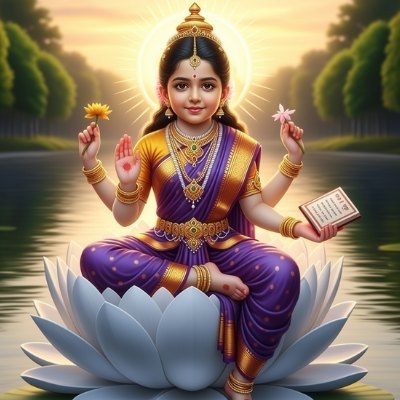
Bala Tripurasundari is a goddess of the Sri Vidya tradition within Shaktism, revered as the child form or youthful daughter-manifestation of Lalita Tripura Sundari, the supreme goddess. She is described in the Lalitopakhyana of the Brahmanda Purana — specifically in Chapter 26 of the Lalita Mahatmya — as a nine-year-old girl who always maintained that form, was a great mine of all lores, possessed a body radiant as the rising sun, and perpetually attended Lalita from near the footrest of the great queen's throne. She is characterised as the vital breath of the Goddess moving externally — her fourth eye. She is the Anga Devi of Lalita — the limb-goddess, an aspect of the Goddess's own being rather than an entirely separate deity. Her defining narrative role in the Lalitopakhyana was the destruction of all thirty sons of Bhandasura in a single engagement while riding her swan-drawn chariot, the Karni Ratha. Her mantra — of three syllables, Aim Klim Sauh — is the first mantra formally imparted to initiates in the Sri Vidya tradition, making her the gateway deity through whom the entire tradition is entered. She is attested in the Brahmanda Purana, the Parashurama Kalpasutra, the Bala Panchanga, and the Tantric literature of the Sri Vidya tradition.
✦ The Name
The name Bala is Sanskrit for girl, child, young one, or one who is young and strong — the word simultaneously denoting youth, feminine identity, and a particular form of strength that is not the brute force of the mature warrior but the concentrated, undiluted energy of the divine in its most essential form. Tripurasundari — meaning the beauty of the three worlds — is shared with the supreme goddess Lalita, establishing that Bala is not a diminished or lesser form of Lalita but the same ultimate beauty and power expressed in a youthful manifestation. The compound Bala Tripurasundari thus means the young beauty of the three worlds, or the child who is the beauty of all creation. The name Balambika — amba being a word for mother — creates a paradox of nurturing and youth that is theologically deliberate: the child goddess who is simultaneously a mother-principle. In the Lalita Sahasranama (Name 74), the compound Bhandaputra-vadhodhyukta-bala-vikrama-nandhita — she who is delighted by the heroic deeds of Bala in slaying the sons of Bhandasura — encodes Bala's defining act within the thousand names of the supreme Goddess.
✦ Origin and Divine Relationships
- Mother: Lalita Tripura Sundari — the supreme goddess of the Sri Vidya tradition, who emerged from the Cidagni Kunda. Bala is described in the Lalitopakhyana as having been generated from Lalita's own heart — an emergence that makes her the Anga Devi, the limb-aspect of Lalita's own being, as opposed to a separately conceived deity.
- Father: Kameshvara — the form of Shiva who manifested as Lalita's consort following her emergence, described in the Lalitopakhyana as a million times more attractive than the god of desire.
- Textual note on timing: The Wisdomlib translation of the Lalitopakhyana (Chapter 26, footnote) records a traditional calculation that Bala's appearance in battle occurred approximately nine or ten years after Lalita's marriage to Kameshvara — a chronological detail that places Bala's age at the time of the battle in poetic correspondence with the nine-year-old form she permanently maintains. A sort of poetic balance is effected by the primary text in matching the daughter of Lalita against the sons of Bhandasura.
- Position within the Shakti court: Anga Devi of Lalita — Bala is specifically identified as the limb-goddess of Lalita, with Annapurna Devi identified as Lalita's Upanga Devi and Ashvarudha Devi identified as Lalita's Pratyanga Devi.
- Bodyguards in battle: Matangi (Raja Matangi / Shyamala) and Varahi (Maha Varahi / Dandanatha) stood as her personal bodyguards when Bala left for the battlefield on the Karni Ratha.
✦ The Description in the Primary Text
The Brahmanda Purana's Lalitopakhyana (Chapter 26, verses 72–77) provides the primary textual description of Bala. She was the daughter of Lalita Devi. She always stayed near the goddess. She was worthy of being worshipped by all Shaktis. She was an adept in martial feats and exploits. Her form and features were like those of Lalita — she was a replica of the supreme goddess in miniature. She was always like a nine-year-old girl yet was a great mine of all lores. Her body was like the rising sun. She was perpetually present near the foot-rest of the great queen. She was like the vital breath of the goddess moving externally. She was her fourth eye. The text then records that upon hearing that Bhandasura's sons — led by Chaturbahu — had entered the battlefield, Bala became furious, resolved inwardly to kill them immediately, and submitted her petition to the great queen.
✦ The Slaying of Bhandasura's Thirty Sons
When Bhandasura, despairing after his initial formations had been broken by the Shakti Sena, dispatched all thirty of his sons into battle with instructions to capture Lalita, Bala — who had until that point watched the war from her mother's chariot — stepped forward and petitioned Lalita for permission to fight them. Lalita initially refused, citing Bala's young age and her maternal love, and pointed to the assembled Matrikas as warriors ready to take the field. Bala prevailed upon her mother with determination and was given permission. Lalita provided her with her own armour and weapons.
Bala mounted her chariot — the Karni Ratha, drawn by one hundred swans — and rode into battle with Matangi and Varahi at her sides as bodyguards. She engaged all thirty sons of Bhandasura simultaneously and destroyed them using the Narayanastra — the weapon of Narayana — killing the entire cohort in one encounter. The asura armies that had followed the thirty sons into battle with raucous confidence watched in shock and dismay. Upon receiving news of the victory, Lalita embraced her daughter with great joy. The entire event is commemorated in the seventy-fourth name of the Lalita Sahasranama, which records the supreme Goddess's delight at Bala's heroic deeds.
Within the Sri Vidya tradition's philosophical interpretation, the thirty sons of Bhandasura are understood as representing the stains caused by the activities of the five organs of knowledge and the five organs of action — totalling ten — in each of the three states of consciousness: waking, dream, and deep sleep. Bala's destruction of these thirty thus represents the removal of the thirty forms of limited, ego-bound cognition that obstruct the realisation of the identity of the individual with the supreme. Bala's very name — child, innocence, undifferentiated awareness — makes her the appropriate agent of this purification.
✦ Iconography
Two principal iconographic traditions for Bala are attested in the Sri Vidya literature. In the first — associated with her role as the warrior-daughter of Lalita and her appearance in the Lalitopakhyana — she is depicted with four arms holding a noose, a goad, a sugarcane bow, and five flower-tipped arrows, mirroring the weapons of her mother Lalita. She has three eyes, is clad in red garments, is adorned with a crescent moon, and radiates the golden-red light of the rising sun. In the second iconographic tradition — associated with her role as the gateway deity of Sri Vidya initiation and her function as the bestower of knowledge — she holds a book in one hand and a rosary in another, displaying the gestures of fearlessness and boon-granting with the remaining two hands. This form emphasises her identity as a great mine of all lores and as the deity through whose mantra all Sri Vidya knowledge is progressively revealed. In both traditions she appears as a nine-year-old girl seated on a red lotus.
✦ Place in the Sri Vidya Initiatory Sequence
In the Sri Vidya tradition, the initiatory sequence is precisely ordered. The first mantra given to an aspirant by the Guru is the Maha Ganapati Tarpanam. The second initiation — and the first mantra of the Sri Vidya sequence proper — is the Bala mantra. Only after receiving the Bala mantra and progressing through its practice does the aspirant become eligible for the Panchadashi or Shodashi mantra of Lalita Tripura Sundari herself. This structural placement is articulated across multiple Tantric sources: the srilalithatripurasundari commentary, the Amritananda Natha meditation guide, and the Parashurama Kalpasutra tradition all confirm that Bala's worship precedes and prepares for the full Sri Vidya upasana. The mantra of Bala — Aim Klim Sauh — consists of three bija syllables. Some traditions also employ a six-syllable variant depending on the stage of practice. The tradition records that attaining siddhi in the Bala mantra confers supernatural abilities and opens the path to the higher attainments of Sri Vidya practice.
✦ The Trinity of Tripura Forms
Within the Sri Vidya and Tantric framework, Bala Tripurasundari forms one of three manifestations of the supreme feminine principle: Bala Tripurasundari as the youthful form embodying creation and fresh energy; Tripura Sundari as the mature form embodying preservation and supreme beauty; and Tripura Bhairavi as the fierce form embodying dissolution and transformation. The three together represent the complete arc of consciousness across its creative, sustaining, and dissolving phases. Bala is understood as the body dimension of this trinity; Tripura Sundari as the mind; and Tripura Bhairavi as consciousness itself in its most penetrating form.
✦ References
Primary Sources
- Brahmanda Purana, Lalitopakhyana (Lalita Mahatmya), Chapter 26, verses 72–77 — The principal primary source for Bala's description, her petition to Lalita, her weapons and chariot, and her destruction of all thirty sons of Bhandasura; the foundational narrative text for her identity.
- Lalita Sahasranama, Name 74: Bhandaputra-vadhodhyukta-bala-vikrama-nandhita — The primary scriptural commemoration of Bala's feat encoded within the thousand names of Lalita, composed by the eight Vak Devis at Lalita's command.
- Parashurama Kalpasutra — A primary Tantric text of the Sri Vidya tradition that includes guidelines for the worship of Bala Tripurasundari and establishes her place in the initiatory sequence; originated from the Dattatreya Samhita and compiled by Sumedha, a disciple of Parashurama.
- Bala Panchanga — A primary text dedicated specifically to Bala Tripurasundari providing detailed guidelines for her worship and the structure of her ritual observances.
- Vamakeshvara Tantra (Nityashodashikarnava) — A Tantric text of the Sri Vidya tradition attesting Bala's position within the divine court of Lalita and the sequence of Sri Vidya initiatory practice.
Modern and Secondary Reference Works
- Wisdomlib — Lalitopakhyana, Chapter 26: Bhandasura's Sons Slain (wisdomlib.org/hinduism/book/lalitopakhyana-lalita-mahatmya/d/doc362964.html) — Provides the English translation of the primary text verses describing Bala, including the footnote on the traditional chronological calculation placing the battle nine to ten years after Lalita's marriage.
- Wikipedia — Bala Tripurasundari article (en.wikipedia.org/wiki/Bala_Tripurasundari) — Confirms Bala's appearance in Chapter 26 of the Lalita Mahatmya, her petition and Lalita's initial reluctance, and the destruction of the thirty sons; cites Rupenaguntla, Satya Narayana Sarma, Hidden Meanings of Lalita Sahasranama, Panchawati Spiritual Foundation, 2018.
- Srilalithatripurasundari.wordpress.com — Commentary on Name 74 — Confirms that Bala is the Anga Devi of Lalita, that Annapurna Devi is Lalita's Upanga Devi and Ashvarudha is the Pratyanga Devi; confirms that the first initiation in Sri Vidya is always the Bala mantra.
- Amritananda Natha Saraswati — Bala Meditation Guide (amritananda-natha-saraswati.blogspot.com) — The most philosophically detailed secondary source, identifying Bala's weapon in the battle as the Narayanastra and providing the Tantric interpretation of the thirty sons as the thirty stains of ego-bound cognition across three states of consciousness; confirms the three-syllable Bala mantra as Aim Klim Sauh.
- Amritanilayam.org — Sri Bala Tripura Sundari — Confirms that the Karni Ratha was drawn by one hundred swans, that Shyamala and Varahi stood as Bala's bodyguards in battle, and that Lalita embraced Bala with joy upon learning of the victory.
- Grokipedia — Bala Tripurasundari article (grokipedia.com/page/Bala_Tripurasundari) — Provides the most detailed iconographic description including the two distinct iconographic traditions, the three eyes, crescent moon adornment, red lotus seat, and the alternative four-armed depictions with book and rosary.
- Hamsapakshi.wordpress.com — Bala Tripurasundari: The Little Warrior — Provides a narrative retelling of the battle sequence drawing on the Lalitopakhyana primary text, including Bhandasura's speech to his sons before their fatal overconfident march into the battlefield.
- Wikipedia — Shri Vidya article (en.wikipedia.org/wiki/Shri_Vidya) — Confirms Bala Tripurasundari as one of the most important deities of the south Indian Sri Vidya tradition alongside Lalita, Ganapati, Rajamata ngi, and Maha Varahi.