
About
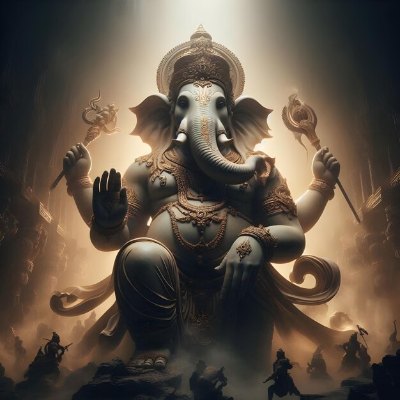
Mahaganesha — Elephant-Headed Deity Manifested from Lalita's Smile and Destroyer of the Jaya-Vighna-Yantra
Mahaganesha · Ganapati · Gananatha · Ganapati of Sri Vidya · Vighnanayaka · Smita-Sambhava · Lalita-Smita-Sambhuta
Mahaganesha is the form of the elephant-headed deity Ganesha as he appears in the Lalitopakhyana of the Brahmanda Purana — specifically in Chapter 27, titled the Exploits of Gananatha. In this context he is not the Ganesha born of Parvati and Shiva as narrated in the Shiva Purana and other Shaiva texts, but a manifestation arising directly from the combined smile of Lalita Tripura Sundari and the gaze of Mahakameshvara, her consort, at a moment of cosmic crisis during the war against Bhandasura. He appeared with ten arms, accompanied by the goddesses Siddhi and Lakshmi, in a joyful and radiant form. His defining act in the Lalitopakhyana was the discovery and destruction of the Jaya-Vighna-Yantra — the magical obstruction diagram created by Vishukra — which had incapacitated the entire Shakti Sena. Following this act, he led the six Vighnanayakas in destroying the forces of Gajasura. As a reward, Lalita granted him the boon of being worshipped before all other deities in any ritual or undertaking — the mythological foundation of Ganesha's universal primacy in the Hindu worship order. In the Sri Vidya tradition, Mahaganesha presides over the first avarana of the Sri Chakra — the Bhupura, or Trailokyamohana Chakra. He is attested in the Brahmanda Purana's Lalitopakhyana, the Parashurama Kalpasutra, the Mudgala Purana, and the broader Tantric literature of the Sri Vidya tradition.
✦ The Name
The name Ganesha is a compound of gana — a group, a multitude, or the divine attendants of Shiva — and isha — lord, master, or ruler. He is thus the lord of the ganas, the presiding deity of divine troops and attendants. The prefix Maha — great or supreme — applied in the Sri Vidya context distinguishes this specific manifestation as Mahaganesha, the supreme form of Ganapati within that tradition, as opposed to the various forms of Ganesha described in other Puranic and Tantric traditions. The name Gananatha — lord of the ganas — is also applied to him in Chapter 27 of the Lalitopakhyana, which bears that name as its title. The Kamakoti Mandali's compilation of correspondences from within the Lalitopakhyana itself identifies Mahaganesha specifically with Lalita's smile — he is the manifestation of the auspicious smile of the supreme Goddess, an identification that encodes the entire theological significance of his appearance: the smile of supreme consciousness dispels all obstruction.
The name Ganapati carries the same essential meaning as Ganesha — lord of the ganas — and is used interchangeably. The six Vighnanayakas — the six subordinate masters of impediments — who accompanied him bear the names Amoda, Pramoda, Durmukha, Sumukha, Arighna, and Vighnakarta, each name encoding a specific quality of the power to create or dispel obstruction.
✦ Origin in the Lalitopakhyana
- Parents (in this manifestation): Lalita Tripura Sundari — the supreme goddess, whose smile provided the origin of Mahaganesha's form — and Mahakameshvara — the supreme Shiva as Lalita's consort, whose simultaneous gaze combined with Lalita's smile to produce the manifestation. The Lalitopakhyana explicitly describes Ganesha as appearing from the smile of the goddess when she looked into Mahakameshvara's face. This origin distinguishes the Sri Vidya Mahaganesha from the Parvati-Shiva-born Ganesha of the Shaiva tradition, and the Wisdomlib footnote to Chapter 27 identifies this distinction as a deliberate theological move to enhance Lalita's greatness.
- Companions in manifestation: Siddhi and Lakshmi — the goddesses of supernatural attainment and prosperity — appeared alongside Mahaganesha at his emergence. In the Sri Vidya theological framework, these two are understood as his Shaktis — Siddhi representing the totality of supernatural powers (the Dasha Siddhi) and Buddhi/Lakshmi representing wisdom-prosperity.
- Subordinate forces: The six Vighnanayakas — Amoda, Pramoda, Durmukha, Sumukha, Arighna, and Vighnakarta — are the six masters of obstacles who accompanied Mahaganesha in the attack on Bhandasura's forces following the destruction of the Jaya-Vighna-Yantra.
✦ The Crisis of the Jaya-Vighna-Yantra
The occasion of Mahaganesha's manifestation was the most dangerous crisis of the war. After Bala Tripurasundari had destroyed all thirty of Bhandasura's sons, Vishukra — the prime minister and occult strategist of Bhandasura's court — was driven into a state of frenzied grief and desperation. He created the Jaya-Vighna-Yantra: a magical obstruction diagram inscribed on a stone slab two krosas — approximately four miles — in extent. The yantra had eight angles and eight tridents, and was defended by eight presiding deities whose names included Alasa and others, the personifications of tendencies causing disaffection and demoralisation. Vishukra worshipped this yantra with elaborate nocturnal rituals and then secretly installed it within the camp of the Goddess Lalita.
The yantra's effect was immediate and comprehensive. The entire Shakti Sena was overtaken by eight ailments: lassitude, meanness, depression, slumber, asthenia, forgetfulness, inattention, and indifference. Lalita's warriors abandoned their weapons and retreated. Vishukra then pressed his attack against the weakened divine army. Only Lalita herself, Bala Tripurasundari, Mahakameshvara, Matangi, and Varahi remained unaffected. Dandanatha and Mantrini — Varahi and Matangi — reported the crisis to Lalita.
✦ The Manifestation and Destruction of the Yantra
Upon receiving the report, Lalita smiled and turned her gaze toward Mahakameshvara's face. From this combined act — smile and gaze, Shakti and Shiva — Mahaganesha emerged: elephant-faced, ten-armed, joyful, and radiant, accompanied by Siddhi and Lakshmi. He entered the military camp of the Goddess, located the hidden Jaya-Vighna-Yantra, and destroyed it — shattering it into many pieces and neutralising its magical power entirely. The Shakti Sena immediately recovered, their eight ailments lifting as the yantra's hold dissolved, and they returned to the field against Vishukra with restored vigour.
Following the destruction of the yantra, Mahaganesha did not withdraw. Accompanied by the six Vighnanayakas — Amoda, Pramoda, Durmukha, Sumukha, Arighna, and Vighnakarta — he attacked the army of Bhandasura directly, destroying the forces of Gajasura in a sustained military engagement before returning to Lalita's presence.
✦ The Boon of Primacy in Worship
Lalita was greatly pleased with Mahaganesha's deeds. At verse 104 of Chapter 27 of the Lalitopakhyana — as confirmed in the Wisdomlib primary text footnote — she granted him the boon that he would be worshipped prior to all other gods in any ritual or undertaking. This boon, granted by the supreme goddess herself within the Lalitopakhyana, provides the mythological foundation within the Sri Vidya tradition for the universal practice of beginning any Hindu ritual with Ganesha worship. The Wisdomlib footnote to Chapter 27 records that this super-position or priority of Ganesha worship is attributed to this boon as a reward for his exploits in the campaign against Bhandasura, and notes that the belief in Ganesha as the destroyer of obstacles was current at the time of the author of the Mahatmya, and that people worshipped Ganesha first even in the formal worship of other deities.
✦ Iconography
Mahaganesha as described in the Lalitopakhyana appeared with ten arms — a form distinct from the more common two-armed or four-armed Ganesha of mainstream worship — in a joyful and radiant aspect. He was accompanied by Siddhi and Lakshmi on either side. His ten arms, in the Sri Vidya iconographic tradition, correspond to the ten directions of space and to the Dasha Siddhi — the ten supernatural attainments — over which he presides as their lord. The Kameshvari Ma medium source, drawing on the Sri Vidya Tantric framework, explains the name Ganapati in the Sri Vidya context as encoding Ga — jna meaning jnana or Buddhi Devi — and Na — Narayani or Lakshmi as Siddhi Devi — with Pati meaning lord: Ganapati is thus the lord of Siddhi and Buddhi, his two companion goddesses at manifestation being his Shaktis in precisely this sense.
✦ Place in the Sri Vidya Tradition
In the Sri Vidya tradition, Mahaganesha presides over the first avarana — the first enclosure — of the Sri Chakra. This is the Bhupura, the earth-ground, also called the Trailokyamohana Chakra — the wheel that enchants the three worlds. It is the outermost layer of the Sri Chakra's nine concentric structures and corresponds to the foundational stratum of manifest existence. The Yogini of this avarana is called Prakata; the Mudra is Sarva Samkshobhini; the Siddhi is Anima; and the mental state of the aspirant at this level is Jagrata — the waking state of ordinary consciousness. Ganapati's association with this outermost avarana places him at the threshold of the entire Sri Chakra system — the first deity encountered and the first obstacle removed as the practitioner begins the inward journey through the nine enclosures toward the central Bindu where Lalita herself resides. The initiatory sequence of Sri Vidya confirms this structural placement: the Maha Ganapati Tarpanam is the very first initiation given to a Sri Vidya aspirant before even the Bala mantra is received.
The Kamakoti Mandali's list of correspondences from the Lalitopakhyana identifies Mahaganesha with Lalita's smile specifically — locating him in the anatomy of the supreme Goddess as the expression that arises from perfect contentment, the outward sign of inner completeness. His destruction of the Jaya-Vighna-Yantra — the obstruction to victory — with his powerful teeth is thus the destruction of obstruction by the very act of divine joy. The Lalita Sahasranama encodes this in its seventy-eighth name: Mahaganesha-nirbhinna-vighnayantra-praharshita — she who is greatly pleased when Mahaganesha shatters the yantra of obstacles.
✦ Theological Significance
The appearance of Mahaganesha in the Lalitopakhyana carries a layered theological significance. At the narrative level, he resolves the most acute crisis of the war by removing the one weapon that conventional martial power could not address — an occult obstruction operating below the level at which swords and arrows are effective. At the cosmological level, his origin from Lalita's smile establishes that the power to remove all obstacles ultimately flows from supreme consciousness in its most serene and joyful aspect — not from effort or force but from the natural smile of the Goddess when she is at rest in her own nature. At the initiatory level, his position at the threshold of the Sri Chakra and at the beginning of the Sri Vidya initiatory sequence encodes the principle that all spiritual progress begins with the removal of internal obstruction — represented by the Jaya-Vighna-Yantra's eight ailments of lassitude, depression, forgetfulness, and their companions, which are precisely the internal states that prevent the practitioner from progressing in sadhana. Mahaganesha, as the lord of the first avarana, is the deity who enables entry into the entire system.
✦ References
Primary Sources
- Brahmanda Purana, Lalitopakhyana (Lalita Mahatmya), Chapter 27: The Exploits of Gananatha — The principal primary source for Mahaganesha's manifestation from Lalita's smile, his ten-armed form, his companions Siddhi and Lakshmi, the destruction of the Jaya-Vighna-Yantra, the engagement against Gajasura's forces with the six Vighnanayakas, and the boon of worship primacy granted by Lalita at verse 104.
- Lalita Sahasranama, Name 78: Mahaganesha-nirbhinna-vighnayantra-praharshita — The primary scriptural commemoration of Mahaganesha's feat encoded within the thousand names of Lalita; the Bhaskararaya commentary on this name provides the detailed description of the Jaya-Vighna-Yantra including its eight angles, eight tridents, and eight presiding deities.
- Parashurama Kalpasutra — A primary Tantric text of the Sri Vidya tradition that establishes the worship of Ganapati as the first initiation in the Sri Vidya sequence and elaborates on his role within the tradition.
- Mudgala Purana — Attests eight incarnations of Ganesha and provides the broader Puranic context for Ganesha's cosmic functions as the lord of obstacles and attainments.
Modern and Secondary Reference Works
- Wisdomlib — Lalitopakhyana, Chapter 27: The Exploits of Gananatha (wisdomlib.org/hinduism/book/lalitopakhyana-lalita-mahatmya/d/doc362965.html) — Provides the English translation of the primary text chapter including the footnote confirming that the boon of worship primacy was granted at verse 104, and that the belief in Ganesha's priority in worship was current at the time of the text's composition.
- Srilalithatripurasundari.wordpress.com — Commentary on Name 78: Mahaganesha-nirbhinna-vighnayantra-praharshita — Provides the most detailed secondary account of the Jaya-Vighna-Yantra's description — eight angles, eight tridents, four-mile extent, eight presiding deities — drawn from the Bhaskararaya commentary; confirms that Mahaganesha was created specifically to remove this yantra.
- Kameshvari Ma, Medium — Ganapati in Shri Vidya (medium.com/@kameshvarima/ganapati-in-shri-vidya-a9fe18078eec) — Provides the most detailed narrative account of the yantra episode, the eight ailments of the Shakti army, the names of the six Vighnanayakas, the attack on Gajasura's forces, and the theological interpretation of Ganapati's name; confirms that Ganapati represents the first avarana of the Sri Chakra.
- Kamakoti Mandali — A List from Lalitopakhyana (kamakotimandali.com) — A primary-text correspondence list from within the Lalitopakhyana itself identifying Mahaganesha specifically with the smile of Lalita; also confirms Sampatkari as manifested from the goddess's goad and Ashvarudha from her noose in the same list.
- Vedadhara / Ramaswamy Sastry — Sree Lalitopakhyanam (ramaswamysastry.blogspot.com) — Provides the narrative context of the war phase in which the Jaya-Vighna-Yantra was deployed and Mahaganesha's destruction of it restored the Shakti army.
- Amritananda Natha Saraswati — Bala Meditation Guide (amritananda-natha-saraswati.blogspot.com) — Confirms the initiatory sequence: Maha Ganapati Tarpanam is the first mantra given to a Sri Vidya aspirant, followed by the Bala mantra and then the higher mantras of Lalita herself.
- Wikipedia — Shri Vidya article (en.wikipedia.org/wiki/Shri_Vidya) — Confirms Ganapati as one of the most important deities of the south Indian Sri Vidya tradition alongside Lalita, Bala, Raja Matangi, and Maha Varahi.
- Bhaskararaya Makhindra — Commentary on the Lalita Sahasranama (c. 1728 CE) — The most authoritative traditional Sanskrit commentary; the source for the detailed description of the Jaya-Vighna-Yantra preserved in the Name 78 commentary.