
About
Shakti Sena — The All-Divine Army of Lalita Tripura Sundari
Shakti Sena · Devi Sena · Sri Chakra Sena · Devi Sainya · Lalita Sena · Shakti Sainya
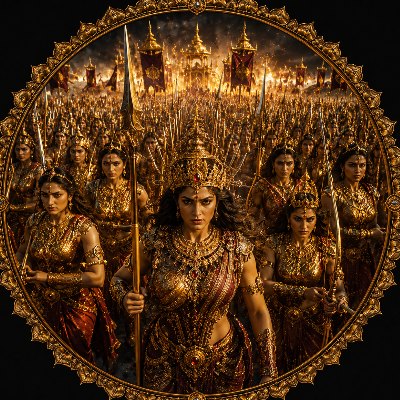
The Shakti Sena is the divine army of Lalita Tripura Sundari — the supreme goddess of the Sri Vidya tradition — assembled and deployed in the war against Bhandasura, the asura emperor of Shunyaka Nagara, as narrated in the Lalitopakhyana of the Brahmanda Purana. It was the first army in the tradition to be constituted entirely of female divine beings — goddesses, Shaktis, Yoginis, Bhairavis, and Nitya Devis — and it fought against Bhandasura's three-hundred-akshauhini force of asuras over four days of increasingly intense battle. The Shakti Sena was not assembled from pre-existing divine forces but created directly by Lalita herself from her own being, her weapons, and her chariot — each unit of the army emerging as a manifestation of a specific aspect of the Goddess's power. Its supreme command structure was constituted by Lalita on the Sri Chakra Ratha at the centre, Mantrini (Raja Matangi) on the Geya Chakra Ratha at the right, and Dandanatha (Maha Varahi) on the Kiri Chakra Ratha at the left. Below this supreme triad were the specialist cavalry and elephant commanders, the Nitya Devis as the army's lunar-cosmic dimension, and — in the final phase of the war — the Dashavatara Shaktis manifested directly from Lalita's own person as counter-weapons. The Shakti Sena is attested across the full Lalitopakhyana narrative of the Brahmanda Purana and encoded in multiple names of the Lalita Sahasranama.
✦ Origin and Constitution of the Army
The Lalitopakhyana records the Shakti Sena's creation in the sequence of events immediately following Lalita's emergence from the Cidagni Kunda — the fire of pure consciousness — and her union with Kameshvara. Lalita hummed with rage — the hum of divine resolve — and from this single utterance sixty-four million Yoginis were born, sixty-four million Bhairavas were born, and innumerable Shakti Senas were created simultaneously. From her four weapons were produced the four great commanders of the specialist regiments: from the ankusha (goad) came Sampatkari Devi with crores of the finest elephants forming the Sindhura Vraja; from the pasha (noose) came Ashvarudha Devi with crores of swift horses forming the cavalry regiment, which advanced in the vanguard of the entire army. From the sugarcane bow came Mantrini Devi — Shyamala — who was crowned prime minister and given Lalita's finger ring as the royal seal. From the five flower arrows came Dandanatha Devi — Varahi — who was made supreme commander of the whole Shakti Sena and given a mace fashioned from Lalita's own eyebrow.
Lalita then created two chariots from her own Sri Chakra Ratha and gave one each to Mantrini and Dandanatha. The Geya Chakra Ratha of Mantrini produced musical sound as it moved. The Kiri Chakra Ratha of Dandanatha was drawn by one thousand boars and piloted by Stambhini Devi. Bala Tripurasundari — the nine-year-old daughter-form of the Goddess — rode on her Karni Ratha drawn by swans. Mahaganesha, manifested from Lalita's smile and Kameshvara's gaze, presided over the army's threshold from the Bhupura. The Nitya Devis attended the army in their full complement. The entire formation was set in motion toward Shunyaka with the four oceans themselves thundering as the army's war drums.
✦ The Army's Formation and Internal Structure
The Lalitopakhyana's internal chariot and formation table, preserved in the Kamakoti Mandali's primary text compilation, records the precise spatial arrangement of the Shakti Sena's principal figures. Hayagriva — the horse-faced avatar of Vishnu who serves as the narrator of the Lalitopakhyana — was placed in the vanguard of the army. Stambhini Devi commanded the rear with the main body of forces behind her. The three principal chariots — Sri Chakra Ratha (Lalita), Geya Chakra Ratha (Mantrini), and Kiri Chakra Ratha (Dandanatha) — moved in unison at the army's centre, the three supreme commanders forming an inseparable command triangle. Sampatkari's elephants moved behind the central chariot formation, and Ashvarudha's cavalry moved ahead of it, forming the forward and rearward mobile screens. The Kiri Chakra Ratha carried celestial physicians — the Ashwini Devas and Dhanvantari — within it, giving the military chariot a healing function for the army's wounded.
✦ The Supreme Command: The Three Chariots
- Lalita Tripura Sundari — Supreme goddess and commander of the entire Shakti Sena. Rode the Sri Chakra Ratha — a chariot of pure luminous energy, four yojanas wide, ten yojanas tall, nine storeys, four wheels — constituted from Mount Meru's essence. Holder of the noose, goad, sugarcane bow, and five flower arrows. She directed every phase of the war and personally fought the final duel with Bhandasura in which she deployed all twenty-three astras including the Mahakameshvarastra that ended the war.
- Raja Matangi (Mantrini) — Prime minister and counsellor. Rode the Geya Chakra Ratha — the chariot of musical sound. Born from Lalita's sugarcane bow. Held Lalita's finger ring as Mudrini — bearer of the royal seal. Praised by gods and sages by sixteen names at the army's advance. Killed Vishukra — Bhandasura's prime minister — in the primary Lalitopakhyana narrative. Served as Bala Tripurasundari's bodyguard alongside Varahi when Bala went to battle.
- Maha Varahi (Dandanatha) — Supreme military commander. Rode the Kiri Chakra Ratha — the boar-wheeled chariot carrying celestial physicians — piloted by Stambhini Devi. Born from Lalita's five flower arrows. Received a mace fashioned from Lalita's eyebrow as her weapon. Praised by gods and sages by twelve names. Killed Vishanga — Bhandasura's military commander. Countered Vishukra's Tarsha-Astra by commanding the Madyasamudra devata. Deployed her bodyguard Tiraskarinika Devi with the Andhanashtra to rescue the Shakti Sena from seven commanders. Personifies the principle of ahamkara in Tantric cosmology.
✦ The Specialist Commanders
- Sampatkari Devi — Chief of the elephant regiment (Sindhura Vraja). Born from Lalita's ankusha (goad). Rode the great elephant Ranakolahala. On the first day of the war she confronted and killed the demon commander Durmada after he destroyed a gem from her crown. Subsequently destroyed the army of Karundasura. Commands the wealth-principle and governs the Sampatkari Vidya with the bija krom.
- Ashvarudha Devi — Chief of the cavalry regiment. Born from Lalita's pasha (noose). Rode the horse Aparajita — the Undefeated — at the head of the entire army's advance formation. On the first day she killed the demon commander Kurunda after deploying her pasha as fiery serpent-ropes to bind his forces. Aparajita fought independently with its hooves. Identified as Lalita's Pratyanga Devi — the subsidiary limb-goddess. Embodies the principle of the disciplined mind mastering the senses.
- Bala Tripurasundari — Daughter-form of Lalita. Rode the Karni Ratha drawn by swans, with Mantrini and Varahi as her bodyguards. Destroyed all thirty of Bhandasura's sons in a single engagement using the Narayanastra. The primary deity of the Sri Vidya initiatory sequence — her three-syllable mantra Aim Klim Sauh is the first mantra formally given to Sri Vidya aspirants. Identified as Lalita's Anga Devi — the primary limb-goddess.
- Mahaganesha — Manifested from Lalita's smile and Kameshvara's gaze as a ten-armed elephant-headed deity accompanied by Siddhi and Lakshmi. Discovered and destroyed Vishukra's Jaya-Vighna-Yantra — the hidden magical obstruction that had incapacitated the entire Shakti Sena — restoring the army to full capacity. Then led the six Vighnanayakas (Amoda, Pramoda, Durmukha, Sumukha, Arighna, Vighnakarta) in destroying Gajasura's forces. Received from Lalita the boon of being worshipped before all other deities in any ritual — the foundation of his universal primacy in the Hindu worship order. Presides over the first avarana (Bhupura/Trailokyamohana Chakra) of the Sri Chakra.
- Jwalamalini — The fourteenth Nitya Devi, performing dual functions within the Shakti Sena: first, illuminating the darkness of Vishanga's night attack alongside the fifth Nitya Vahnivasini; second, constructing the hundred-yojana-wide, thirty-yojana-tall fire wall around the entire Shakti Sena at Lalita's command following the night attack. Six-faced, twelve-armed, ruler of the solar, lunar, and fire kalas.
- Stambhini Devi — Member of Varahi's family and retinue. Served as the personal charioteer (pilot) of the Kiri Chakra Ratha throughout the war. Commanded a force of twenty akshauhinis guarding the one-yojana entry passage on the southern face of Jwalamalini's fire wall — designated Vighna Devi for this threshold role. Also served as the rear commander of the entire Shakti Sena's marching formation.
✦ The Fifteen Nitya Devis
The fifteen Nitya Devis — the eternal lunar goddesses each governing one of the fifteen visible tithis of the waxing moon — attended the Shakti Sena as its cosmic dimension, representing the fifteen kalas of Lalita's own consciousness in their manifest form. Their names, tithi correspondences, and sequence are: Kameshvari (Pratipat), Bhagamalini (Dvitiya), Nityaklinna (Tritiya), Bherunda (Chaturthi), Vahnivasini (Panchami), Mahavajreshvari (Shashthi), Shivaduti (Saptami), Tvarita (Ashtami), Kulasundari (Navami), Nitya (Dashami), Nilapataka (Ekadashi), Vijaya (Dvadashi), Sarvamangala (Trayodashi), Jvalamalini (Chaturdashi), and Chitra (Purnima). Lalita herself constitutes the sixteenth and invisible kala — the full moon's unchanging essence — making the inclusive count of the Nityas with Lalita sixteen, the Shodasha Nityas.
Their collective military act during the war was decisive. When Vishanga organised a treacherous night attack on the Shakti Sena's rear, the Nitya Devis Vahnivasini and Jvalamalini illuminated the battlefield by blazing with their inherent fire-radiance. With the darkness dispelled and the concealed demons exposed, all sixteen Nityas — the inclusive count with Lalita — attacked and destroyed Vishanga's entire night-attacking force. Its commanders were killed and Vishanga himself fled wounded. This collective action is commemorated in the Lalita Sahasranama (Name 72): Nityaparakrama-topa-nirikshana-samutsuka — seeing the valour of the Nitya Devatas, Lalita was extremely pleased.
✦ The Dashavatara Shaktis
The Dashavatara Shaktis were the ten Shakti-forms of Vishnu's principal avatars manifested by Lalita directly from her own being during the final personal duel with Bhandasura. They were not pre-existing members of the Shakti Sena but living pratyastras — counter-weapons taking divine form — each generated in response to a specific astra deployed by Bhandasura. Each of Bhandasura's weapons invoked the power of a demonic adversary from a previous cosmic cycle, and each of Lalita's counter-astras manifested the corresponding avatar who had originally defeated that adversary. The ten were: the Adi-Kurma-Astra (Kurma/Tortoise form), the Maha-Varaha-Astra (Varaha/Boar), the Ugra-Narasimha-Astra (Narasimha/Man-Lion), the Vamana-Astra (Vamana/Dwarf), the Bhargava-Astra (Parashurama), the Kodanda-Rama-Astra (Rama with his bow, with Lakshmana emerging from Lalita's left index fingernail to slay Indrajit), the Haladhara-Astra (Balarama), the Vasudeva-Astra with Sankarshana-Astra, Pradyumna-Astra, and Aniruddha-Astra (the four vyuha forms of Krishna-Vishnu), and the Kalki-Astra (the future avatar). The Maha-Durgastra — which produced Durga on her lion to destroy the army of resurrected ancient demons unleashed by the Maha-Asurastra — preceded this sequence. Following their victories, Lalita commanded all ten avatar-murtis to reside in Sri Vaikunta and re-enact their deeds in every cosmic cycle — making the recurring Dashavatara tradition in each cosmic age a permanent commission from the supreme Goddess.
✦ The Four-Day War: A Summary
The Shakti Sena's campaign against Bhandasura unfolded across four days. On the first day, Sampatkari killed Durmada and Ashvarudha killed Kurunda — two of Bhandasura's opening commanders. On the second day, Bhandasura's thirty sons entered the battle and were destroyed in a single engagement by Bala Tripurasundari. Vishukra, driven to extremity, created and installed the Jaya-Vighna-Yantra, which incapacitated the entire Shakti Sena; Mahaganesha, manifested from Lalita's smile, discovered and destroyed it. Vishukra then deployed the Tarsha-Astra; Dandanatha countered it with the Madyasamudra. On the third day, Vishanga launched the treacherous night attack; the Nitya Devis illuminated and destroyed his forces. Jwalamalini constructed the fire wall. Dhumini's ten sons entered battle alongside Vishukra and Vishanga. In the subsequent phase, Vishukra and Vishanga were killed by the supreme commanders. On the fourth and final day, Lalita fought Bhandasura directly in the twenty-three-exchange astra duel, deploying the Dashavatara Shaktis, the Narayanastra, the Pashupatastra, and ultimately the Mahakameshvarastra that vaporised Bhandasura and erased Shunyaka.
✦ The Lalita Sahasranama Encoding of the Shakti Sena
The Lalita Sahasranama encodes the principal components of the Shakti Sena across a continuous sequence of names from Name 64 through Name 84, each name recording a specific aspect of the army's formation, commanders, weapons, or victories. Key names encoding the Shakti Sena as a collective include: Name 64 (Kula-amrutaika-rasika — the army as the taster of the nectar of the Kula tradition), Name 65 (the army's dharmic mandate), Name 66 (Sampatkari-samaroodha-sindhura-vraja-sevita), Name 67 (Ashvarudhadhishtita-ashvakotikotibhiravruta), Name 68 (Chakraraja-ratharudha-sarvayudha-parishkrta — Lalita herself fully armed), Name 69 (Geyachakra-ratharudha-mantrini-parisevita), Name 70 (Kirichakra-ratharoodha-dandanatha-puraskrita), Name 71 (Jvalamalinikakshipta-vahniprakara-madhyaga), Name 72 (Nityaparakrama-topa-nirikshana-samutsuka), Name 74 (Bhandaputra-vadhodhyukta-bala-vikrama-nandhita), Name 75 (Mantrinyamba-virachita-vishanga-vadhatoshita), Name 76 (Vishukra-prana-harana-varahi-viryanandhita), and Name 78 (Mahaganesha-nirbhinna-vighnayantra-praharshita). These names together constitute the Shakti Sena's canonical scriptural record within the Lalita Sahasranama's thousand-name structure.
✦ Theological Significance
The Shakti Sena is unique in the Hindu Puranic tradition as an entirely feminine divine army. Every member of its command structure — from the supreme commander Dandanatha through the specialist regiment chiefs Sampatkari and Ashvarudha, the prime minister Mantrini, the daughter-warrior Bala, the fire-wall builder Jvalamalini, and the threshold-keeper Stambhini — is a goddess or a feminine divine form. Even the male figures associated with the army — Mahaganesha, the Dashavatara murtis, and Hayagriva the narrator-vanguard — are understood in the Shakta theological framework as expressions of or subordinates to the feminine power that produced them. The Dashavatara Shaktis are not Vishnu's avatars deployed independently but counter-weapons manifested from the Goddess's own body — the Shakta tradition's assertion that all Vaishnava avatar-power ultimately flows from and returns to the supreme feminine consciousness. The Shakti Sena is thus both a military narrative and a complete theological statement: the organisation of all cosmic powers — lunar (Nitya Devis), solar and fire (Jvalamalini), elemental (Sampatkari's earth-wealth, Ashvarudha's wind-speed), intelligence (Mantrini), ahamkara (Dandanatha), avatar-power (Dashavatara Shaktis), and pure consciousness (Lalita at the centre) — under the single unified command of the supreme Goddess.
✦ References
Primary Sources
- Brahmanda Purana, Lalitopakhyana (Lalita Mahatmya), Chapters 14–29 — The complete primary source for the Shakti Sena's formation, structure, commanders, four-day war narrative, and the Dashavatara Shaktis; narrated as a dialogue between Hayagriva and Agastya.
- Lalita Sahasranama (within the Lalitopakhyana) — Names 64–84 encode the entire Shakti Sena's principal components, commanders, chariots, actions, and victories within the thousand names composed by the eight Vak Devis at Lalita's command.
- Nityashodashikarnava (Vamakeshvara Tantra) — The principal Tantric text for the fifteen Nitya Devis as part of the Shakti Sena's cosmic dimension; provides their mantras, yantras, and tithi correspondences.
- Parashurama Kalpasutra — Establishes the Sri Vidya worship order for all principal members of the Shakti Sena; designates Varahi as Para Vidya and specifies Bala's mantra as the first Sri Vidya initiation.
- Tripura Rahasya, Jnana Khanda — An independent Sanskrit text attesting the war between Lalita and Bhandasura including the Shakti Sena's role.
Modern and Secondary Reference Works
- Wisdomlib — Lalitopakhyana (Lalita Mahatmya), full English translation (wisdomlib.org/hinduism/book/lalitopakhyana-lalita-mahatmya) — The principal English translation of the primary text; chapters 14–29 cover the complete Shakti Sena formation and war narrative.
- Kamakoti Mandali — A List from Lalitopakhyana (kamakotimandali.com) — The primary text correspondence table identifying each commander with her origin in Lalita's body or weapons, the complete Nitya Devi list, and the full twenty-three astra-pratyastra exchange table for the Bhandasura duel including all ten Dashavatara counter-astras.
- India-guide.blogspot.com — Lalitopakhyanam: Story of Lalita Tripura Sundari Devi — Provides the primary text narrative confirming the creation of 64,000,000 Yoginis and 64,000,000 Bhairavas from Lalita's hum; the sequence of commanders' creation from weapons; the four-ocean war drums; the complete first-day battle record.
- Srilalithatripurasundari.wordpress.com — Lalitopakhyana Synopsis and Name Commentaries (Names 64–84) — The most comprehensive secondary source for the Shakti Sena's individual components; provides section-by-section narrative of all four days of the war and verse-by-verse commentary on each Sahasranama name encoding the army's structure.
- Scribd — Glimpses of LalitOpakhyana Through Lalitha Sahasranama (all editions) — The chariot formation table confirming Hayagriva at the vanguard and Stambhini at the rear; the complete narrative of all four war days; the Dashavatara sequence including the left fingernail detail for Lakshmana; the post-victory command to the ten avatar-murtis to reside in Vaikunta.
- Omshivashakti.wordpress.com — Lalitopakhyana: The Story of the Goddess Lalita — Full narrative summary of the Shakti Sena's formation and the war, section by section; the most accessible prose account of the army's creation and deployment.
- Nivniks.wordpress.com — Sri Lalitopakhyana Parts 7–10 — Detailed narrative accounts of individual war phases including the Jaya-Vighna-Yantra episode, the Nitya Devis' night battle, and the fire wall construction; confirms the ten-akshauhini figure for Dhumini's sons alongside Vishukra and Vishanga in the army's reorganisation.
- Wikipedia — Bhandasura article (en.wikipedia.org/wiki/Bhandasura) — Confirms the Wisdomlib Chapter 29 citation for the final duel including Narasimha and Kalki coming to Lalita's aid; confirms the Maha-Asurastra episode and Durga's manifestation from Lalita's laughter.
- Tantra.press — The Fifteen Nityas in the Crescent Moon — Confirms the complete Nitya Devi list and their individual cosmic functions within the Shakti Sena's lunar dimension.