
About
Raja Matangi — Prime Minister of Lalita Tripura Sundari, Goddess of Speech and the Sovereign Arts
Raja Matangi · Rajashyamala · Shyamala · Mantrini · Mudrini · Sachiveshani · Mantrini Devi · Shyamala Devi · Matangi Mahavidya · Veda Mata · Laghushyama
Raja Matangi is the prime minister and chief counsellor of the supreme goddess Lalita Tripura Sundari in the Sri Vidya tradition. She is also known as Shyamala — the dark green one — and as Mantrini, meaning the minister or the one who holds the mantra-power. Within the broader Shakta tradition she is identified as the ninth of the ten Mahavidyas — the great wisdom goddesses — and is considered the Tantric form of Sarasvati, governing speech, music, knowledge, the sixty-four arts, mantra shakti, and the power of divine command. In the Lalitopakhyana of the Brahmanda Purana, she was born from Lalita's sugarcane bow, was crowned prime minister of the divine court and given Lalita's own finger ring — the royal seal — making her the executive authority of Lalita's empire. Her chariot was created by Lalita from her own Sri Chakra Ratha and named the Geya Chakra Ratha — the chariot of musical sound. In the war against Bhandasura, she killed Vishukra, the prime minister and principal occult strategist of Bhandasura's court. She is also identified in the Lalitopakhyana with the sage Matanga's devotion, through which she was born as his daughter Laghushyama. She is attested in the Brahmanda Purana, the Lalita Sahasranama, the Devi Bhagavata Purana, the Parashurama Kalpasutra, the Purashcharyarnava, the Saradatilaka, the Shyamaladandakam, and the Kubjika Upanishad.
✦ The Names
The name Shyamala is Sanskrit for dark, dark-complexioned, or of the colour of rain-bearing clouds — specifically the deep emerald-green or blue-black of a sky charged with monsoon water. It is her most ancient and essential name, evoking her deep association with the fertile, generative, and sonic dimensions of nature. Raja Shyamala — royal Shyamala — identifies her specifically as the queen among the Shyamala goddesses, the chief of her class. Matangi derives from the sage Matanga, whose penance drew her forth as a daughter, and from matanga which can also denote an elephant — her ample form being compared to the frontal globes of an elephant's forehead in one etymology recorded in the Scribd Rajashyamala source. As Mantrini — the minister, the one who embodies mantra-power — she is the operative intelligence of Lalita's divine government, the figure through whom the Goddess's intentions are formulated, articulated, and executed. As Mudrini — the seal-bearer — she is entrusted with the royal mudra, Lalita's finger ring, the mark of executive authority. As Sachiveshani she is the counsellor-sovereign. The Lalita Sahasranama (Name 10, Mantrini-nyasta-rajyadhuh) states plainly that to Mantrini is entrusted the burden of the kingdom's governance — a direct scriptural confirmation of her administrative sovereignty.
The sixteen names preserved in the primary Lalitopakhyana — Sangeeta Yogini, Shyama, Shyamala, Mantra Nayika, Mantrini, Sachiveshani, Pradhaneshi, Shukapriya, Vinaavati, Vainiki, Mudrini, Priyakapriya, Nipapriya, Kadambeshi, Kadamba Vana Vasini, and Sadamada — collectively encode the range of her functions: music, counsel, mantra-mastery, the royal seal, the love of parrots, the vina, and the forest of Kadamba trees that is her dwelling.
✦ Origin from Lalita's Sugarcane Bow
The Lalitopakhyana and its Scribd summary both confirm that Shyamala — the prime minister — was born from Lalita's sugarcane bow. This origin is theologically precise. The sugarcane bow is one of Lalita's four weapons, representing the mind — the instrument through which desire operates and through which the universe is drawn toward the Goddess. Mantrini, born from the mind-bow, is therefore the embodiment of the mind's most refined function: the capacity to formulate intention into mantra, to govern through articulate wisdom rather than through force, to make the power of the supreme consciousness operative in the world of form and speech. The Vedadhara and Scribd sources confirm that immediately after Shyamala emerged from the bow, a parrot appeared in her hand — and from that parrot emerged Dhanurveda, the divine science of archery, holding a spectacular bow named Chitrajeevam, which he presented to Lalita as a gift — an event that symbolically makes Shyamala the indirect source of Lalita's primary weapon in the war.
✦ Appointment as Prime Minister and the Finger Ring
The Lalitopakhyana (synopsis section 214–215) records that Lalita crowned Shyamala Devi as her prime minister and handed over her finger ring to her. The finger ring — the mudra, the royal seal — is the instrument through which the queen's authority is authenticated and through which official decrees are issued. By entrusting it to Shyamala, Lalita conferred upon her not merely a ministerial title but the actual executive power of the divine empire. This act established two of Shyamala's principal identities simultaneously: Mantrini, the minister who holds mantra-power, and Mudrini, the seal-bearer who holds executive authority. Lalita subsequently created a chariot from her own Sri Chakra Ratha for Shyamala — named the Geya Chakra Ratha — a chariot that produced beautiful musical sound as it moved. The sixty-ninth name of the Lalita Sahasranama, Geyachakra-ratharudha-mantrini-parisevita — she who is attended by Mantrini riding the Geya Chakra Ratha — encodes this moment permanently in the Goddess's thousand names.
✦ The Origin Story of the Name Matangi
The Lalitopakhyana preserves a separate narrative explaining the specific name Matangi and its connection to the sage Matanga. The synopsis (sections 364–367) records that Matanga once felt publicly humiliated and undertook great penance directed at Mudrinidevi — Mantrini Devi, who had received the royal ring from Lalita. Mantrini was pleased by his penance and granted him the boon that she herself would be born as his daughter. Shortly afterward, Shyamala Devi appeared in the dream of Siddhamati Devi, the consort of Matanga, and gave her a flower from her ear ornament. A female child was born very soon and named Laghushyama — meaning the swift or the small Shyamala, born in a very short duration — and she was also called Matangi and Matanga Kanyaka, the daughter of Matanga. With her power she generated crores of virgins who remained near Mantrini Devi's house singing her praises.
✦ Role in the War and the Killing of Vishukra
In the war against Bhandasura's forces, Matangi served as one of the two supreme commanders flanking Lalita — together with Varahi, the military commander — and was praised by gods and sages by sixteen specific names as the army advanced into battle. The Scribd primary text summary (Glimpses of LalitOpakhyana) records that when the army moved forward, Varahi, Matangi, and Lalita were praised by gods and sages by twelve, sixteen, and twenty-five names respectively, confirming the precise gradation of their divine rank.
Matangi — here in the role of Mantrini — killed Vishukra, the prime minister and chief occult strategist of Bhandasura's court. This killing is directly symmetrical with the structure of the two courts: Bhandasura's prime minister fell to Lalita's prime minister, and Bhandasura's military commander Vishanga fell to Lalita's military commander Varahi. The primary text assigns the Brahmasirashtra as the weapon deployed by Mantrini against Vishukra in one account, while another account names Varahi as Vishukra's killer. This divergence across recensions has been noted in preceding profiles; the most consistent attribution in the primary Lalitopakhyana text places Vishukra's death at Mantrini's hands.
✦ Identity as the Ninth Mahavidya
Within the Dasha Mahavidya system — the ten great wisdom goddesses of the Shakta tradition — Matangi is counted ninth. She is understood as the Tantric counterpart of Sarasvati, the Vedic goddess of speech, knowledge, and the arts, but occupies a domain that Sarasvati does not: the spaces of impurity, the margins of conventional society, the wild and untamed dimensions of sound and speech that exist beyond the formal Vedic order. While Sarasvati governs scripture, grammar, and the refined arts, Matangi governs the living, spontaneous power of mantra, the speech that operates at the edge of propriety, and the knowledge that arises from direct experience rather than from textual transmission. She is the goddess of the outcaste, the wanderer, and the one who speaks truth without diplomatic softening — all of which make her the perfect embodiment of the administrative function of divine government, where the ability to speak truth to power and to execute difficult decisions is more important than formal decorum.
✦ Iconography
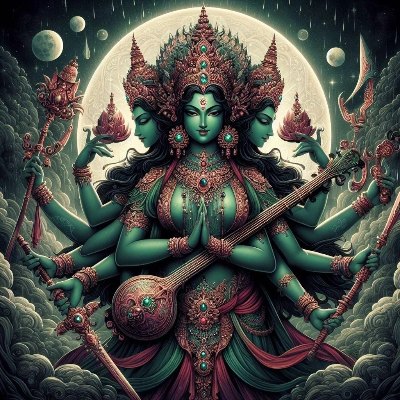
Matangi is most commonly described as emerald green or dark green in complexion — the colour of rain-heavy clouds and of dense forest, evoking the fertility and vitality she governs. The Dhyana Mantra of Raja Matangi from the Purashcharyarnava gives the most detailed canonical description: she has a crescent moon on her forehead, long wild hair, a smiling expression, and intoxicated eyes, and wears a garland of kadamba flowers and various ornaments. She perspires slightly around her face, an unusual and specifically beautiful detail. Below her navel are three horizontal folds of skin and a thin vertical line of fine hair. She is seated on an altar or gem-throne and flanked by two parrots. She holds a veena — the classical Indian stringed instrument — in one of her hands, encoding her sovereignty over music and the sonic dimension of mantra. The Saradatilaka adds that she plays the veena, wears conch-shell earrings and flower garlands, and has flower paintings adorning her forehead. In her warrior form she holds a noose, a sword, a goad, and a club. In the Kubjika Upanishad she is described as blue, with blue garments, blue perfumes, blue ornaments, and a blue parrot.
The Shyamaladandakam — an independent devotional text addressed to Shyamala — describes her as playing a ruby-studded veena and as speaking sweetly. In some depictions she carries the four weapons of Lalita herself — sugarcane bow, flower arrows, noose, and goad — indicating her role as Lalita's executive representative whose authority is inseparable from the Goddess's own. When Matangi is depicted with four arms, the four arms are understood in some traditions as representing the four Vedas.
✦ Place in the Sri Vidya Tradition
In the Sri Vidya tradition, Matangi governs Vak Shakti — the power of speech — and Mantra Shakti — the power of sacred sound. She is identified as the ninth Vak Devi and as Veda Mata, the mother of the Vedas. The Kamakoti Mandali correspondence list from within the Lalitopakhyana identifies Shyamala with Lalita's buddhi — the faculty of intelligence and discrimination — making her the cognitive executive of the Goddess's cosmic operations. The Shyamala Navratri is observed in the Magh month specifically for her worship. The Hindu Blog source records that devotion to Lalita is considered incomplete without first pleasing Shyamala, since she grants the permission and the cognitive capacity required to approach the supreme Goddess. She is one of the two figures — Shyamala and Varahi — who are positioned on either side of Lalita Tripura Sundari in the standard Sri Vidya icon arrangement.
✦ References
Primary Sources
- Brahmanda Purana, Lalitopakhyana, sections 214–219 and 364–367 — Primary source for Shyamala's birth from Lalita's sugarcane bow, her coronation as prime minister, the gift of the finger ring, the creation of the Geya Chakra Ratha, and the Matanga penance narrative producing Laghushyama.
- Lalita Sahasranama, Name 10: Mantrini-nyasta-rajyadhuh; Name 69: Geyachakra-ratharudha-mantrini-parisevita — Two names directly encoding Matangi's ministerial sovereignty and her chariot within the thousand names of Lalita.
- Purashcharyarnava — Contains the Dhyana Mantra of Raja Matangi providing the canonical iconographic description including crescent moon, kadamba garlands, intoxicated eyes, perspiration, the veena, and the two parrots.
- Saradatilaka — Adds the ruby-studded veena, conch-shell earrings, flower garlands, and forehead painting to the Raja Matangi iconographic description.
- Shyamaladandakam — An independent devotional text in Sanskrit addressed to Shyamala recording her as the sweet-speaking player of the ruby-studded veena.
- Kubjika Upanishad — Records Matangi as the blue one with blue garments, blue perfumes, blue ornaments, and a blue parrot; an alternate iconographic tradition.
- Parashurama Kalpasutra — A primary Sri Vidya Tantric text establishing the worship of Matangi within the Sri Vidya tradition and her place in the devotional sequence.
Modern and Secondary Reference Works
- Lalitopakhyana Synopsis (srilalithatripurasundari.wordpress.com) — Provides the most detailed account of sections 214–219 and 364–367; confirms the sequence of Shyamala's birth, coronation, ring, chariot, and the Matanga penance narrative.
- Omshivashakti.wordpress.com — Lalitopakhyana: The Story of the Goddess Lalita — Corroborates the synopsis account including the sixteen names of Mantrini and the creation of the Geya Chakra Ratha.
- Nivniks.wordpress.com — Sri Lalitopakhyana Part 7 — Provides the full sixteen-name list of Mantrini Devi and the account of the parrot in her hand producing Dhanurveda and the bow Chitrajeevam.
- Scribd — Glimpses of LalitOpakhyana Through Lalitha Sahasranama — Confirms that Shyamala the prime minister was born from Lalita's sugarcane bow; records that Mantrini killed Vishukra using the Brahmasirashtra weapon.
- Scribd — Understanding Raja Matangi Mantras — Provides the etymology of the name Matangi including the elephant-bosom derivation; confirms her role as Mantrini and Mudrini and her governance of speech, wisdom, and the arts.
- Wikipedia — Matangi article (en.wikipedia.org/wiki/Matangi) — Confirms her status as the ninth Mahavidya, the Tantric form of Sarasvati; provides the Purashcharyarnava iconographic description and the Saradatilaka additions; confirms her two-to-four-armed forms and the list of objects she holds.
- Srilalithatripurasundari.wordpress.com — Commentary on Name 69 — Confirms the Geya Chakra Ratha as Mantrini's chariot and its musical property; records that the 79 yoginis of the Sri Chakra are also called mantrinis — a different usage from the specific deity Mantrini.
- Kamakoti Mandali — A List from Lalitopakhyana (kamakotimandali.com) — Confirms the Lalitopakhyana's internal identification of Shyamala with Lalita's buddhi — the faculty of intelligence — within the correspondence table of the Goddess's bodily and cosmic dimensions.
- Hindu Blog — Shyamala Navratri article (hindu-blog.com) — Records the Shyamala Navratri observance; confirms her identity as the ninth Vak Devi and as Veda Mata; states that devotion to Lalita is incomplete without first pleasing Shyamala.
- Kinsley, David — Tantric Visions of the Divine Feminine: The Ten Mahavidyas, University of California Press, 1997 — Scholarly secondary source confirming Matangi's position as the ninth Mahavidya, her governing domain over speech and impurity, and her comparison with Sarasvati.