
About
Maha Varahi — Supreme Commander of Lalita's Army and Destroyer of Vishukra
Maha Varahi · Varahi · Dandanatha · Dandanayika · Vartali · Vaartali · Potrini · Panchami · Dandini · Barahi · Dhruma Varahi
Maha Varahi is the supreme military commander of the army of Lalita Tripura Sundari — the Shakti Sena — and one of the two highest-ranking functionaries of Lalita's divine court, the other being Raja Matangi the prime minister. She is also known as Dandanatha — the lord or master of the staff or sceptre of authority — and as Vartali, the name applied to her in the Lalitopakhyana at the moment of her appointment. In the war against Bhandasura she served as commander-in-chief of the entire Shakti Sena, killed Vishukra the prime minister of Bhandasura's court with her plough and pestle, countered Vishanga's Tarsha-Astra by commanding the Madyasamudra devata to quench her army's thirst, and deployed her personal bodyguard Tiraskarinika Devi to rescue the Shakti Sena from the assault of Bhandasura's seven commanders. She was born from Lalita's five flower-tipped arrows, was given a mace created by Lalita from her own eyebrow, and rode the Kiri Chakra Ratha — a chariot whose wheels were fashioned from boar-heads and which carried celestial physicians including the Ashwini Devas and Dhanvantari. She is identified in the Tantric-Raja-Tantra with the principle of ahamkara — the ego function — and in the Sri Vidya tradition is elevated to the status of Para Vidya — transcendental knowledge. She is one of the seven Matrikas of the Hindu tradition, appearing across the Devi Mahatmya, the Matsya Purana, the Vishnu-dharmottara Purana, the Agni Purana, the Devi Purana, the Parashurama Kalpasutra, and the Lalitopakhyana of the Brahmanda Purana.
✦ The Names
The name Varahi derives from Varaha — the boar, the third avatar of Vishnu — and is the feminine form, meaning the she-boar or one who possesses the energy of the boar. Varahi is the Shakti — the feminine power — of Varaha, and her boar-face, dark complexion, plough, and pestle all encode the deep earth-symbolism of the boar deity: the boar that dives into primordial waters to retrieve the earth, the plough that tills the soil, the pestle that threshes the grain. Dandanatha means lord of the danda — the staff of authority, the instrument of righteous punishment — and identifies her specifically as the keeper of divine law and discipline within Lalita's court. She is called Vartali and Vaartali in some passages of the Lalitopakhyana — a name whose precise etymology is not elaborated in the sources consulted. Potrini — one with the boar snout — is the name used for her in the Lalitopakhyana's synopsis (section 331), identifying her specifically by her distinctive iconographic feature. Panchami identifies her as the fifth among the eight Matrikas of the Ashtamatrika grouping. In Rajasthan and Gujarat she is worshipped as Dandini; in Nepal as Barahi.
✦ Origin from Lalita's Five Flower Arrows
The Lalitopakhyana and its Scribd summary confirm that Varahi — the commander-in-chief — was born from Lalita's five flower-tipped arrows. The five flower arrows are among Lalita's four primary weapons, representing the five sense objects that draw consciousness into engagement with the world. Varahi, born from these arrows, thus embodies the directed, purposeful force of the senses when they are brought under divine command — their power turned toward destruction of the demonic rather than entanglement in the mundane. The Lalitopakhyana synopsis (section 216–217) records that Lalita made Vaarataalee Devi the chief of her army and gave her the title Dandanatha, then created a mace from her own eyebrow and presented it to Dandanatha. The mace created from the goddess's eyebrow — the line of beauty and determination that frames the Goddess's gaze — is one of the most distinctive weapons in the Lalitopakhyana's arsenal, encoding the principle that Varahi's military authority flows from Lalita's own concentrated will.
✦ Appointment and the Kiri Chakra Ratha
- Title and authority: Lalita appointed Vaartali as the chief of her army with the title Dandanatha and gave her a mace fashioned from her own eyebrow. The Lalitopakhyana synopsis (section 216) records this as a direct act of creation and appointment — both the title and the weapon came from Lalita simultaneously.
- Chariot: The Kiri Chakra Ratha — the chariot whose wheels are fashioned from boar-heads or whose chariot is drawn by boars, depending on the reading of the compound. The seventieth name of the Lalita Sahasranama, Kirichakra-ratharoodha-dandanatha-puraskrita — she who is attended by Dandanatha riding the Kiri Chakra Ratha — records this chariot as integral to Varahi's identity. The commentary on this name confirms that the Kiri Chakra always moved in step with the Sri Chakra of Lalita and the Geya Chakra of Shyamala — the three chariots forming a procession of supreme command. The Sri Rajarajeswari Peetham source notes that the Kiri Chakra carried celestial physicians, including the Ashwini Devas and Dhanvantari, the divine physician — giving the military chariot a healing function consistent with Varahi's role as the guardian of her army's wellbeing.
- Bodyguard: Tiraskarinika Devi — Varahi's personal escort — who rode a flying vehicle called Tamoliptam and deployed the Andhanashtra — the arrow of blindness — against Bhandasura's seven commanders, forcing them to close their eyes and allowing the Shakti Sena to press forward.
- Praise at the army's advance: When the Shakti Sena marched toward battle, the gods and sages praised Varahi, Matangi, and Lalita by twelve, sixteen, and twenty-five names respectively — a graduated hierarchy of divine praise confirming Varahi's rank as the army's first commander, below only Mantrini in the court hierarchy.
✦ Role in the War: Key Episodes
Varahi's war conduct in the Lalitopakhyana is narrated across several distinct episodes. On the first day of battle, Sampatkari and Ashvarudha dealt with Bhandasura's initial commanders. In the subsequent days, as Bhandasura reorganised and his brothers Vishukra and Vishanga returned with reinforced forces, Varahi and Mantrini mounted their chariots simultaneously and engaged the two principal demons directly in the primary Lalitopakhyana narrative.
When Vishukra discharged the Tarsha-Astra — the weapon causing intense and incapacitating thirst — against the Shakti Sena, Varahi immediately responded by commanding the Madyasamudra devata — the presiding deity of the ocean of liquor held within her chariot's enclosure — to appear in human form and quench her army's thirst by showering rain of liquor. The devata accomplished this and Varahi conferred upon it the boon of usage in sacrifices as a reward. This episode established the ritual significance of a particular offering within the Sri Vidya tradition.
Varahi then engaged Vishukra directly and killed him — using her plough to seize and drag him and her pestle to deliver the killing blow. This is the attribution consistent with the primary Lalitopakhyana narrative as reported by Hayagriva and recorded in the Lalitopakhyana synopsis (section 331) and the commentary on Name 70 of the Lalita Sahasranama.
✦ The Textual Variant: Who Killed Vishukra and Who Killed Vishanga
The Lalitopakhyana and the Lalita Sahasranama give opposite attributions for the deaths of Vishukra and Vishanga — a discrepancy that has been noted by traditional scholars and recorded in multiple secondary sources. The primary Lalitopakhyana narrative, as narrated by Hayagriva, records that Dandanatha Devi killed Vishukra with her plough and pestle, and Mantrini Devi killed Vishanga. The Lalita Sahasranama, composed by the eight Vak Devis who were stationed on the seventh tier of the Sri Chakra Raja chariot, encodes the opposite in two specific names: Mantrinyamba-virachita-vishanga-vadhatoshita — Lalita pleased by Mantrini's killing of Vishanga — and Vishukra-prana-harana-varahi-viryanandhita — Lalita delighted by Varahi's killing of Vishukra.
The Scribd scholarly commentary on this discrepancy offers an explanation: the Lalitopakhyana narration was given by Hayagriva, who was placed in the forefront of the army and may have observed the battle from a different vantage than the Vak Devis stationed on the seventh tier of the Sri Chakra Raja chariot. The Scribd commentary suggests that the Vak Devis' account may be considered clearer given their central elevated position. The nivniks.wordpress.com account (Sri Lalitopakhyana Part 10) records the battle engagement as: Dandanatha Devi took on Vishukra and Mantrini Devi battled against Vishanga — consistent with the Sahasranama's name attributions when read as reflecting their initial assignments, with the kills possibly switching in the heat of battle. The discrepancy is an established textual fact and both versions are preserved here with full attribution.
✦ Identity as Ahamkara and Theological Significance
The Tantra-Raja-Tantra identifies Varahi with the principle of ahamkara — the ego-function, the sense of individual selfhood — within the Samkhya-Tantric cosmological framework. The Kamakoti Mandali correspondence list from the Lalitopakhyana identifies Varahi specifically with Lalita's ahamkara, placing her within the anatomy of the supreme Goddess as the function of self-differentiation. This identification is theologically precise: the military commander who enforces boundaries, maintains discipline, and distinguishes between friend and enemy embodies exactly the function of the ego as the principle of discrimination and protective self-assertion within the cosmic order. In the Sri Vidya tradition, Varahi is elevated beyond her Matrika function to the status of Para Vidya — transcendental knowledge — a designation recorded by the Parashurama Kalpasutra. She is a ratri devata — a night goddess — and the Parashurama Kalpasutra explicitly states that she should be worshipped between sunset and sunrise, making her specifically a deity of the liminal and the dark. Tantric Shakta tradition prescribes her worship through Vamamarga practices.
The Sri Rajarajeswari Peetham source records a precise cosmological correspondence: Rajashyamala represents the cooling moon energy or the Ida Nadi and the five downward triangles in the Sri Chakra, while Varahi embodies the sun energy or Pingala Nadi and the four upward triangles. Together they form the bipolar structure of Lalita's court — lunar and solar, receptive and projective, counsel and command — that mirrors the internal structure of the Sri Chakra's nine-triangle geometry.
✦ The Five Forms of Varahi
Tantric texts enumerate five forms of Varahi: Svapna-Varahi — the dream-form, who appears in devotees' dreams with oracular guidance; Chanda-Varahi — the fierce or wrathful form; Mahi-Varahi, also called Bhairavi — the earth-form associated with the Bhairavi aspect of the supreme Goddess; Krcca-Varahi — the form associated with difficult or dangerous undertakings; and Matsya-Varahi — the fish-form, depicted with spiral-coiled hair and holding a fish and a wine-cup, distinctive to Tantric Shakta iconography. Each form has its own dhyana mantra, yantra, and worship protocol within the Varahi upasana tradition. Thirty yantras and thirty mantras are prescribed across the tradition for Varahi worship.
✦ Iconography
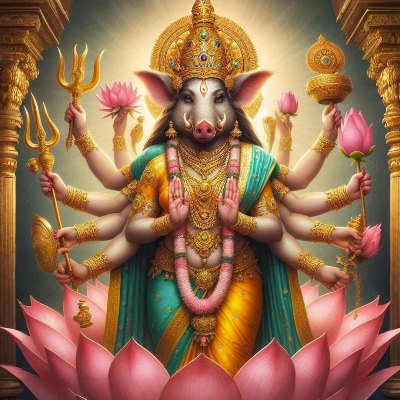
Varahi is consistently described across Puranic and Tantric sources with a woman's body and the face of a sow — the female pig or wild boar. Her complexion is described as dark, resembling a storm cloud. She wears the karanda mukuta — a tall conical crown in diminishing tiers — and is adorned with coral ornaments and ankle-bracelets. Her principal weapons across different scriptural sources include the hala (plough), the musala or musula (pestle or cudgel), and various combinations of the danda (staff), khadga (sword), khetaka (shield), pasha (noose), ankusha (goad), shakti (spear), and saranga bow depending on the text and tradition. The Vishnudharmottara Purana gives a six-armed form holding the danda, khetaka, khadga, and pasha in four hands, with the remaining two in abhaya and varada mudra. The Purva-Karanagama gives her the saranga bow, hala, and musala. The Agni Purana gives her the gada, shankha, sword, and ankusha. The Devi Purana gives sword, iron club, pasha, and khetaka. Her vahana is most commonly the buffalo, Mahisha, though she is also depicted on a lion, a boar, the serpent Shesha, and a lotus pedestal. In the Khadgamala tradition of the Sri Vidya, she is stationed at the North-West of the Bhupura, guarding one of the eight directional positions of Tripura.
✦ References
Primary Sources
- Brahmanda Purana, Lalitopakhyana, sections 216–217 and 271–273 and 331 — Primary source for Varahi's birth from Lalita's five flower arrows, the mace created from Lalita's eyebrow, the appointment as Dandanatha, the Tiraskarinika episode, the Madyasamudra episode, and the killing of Vishukra with plough and pestle.
- Lalita Sahasranama, Name 70: Kirichakra-ratharoodha-dandanatha-puraskrita; Names encoding the Vishukra and Vishanga killings — Establishes Varahi's chariot and her role in the war within the thousand names; also presents the reversed attribution of the killings relative to the Lalitopakhyana narrative.
- Devi Mahatmya (Markandeya Purana) — One of the earliest texts establishing Varahi as one of the seven Matrikas; records her creation by Durga to combat demon armies.
- Matsya Purana — Records the iconographic description of Varahi as a Matrika.
- Vishnudharmottara Purana — Provides the six-armed iconographic description including the danda, khetaka, khadga, pasha, abhaya, and varada.
- Purva-Karanagama — Records the sarnga bow, hala, and musala as Varahi's weapons.
- Agni Purana — Describes Varahi wielding gada, shankha, sword, and ankusha.
- Devi Purana — Records sword, iron club, pasha, and khetaka as Varahi's weapons; includes the Raktabija episode.
- Tantra-Raja-Tantra — Identifies Varahi with the principle of pride and ahamkara within the framework of the eight Matrikas as eight unfavourable dispositions.
- Parashurama Kalpasutra — Elevates Varahi to Para Vidya status within the Sri Vidya tradition; specifies midnight as the time of her worship.
- Bhavanopanishad — Associates the eight Matrikas including Varahi with unfavourable dispositions of consciousness.
Modern and Secondary Reference Works
- Lalitopakhyana Synopsis (srilalithatripurasundari.wordpress.com) — Section 331 confirms Dandanatha Devi (Potrini) killed Vishanga with plough and pestle in the primary Lalitopakhyana text; explicitly notes the reversal in the Lalita Sahasranama attributions.
- Srilalithatripurasundari.wordpress.com — Commentary on Name 70 — Confirms that Dandanatha pulled Vishanga with her plough and killed him with her pestle; confirms the Kiri Chakra's movement in step with the Sri Chakra and Geya Chakra; records the Madyasamudra episode and the boon of sacrificial usage.
- Nivniks.wordpress.com — Sri Lalitopakhyana Part 10 — The most detailed narrative account of the Dandanatha-Mantrini simultaneous engagement against Vishukra and Vishanga; records the Tarsha-Astra, the Madyasamudra response, and the Sahasranama attribution differences with both specific name references.
- Scribd — Glimpses of LalitOpakhyana Through Lalitha Sahasranama — Provides the scholarly explanation of the attribution discrepancy: the Lalitopakhyana narrated by Hayagriva from the front of the army gives Vishukra to Shyamala and Vishanga to Varahi; the Sahasranama narrated by the Vak Devis from the seventh tier of the Sri Chakra Raja chariot reverses these; both versions with narrators identified.
- Wikipedia — Varahi article (en.wikipedia.org/wiki/Varahi) — Confirms her principal names, weapons, vahanas, five Tantric forms, and the Sri Vidya elevation to Para Vidya status; records the Parashurama Kalpasutra's specification of midnight worship.
- Wisdomlib — Varahi definition (wisdomlib.org/definition/varahi) — Records the full range of iconographic descriptions across the Matsya, Agni, Devi, and Vishnudharmottara Puranas; confirms the Tantra-Raja-Tantra identification with ahamkara; records the Khadgamala tradition's placement of Varahi at the North-West of the Bhupura.
- Sri Rajarajeswari Peetham — Sri Varahi Devi (srirajarajeswaripeetham.org) — Confirms her birth from Lalita's flower arrows, identifies her with ahamkara tattva, and records the cosmological correspondence of Varahi with Pingala Nadi and the four upward triangles of the Sri Chakra, contrasted with Rajashyamala's Ida Nadi and five downward triangles.
- Kamakoti Mandali — A List from Lalitopakhyana (kamakotimandali.com) — Confirms the Lalitopakhyana's internal identification of Varahi with Lalita's ahamkara within the correspondence table.