
About
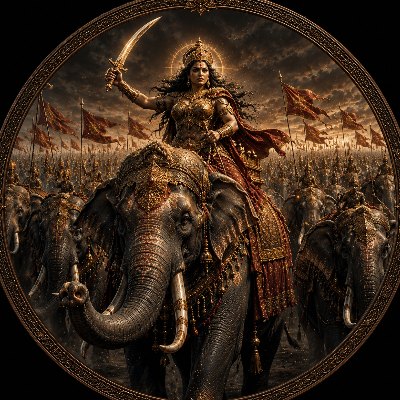
Sampatkari — Chief of Lalita's Elephant Army, Born from the Divine Goad
Sampatkari · Sampatkaridevi · Sampatkari Devi · Sambathkari · Sukasampatkari
Sampatkari is a goddess of the Sri Vidya tradition who serves as the commander of the elephant army of Lalita Tripura Sundari — the Sindhura Vraja, the regiment of elephants — within the Shakti Sena. She was born from the ankusha — the elephant goad — held in one of Lalita's four hands, and at the moment of her emergence she was accompanied by crores upon crores of the finest elephants. She rode as her personal mount the great elephant Ranakolahala — whose name means battle-uproar or one who delights in the clamour of war. In the battle against Bhandasura she confronted and killed the demon commander Durmada on the first day of the war. She is named in the sixty-sixth name of the Lalita Sahasranama, Sampatkari-samaroodha-sindhura-vraja-sevita — she who is attended by herds of elephants under the command of Sampatkari — and is identified in the Lalita Sahasranama commentary and the Svatantra Tantra as a deity of considerable independent Tantric significance with a three-syllable bija mantra and her own Vidya known as the Sampatkari Vidya. She is attested in the Brahmanda Purana's Lalitopakhyana, the Lalita Sahasranama, and the Kamakoti Mandali's correspondence list drawn from the primary Lalitopakhyana text.
✦ The Name
The name Sampatkari is a Sanskrit compound formed from sampat — wealth, prosperity, abundance, or good fortune — and kari — one who brings, one who makes, or one who bestows. Sampatkari thus means the bestower of wealth, the one who creates abundance, or the one who brings good fortune. In the Sri Vidya context, wealth carries a theological depth beyond material prosperity: the Lalita Sahasranama commentary on Name 66 interprets Sampatkari as fullness of a joyous state of mind — the inner richness of a consciousness resting in its own completeness rather than seeking externally. The same commentary offers a philosophical reading of Sukasampatkari as the ability to distinguish the knower, the known, and knowledge as a single undivided experience — the state of turiya or the fourth consciousness, which alone is permanent, and which constitutes the highest sampat or wealth. The name of her elephant, Ranakolahala — the one who delights in battle-uproar — stands in precise contrast to Sampatkari's own peaceable name, making the pairing of peaceful name and fierce mount a theologically deliberate juxtaposition.
✦ Origin from Lalita's Goad
The Lalitopakhyana (section 223) records that Sampatkari emerged from Lalita's ankusha — the elephant goad — along with crores and crores of elephants, all of which followed Lalita as her elephant regiment. The ankusha in Lalita's four-armed iconography represents the power of repulsion — the force that directs the mind away from what hinders and turns it toward what liberates — and also encodes the qualities of krodha and jnana — righteous wrath and knowledge — as recorded in the Anandamoyee source. Sampatkari, born from this instrument, embodies the directive force of concentrated purpose: the power that marshals enormous resources — the elephant being the symbol of wealth, memory, and unstoppable forward movement — and channels them toward a single end. The ankusha function of repelling obstacles finds its military expression in Sampatkari's elephant army, whose purpose was to break through the demonic formations arrayed against the Shakti Sena.
The Kamakoti Mandali correspondence list from within the Lalitopakhyana itself identifies Sampatkari as arising from Lalita's goad — consistent across all primary text accounts. The Hindu-blog.com source states that Sampatkari emerged from the pasha (noose), attributing the noose-origin to Sampatkari and the goad-origin to Ashvarudha. This is the reverse of the primary text as confirmed by the omshivashakti.wordpress.com primary narrative, the India-guide.blogspot.com account, and all three Scribd sources; accordingly that secondary attribution is not followed here.
✦ Divine Relationships and Position
- Creator and sovereign: Lalita Tripura Sundari — the supreme goddess, from whose ankusha Sampatkari was born and whose elephant regiment she commands.
- Counterpart in creation: Ashvarudha — who emerged from Lalita's pasha (noose) at the same time as Sampatkari's emergence from the goad, and who commands the cavalry regiment of the Shakti Sena. The two goddesses are frequently paired in worship and ritual, as they represent the two primary non-chariot divisions of Lalita's army — elephants and horses.
- Position in the Shakti Sena: Sampatkari commanded the elephant regiment — the Sindhura Vraja — of the Shakti Sena. She occupied a subordinate but direct command position under the supreme triad of Lalita, Matangi, and Varahi, and was one of the first commanders to engage the enemy on the first day of the war.
- Bodyguard role for Bala Tripurasundari: The Amritanilayam source confirms that when Bala Tripurasundari rode out to battle the thirty sons of Bhandasura, Sampatkari and Ashvarudha stood alongside Matangi and Varahi as her escort. This establishes Sampatkari's protective function toward the child form of the Goddess in addition to her combat command role.
✦ The Killing of Durmada
On the first day of the war against Bhandasura, Sampatkari's elephant regiment was the formation that engaged the initial wave of Bhandasura's commanders. The demon commander Durmada — whose name means one with bad intoxication or fierce pride — was dispatched by Bhandasura against the Shakti Sena on this day. The Lalitopakhyana narrative records that as Durmada realised his ground forces were being overwhelmed by Sampatkari's elephants, he entered personal combat, arriving mounted on a camel. In the fierce exchange that followed, Durmada succeeded in striking and destroying one gem from Sampatkari's crown. Sampatkari, enraged by this, unleashed her arrows upon him and killed him by piercing his heart. The killing of Durmada on the first day established Sampatkari as the dominant force in the initial phase of the war and secured the Shakti Sena's opening advantage.
✦ The Lalita Sahasranama and the Deeper Purport
The sixty-sixth name of the Lalita Sahasranama — Sampatkari-samaroodha-sindhura-vraja-sevita — records Lalita as attended by herds of elephants ridden by Sampatkari. The Lalita Sahasranama commentary on this name provides two layers of meaning. At the literal level it describes the elephant regiment following Lalita into battle. At the philosophical level it encodes the state of sukasampatkari — the fullness of joyous awareness — in which the apparent multiplicity of sense-objects (represented by the herds of elephants, each elephant being an aggregate of sound, form, taste, touch, and smell in the Kashmirian philosophical reading of the name's deeper meaning) is perceived as a unified experience of consciousness. The commentary states that the ability to distinguish the knower, the known, and the act of knowing as simultaneously different and unified constitutes the turiya state, and that in great yogins this state — called sampatkari — is permanent.
The same name contains a concealed three-syllable bija-akshara used in the Sampatkari Vidya — identified in the commentary as the bija krom, composed of the syllables ka, ra, and ma with a bindu. The commentary records: ka stands for joy and fame; ra, as the bija of agni, bestows supernatural powers — any mantra containing ra confers such powers; ma stands for comforts in the present and future births. The full bija krom thus encodes the complete range of Sampatkari's blessings — worldly joy, supernatural power, and sustained wellbeing across lifetimes.
✦ The Sampatkari Vidya
The Lalita Sahasranama commentary on Name 66 identifies the Sampatkari Vidya as a distinct and very powerful Tantric practice. The Neivedhyam commentary on the same name confirms that Sampatkari is described in the Svatantra Tantra as a deity of unimaginable power with a three-syllable bija-akshara. The manblunder.com source records that the bijas hsauh and shaukh form the incomplete mantra of Ardhanarisvara within her Vidya. The full Sampatkari Vidya is considered secretive — its bija is described as concealed within the Sahasranama name itself, making the recitation of the name simultaneously a practice of the Vidya. In this framework, Sampatkari is not merely a military figure within the Lalitopakhyana's war narrative but a self-contained deity with an independent Tantric worship tradition, a specific bija mantra, and a philosophical significance within the Sri Vidya framework.
✦ Iconography and Worship
Sampatkari Devi is depicted riding the great elephant Ranakolahala — who delights in war — surrounded by millions of the finest elephants of the divine realms. The Astroved source records that she holds a sword resembling the eyebrows of Yama, the god of death — a weapon emphasising her capacity for swift and final destruction of the demonic. She is presented in the iconographic tradition in a martial form consistent with her role as the commander of the elephant regiment rather than in a seated devotional form, though secondary sources also emphasise her wealth-bestowing and prosperity-granting aspects in the context of devotee worship.
The elephant as her symbolic instrument connects Sampatkari to a deep complex of Indic associations: the elephant embodies memory, wisdom, royal authority, abundance, and unstoppable forward movement. The elephant's connection to rain clouds — both being associated with abundance and water — further ties Sampatkari to the domain of material prosperity she governs for her devotees. The worship of Sampatkari Devi is believed to bring material wealth, the satisfaction of legitimate desires, and the spiritual richness of a consciousness resting in its own fullness.
✦ References
Primary Sources
- Brahmanda Purana, Lalitopakhyana, section 223–225 — Primary source for Sampatkari's birth from Lalita's ankusha (goad), the emergence of the crores of elephants accompanying her, the elephant Ranakolahala, and the parallel emergence of Ashvarudha from the pasha (noose).
- Lalita Sahasranama, Name 66: Sampatkari-samaroodha-sindhura-vraja-sevita — The primary scriptural encoding of Sampatkari's role as commander of the elephant regiment within the thousand names of Lalita; contains the concealed bija of the Sampatkari Vidya.
- Lalita Sahasranama, Name 9 (Sampatkari reference in the earlier names) — The Lalita Sahasranama commentary notes that Sampatkari Devi is first discussed at Name 9, where the bija krom is first identified; confirming her significance is established early in the Sahasranama.
- Svatantra Tantra — Records Sampatkari as a deity of unimaginable power with a three-syllable bija-akshara; the primary Tantric source for the Sampatkari Vidya.
Modern and Secondary Reference Works
- Omshivashakti.wordpress.com — Lalitopakhyana: The Story of the Goddess Lalita, sections 223–225 — Provides the primary text narrative of Sampatkari's emergence from the goad, the elephant Ranakolahala, and the first-day battle with Durmada including the destruction of the gem from her crown and her killing of Durmada with heart-piercing arrows.
- India-guide.blogspot.com — Lalitopakhyanam, Story of Lalita Tripura Sundari — Corroborates the primary text sequence: Sampatkari from the ankusha riding Ranakolahala, Ashvarudha from the pasha riding Aparajita; details the confrontation with Durmada on his camel and Sampatkari's victory.
- Scribd — Glimpses of LalitOpakhyana Through Lalitha Sahasranama (both editions) — Confirms Sampatkari as chief of the elephant army from the goad; records the first-day killing of Durmada by Sampatkari and Kurunda by Ashvarudha.
- Srilalithatripurasundari.wordpress.com — Commentary on Name 66: Sampatkari-samaroodha-sindhura-vraja-sevita — Provides the most detailed commentary on the name's literal and philosophical dimensions including the sukasampatkari interpretation, the turiya state, and the bija krom analysis.
- Krishnaseshadri.wordpress.com — Thousand names of Lalita: Name 66 — Confirms that Sampatkari sprang from the goad of Lalitambika, rides Ranakolahala, and is followed by millions of the finest elephants; provides the deeper philosophical purport of sampatkari as the transient and permanent states of turiya consciousness.
- Anandamoyee.home.blog — Sri Sampatkari Devi Mantra — Records the sequence of Lalita's creations from her four weapons: goad producing Sampatkari, noose producing Ashvarudha, sugarcane bow producing Mantrini, five arrows producing Varahi; provides the theological significance of the ankusha as encoding krodha and jnana.
- Kamakoti Mandali — A List from Lalitopakhyana (kamakotimandali.com) — Confirms the Lalitopakhyana's internal identification of Sampatkari with Lalita's goad.
- Manblunder.com — Sri Sampatkari Devi Mantra — Records the bijas hsauh and shaukh as forming the incomplete mantra of Ardhanarisvara within the Sampatkari Vidya; confirms that Sampatkari is worthy to be wielded by Lalita as a divine instrument.
- Nivniks.wordpress.com — Sri Lalitopakhyana Part 7 — Confirms the sequence of the army's formation: Sampatkari's elephant regiment following Lalita Devi into battle in the army advance.