
About
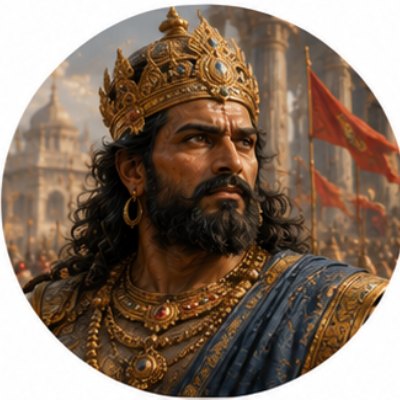
Anenas — The Unbending Sovereign of the Solar Dynasty
Anenas · Anena · An-enas
Anenas is a sovereign king of the Solar Dynasty, the Surya Vansha, who ruled from the capital of Ayodhya as part of the foundational Ikshvaku lineage. He is the son of the celebrated emperor Kakutstha — the warrior king who, under the name Puranjaya, rode the transformed Indra into a cosmic battle against the Asuras and whose exploit gave the dynasty its permanent hereditary epithet — and the father of King Prithu of Ayodhya, who continued the succession after him. His place in the genealogical record is consistently attested across the Vishnu Purana, the Bhagavata Purana, and the Valmiki Ramayana, all three of which name him explicitly as the generational link between Kakutstha and Prithu in the long Solar descent that eventually reaches Dasharatha and his son Rama. The name Anenas carries the meaning of sinless or blameless in Sanskrit, a designation that the tradition treats as reflective of the moral character associated with his reign. No independent narrative episode is attributed to him in the primary sources; his significance is genealogical and dynastic, as the king who preserved and transmitted the prestige and territorial continuity of the Ayodhya throne across the generation immediately following his father's epoch-defining rule.
✦ The Name
The name Anenas is a compound formed from the Sanskrit negative prefix an- and enas, meaning sin, transgression, or fault. The compound therefore carries the meaning sinless, blameless, or one free from transgression. The name functions in the Puranic genealogical context both as a personal designation and as an implicit characterisation of the king's reign — the bestowal of such a name upon a Solar Dynasty monarch signals the tradition's presentation of him as a ruler of moral rectitude who upheld dharmic order without deviation or reproach.
In older Vedic literature, the term anenas appears independently as an exalted descriptive epithet applied to forces or beings of pristine, unblemished quality — pure atmospheric currents, untainted cosmic energies — carrying a sense of elemental purity that predates its use as a royal personal name. The adoption of this term as a dynastic name for an Ikshvaku king situates the Puranic figure within a broader Vedic semantic tradition in which blamelessness is treated as both a spiritual and a political virtue of the highest order.
✦ Lineage
- Great-grandfather: Ikshvaku — eldest son of Vaivasvata Manu, the seventh Manu and progenitor of the current human race, founder of the royal house of Ayodhya, and patriarch of the Solar Dynasty from whom all Ikshvaku kings descend.
- Grandfather: Vikukshi, also known as Shashada — son of Ikshvaku, whose epithet Shashada, meaning the rabbit-eater, was acquired after he consumed a hare from a ritual food offering, leading to a temporary banishment by his father on the counsel of the sage Vasishtha before his eventual restoration to the succession.
- Father: Kakutstha, born Puranjaya — the emperor whose defining exploit was riding the transformed Indra, king of the gods, in the form of a great white bull into battle against the Asuras, defeating the demon host and earning the name Kakutstha, meaning he who sat upon the hump, which thereafter became the hereditary dynastic epithet borne by all kings of his lineage.
- Son and successor: Prithu — king of Ayodhya, not to be confused with the primordial earth-sovereign Prithu Vainya of separate Puranic tradition, who milked the earth in the form of a cow to restore abundance; this Prithu is the Ikshvaku Prithu of the Solar Dynasty, son of Anenas and father of Visvagasva.
- Grandson: Visvagasva, also rendered Visvagashva — son of Prithu and the next generational link in the Ayodhya succession after Anenas's immediate line.
No wife or wives of Anenas are named in any of the primary sources consulted. The texts record only the patrilineal succession.
✦ Textual Attestation
Anenas is one of the more consistently attested figures in the early portion of the Solar Dynasty king-list, appearing by name in three of the principal primary sources for the Ikshvaku genealogy. The Vishnu Purana at Book 4, Chapter 2 records the succession explicitly, naming him as the son of Kakutstha and the father of Prithu, and continuing the line through Prithu to Visvagasva. The Bhagavata Purana at Canto 9, Chapter 6 corroborates this sequence, placing Anenas in the same generational slot and recording the same three-generation chain of Kakutstha, Anenas, and Prithu. The Valmiki Ramayana at Bala Kanda, Sarga 70 includes Anenas in the formal genealogical recitation delivered by the sage Vasishtha before Rama's wedding in Mithila, situating him between Kakutstha and Prithu in the unbroken descent from Ikshvaku to Rama. This triple attestation across the Vishnu Purana, the Bhagavata Purana, and the Valmiki Ramayana makes Anenas's position in the Solar Dynasty succession among the more securely established placements in this portion of the dynastic record.
✦ Textual Variants and Inconsistencies
The principal textual ambiguity associated with the name Anenas concerns its assignment across generations rather than any dispute about the existence of the figure. As noted in connection with the reign of Kakutstha, the Bhagavata Purana at Canto 9, Chapter 6 presents Puranjaya, Kakutstha, and Anenas as three names of a single individual — the king who rode Indra into battle — rather than treating Anenas as a distinct successor. Under this reading, Kakutstha and Anenas are the same person, and the name Anenas functions as a third personal epithet of the celebrated emperor rather than as the name of his son. The Vishnu Purana and the Valmiki Ramayana, by contrast, treat Anenas as a separate individual and a distinct generation, the son of Kakutstha and the father of Prithu. The two textual traditions therefore disagree on whether Anenas is a name or a person — an epithet of the father or the identity of the son. The Vishnu Purana and Ramayana version, which assigns Anenas to a separate generation, is the more widely followed in mainstream Puranic genealogical scholarship, but the Bhagavata Purana's conflation of the three names is a genuine alternative reading within the primary tradition and cannot be set aside.
✦ Connection to the Wider Genealogy
Anenas stands four generations from the founding patriarch of the Solar Dynasty, counting from Ikshvaku. Through his son Prithu and grandson Visvagasva the line descends through a long succession of Ayodhya kings, eventually reaching the celebrated emperor Mandhata — son of Yuvanashva, who is himself a descendant in this same line — whose reign is among the most extensively narrated in the Puranic accounts of the Solar Dynasty's middle period. The descent continues further through many generations to Trishanku, Harishchandra, Sagara, Bhagiratha, Dilipa, Raghu, Aja, Dasharatha, and finally to Rama, the seventh avatar of Vishnu and the hero of the Valmiki Ramayana. As a lineal ancestor of Rama, Anenas is among the kings enumerated in the formal ancestral recitation that establishes the purity and antiquity of the Solar line at the time of Rama's wedding — his name serving, in the Ramayana's usage, as one of the generational proof-points in the unbroken chain from the primordial Ikshvaku to the divine hero of the Treta Yuga.
✦ References
Primary Sources
- Vishnu Purana, Book 4, Chapter 2: The foundational genealogical source for this profile, recording the explicit three-generation succession of Kakutstha, Anenas, and Prithu, and continuing the line to Visvagasva; treats Anenas as a distinct individual and separate generation from Kakutstha.
- Bhagavata Purana, Canto 9, Chapter 6, verse 33: Corroborates the succession of Kakutstha to Anenas to Prithu to Visvagasva, though the same chapter also presents the three names Puranjaya, Kakutstha, and Anenas as belonging to a single king, creating the textual ambiguity discussed in the Variants section.
- Valmiki Ramayana, Bala Kanda, Sarga 70: Includes Anenas by name in the formal genealogical recitation of Rama's Solar ancestry delivered by Vasishtha before the wedding at Mithila, situating him between Kakutstha and Prithu and treating him as a distinct generational figure.
Secondary and Reference Sources
- Wisdomlib — definition entry for Anenas: Aggregates references to Anenas across multiple Puranic texts and provides cross-references to the relevant passages in the Vishnu Purana and Bhagavata Purana; useful for confirming the range of sources and noting the name-versus-person ambiguity.
- F. E. Pargiter, Ancient Indian Historical Tradition (1922): Provides systematic comparison of Solar Dynasty king-lists across the major Puranas, including analysis of the divergences between Bhagavata and Vishnu Purana treatments of the Kakutstha-Anenas-Prithu sequence, directly relevant to the Variants section of this profile.
- Vettam Mani, Puranic Encyclopaedia (1975): Supplies a consolidated reference entry for Anenas within the Ikshvaku lineage, drawing on both epic and Puranic sources and noting his position as a stable genealogical link in the early Solar succession.