
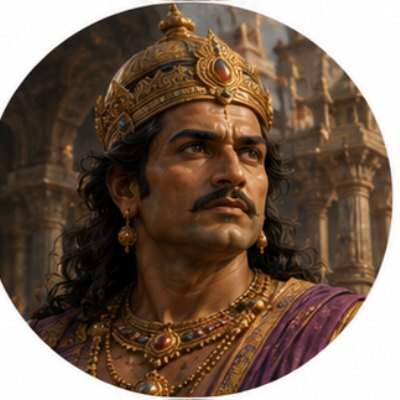
About
Ardra — King of Ayodhya of the Solar Dynasty
Ardra · Ardri · Adri · Anardra
Ardra is a king of the Solar Dynasty, the Surya Vansha, who ruled from the capital of Ayodhya as part of the foundational Ikshvaku lineage. He is the son of King Visvagashva — a monarch celebrated in the Mahabharata for his strict observance of vegetarianism and his sustained practice of cow-gifting to sages and the needy, through which he is said to have attained elevated celestial merit — and the father of King Yuvanashva I, through whom the Solar line continues its long descent toward the later imperial kings of Ayodhya. His position in the dynastic succession is recorded in the Vishnu Purana, corroborated by the Vayu Purana, the Brahma Purana, the Bhagavata Purana, and the Mahabharata, all of which name him as the generational link between Visvagashva and Yuvanashva I in the Ikshvaku king-list. No extended narrative episode is attributed to Ardra in any of the primary sources; his significance in the tradition is genealogical, as a structurally necessary bridge between the earliest generations of the Solar Dynasty and the line of kings through whom the dynasty reaches its later imperial zenith under Mandhata and its theological culmination in Rama, the seventh avatar of Vishnu.
✦ The Name
The name Ardra derives from the Sanskrit root meaning wet, moist, or fresh — carrying connotations of vitality, fertility, and life-giving moisture. In the Vedic and astrological traditions, Ardra is also the name of the sixth nakshatra, the lunar mansion associated with the star Betelgeuse, which is governed by the deity Rudra and is regarded as a nakshatra of storm, transformation, and fierce energy. Whether the royal name was intended to invoke these associations directly cannot be established from the primary sources, which do not offer an explicit etymology for the king's name. The variant spellings Ardri and Adri found in certain Puranic manuscripts, and the form Anardra noted in some regional traditions, are treated by commentators as orthographic or scribal variants referring to the same figure rather than as evidence of distinct individuals, since the genealogical position across all variant spellings is consistent — son of Visvagashva, father of Yuvanashva I.
✦ Lineage
- Founding patriarch: Ikshvaku — eldest son of Vaivasvata Manu, the seventh Manu and progenitor of the current human race, founder of the royal house of Ayodhya, and patriarch of the Solar Dynasty from whom all Ikshvaku kings descend.
- Great-great-grandfather: Kakutstha, born Puranjaya — the emperor whose defining exploit was riding the transformed Indra, king of the gods, in the form of a great white bull into battle against the Asura host, defeating the demons, restoring the heavenly realms to the Devas, and earning the name Kakutstha, meaning he who sat upon the hump, which became the hereditary dynastic epithet borne by all his descendants.
- Great-grandfather: Anenas — king of Ayodhya, son of Kakutstha, whose name carries the Sanskrit meaning of sinless or blameless; recorded in the Vishnu Purana and the Valmiki Ramayana as a distinct generational figure and immediate successor of Kakutstha, though the Bhagavata Purana presents Anenas as one of three names belonging to Kakutstha himself.
- Grandfather: Prithu of Ayodhya — king of the Solar Dynasty, son of Anenas, to be distinguished from the entirely separate figure of Prithu Vainya, the primordial earth-sovereign of a different Puranic tradition whose exploit of milking the earth in the form of a cow belongs to a lineage unconnected to the Ikshvaku Solar line.
- Father: Visvagashva — king of Ayodhya, son of Prithu, celebrated in the Mahabharata's Anushasana Parva for his practice of complete abstention from meat as an expression of ahimsa and for his sustained gifting of cows to sages and the needy, through which he is recorded as having attained elevated celestial standing.
- Son and successor: Yuvanashva I — king of Ayodhya, son of Ardra, and the next generational link in the Solar Dynasty succession; to be distinguished from the later Yuvanashva whose miraculous circumstances of birth, drinking a consecrated ritual liquid intended for his wives and thereby gestating and giving birth to a son from his own abdomen, produced the celebrated emperor Mandhata.
- Grandson: Shravasta — son of Yuvanashva I, a Solar Dynasty king credited in the tradition with the founding of the ancient city of Shravasti, one of the major urban centres of early Indian history and a site of enduring religious importance in both the Hindu and Buddhist traditions.
No wife or wives of Ardra are named in any of the primary sources consulted. The texts record only the patrilineal succession.
✦ Textual Attestation
Ardra's position in the Solar Dynasty king-list is confirmed across multiple primary sources. The Vishnu Purana at Book 4, Chapter 2 provides the most explicit genealogical statement, recording that the son of Prithu was Visvagashva, the son of Visvagashva was Ardra, and the son of Ardra was Yuvanashva — establishing the three-generation chain with precision. The Vayu Purana and the Brahma Purana corroborate this succession in their respective Solar Dynasty genealogical chapters. The Bhagavata Purana at Canto 9, Chapter 6 tracks this branch of the Ikshvaku line and places Ardra within it consistently with the Vishnu Purana's ordering. The Mahabharata at Vana Parva, Chapter 20, verses 3 and 4, lists Ardra by name in its genealogical enumeration of the ancient Ikshvaku kings, recording him as the successor of Visvagashva and the father of Yuvanashva. The convergence of these independent textual traditions on the same genealogical placement makes Ardra's position one of the more securely attested nodes in this portion of the early Solar Dynasty succession.
✦ Textual Variants and Inconsistencies
The primary textual variation associated with Ardra concerns his name rather than his genealogical placement, which remains stable across all major sources. The forms Ardri and Adri appear in different manuscript traditions of the Puranas alongside the primary form Ardra, and the variant Anardra is noted in certain regional manuscript traditions. These variants are consistently mapped to the same generational position — son of Visvagashva, father of Yuvanashva I — and are treated by commentators as scribal or orthographic divergences rather than as indicators of separate figures. No substantive narrative divergence between these name-variant traditions has been identified in the sources consulted. The Vayu Purana and Brahma Purana accounts of his reign note an absence of famine and crime as characteristics of his rule, a detail not foregrounded in the Vishnu Purana's genealogical treatment, but this represents a difference of emphasis rather than a contradiction between texts.
✦ Connection to the Wider Genealogy
Ardra stands seven generations from the founding patriarch Ikshvaku, counting through Vikukshi, Kakutstha, Anenas, Prithu, and Visvagashva before reaching him. Through his son Yuvanashva I and grandson Shravasta — the founder of Shravasti — the line descends through further Solar kings toward the celebrated emperor Mandhata, son of the later Yuvanashva, whose world-conquest and extraordinary birth make him one of the most extensively narrated monarchs in the Puranic accounts of the Solar Dynasty's middle period. The descent continues through Mandhata's line and beyond, passing through Trishanku, whose desire to ascend bodily to heaven became one of the tradition's defining episodes of conflict between royal ambition and brahminical authority, and through Harishchandra, celebrated as the supreme exemplar of truth-keeping among all Solar kings, before continuing further to Sagara, Bhagiratha, Dilipa, Raghu, Aja, Dasharatha, and finally to Rama, the seventh avatar of Vishnu and the hero of the Valmiki Ramayana. Ardra's position as a bridge-generation in the early-to-middle transition of the Solar Dynasty places him among the structurally necessary ancestors through whom the dynastic continuity of the Ayodhya throne was preserved across the long arc from the primordial founding era to the culminating events of the Treta Yuga.
✦ References
Primary Sources
- Vishnu Purana, Book 4, Chapter 2: The foundational genealogical source for this profile, providing the explicit three-generation succession statement naming Visvagashva, Ardra, and Yuvanashva in the Ikshvaku Solar Dynasty king-list.
- Vayu Purana — Solar Dynasty genealogical chapters: Corroborates the Vishnu Purana succession and adds the characterisation of Ardra's reign as a period free from famine and crime.
- Brahma Purana — Solar Dynasty genealogical chapters: Replicates the succession order for this portion of the Ikshvaku line, confirming Ardra's position between Visvagashva and Yuvanashva I.
- Bhagavata Purana, Canto 9, Chapter 6: Tracks this branch of the Ikshvaku lineage from Vikukshi downward through Ardra to Yuvanashva, consistent with the Vishnu Purana's ordering.
- Mahabharata, Vana Parva, Chapter 20, verses 3–4: Lists Ardra by name in the ancient genealogical enumeration of the Ikshvaku kings, recording him as the successor of Visvagashva and the father of Yuvanashva.
Secondary and Reference Sources
- Vettam Mani, Puranic Encyclopaedia (1975): Supplies the consolidated reference entry for Ardra within the Ikshvaku lineage, drawing on the Vishnu Purana and Mahabharata passages and noting the variant name forms across manuscript traditions.
- Wisdomlib — definition entry for Ardra: Aggregates cross-references to Ardra across multiple texts and identifies the relevant primary passages, useful for confirming the range of sources in which the name appears and for tracking the orthographic variants.
- F. E. Pargiter, Ancient Indian Historical Tradition (1922): Provides systematic comparison of Solar Dynasty king-lists across the major Puranas, confirming the consistent placement of Ardra between Visvagashva and Yuvanashva I and noting the name variants across manuscript traditions.