
About
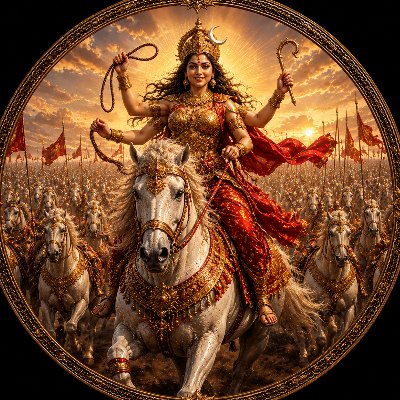
Ashvarudha — Chief of Lalita's Cavalry, Born from the Divine Noose
Ashvarudha · Ashwarudha · Ashwaroodha · Asvarudha · Ashvarudha Devi · Pratyanga Devi of Lalita
Ashvarudha is a goddess of the Sri Vidya tradition who serves as the commander of the cavalry — the horse regiment — of Lalita Tripura Sundari's Shakti Sena. She was born from the pasha — the noose — held in one of Lalita's four hands, and at the moment of her emergence she was accompanied by crores upon crores of swift horses that moved in advance of Lalita's chariot. She rode as her personal mount the great horse Aparajita — the Undefeated — described as white and as one that cannot be conquered. In the battle against Bhandasura she confronted and killed the demon commander Kurunda on the first day of the war, and subsequently destroyed the twenty-akshauhini army of the demon Karundasura. She is named in the sixty-seventh name of the Lalita Sahasranama, Ashvarudhadhishtitatashvakotikotibhiravruta — she who is attended by crores of horses under the command of Ashvarudha. Her dhyana shloka is preserved in the Shilparatna. She is identified as the Pratyanga Devi of Lalita Tripura Sundari — the subsidiary limb-goddess — and is attested in the Brahmanda Purana's Lalitopakhyana, the Lalita Sahasranama, and the Tripura Siddhanta.
✦ The Name
The name Ashvarudha is a Sanskrit compound formed from ashva — horse — and rudha — mounted, riding, or one who has ascended. Ashvarudha thus means the one who is mounted on a horse or the rider of the horse. As the commander of the cavalry she is named by her function and her mount simultaneously — a naming convention that makes her identity inseparable from the regiment she leads. The philosophical reading of the name, preserved in the Neivedhyam commentary on Name 67, expands this: ashva — horse — is an allegory for the five senses (indriyas), and the mind, which rides and directs the senses, is the true Ashvarudha. The mind is the rider; the senses are its horses; and Ashvarudha as a deity embodies the power of the disciplined mind that masters and channels the senses toward divine purpose rather than worldly distraction. The name of her horse Aparajita — the Undefeated — carries precise theological weight: the mind that has mastered the senses cannot be conquered by worldly forces.
✦ Origin from Lalita's Noose
The Lalitopakhyana (section 225) records that Ashvarudha emerged from Lalita's pasha — the noose — along with a vast army of swift horses which then moved in front of Lalita's chariot as the advance cavalry. The pasha in Lalita's four-armed iconography represents attachment or bondage — specifically the power that binds consciousness to the manifest world, and simultaneously the power that can be turned to bind and capture the demonic. From this noose-weapon came a goddess whose own weapon of choice is also the pasha, which she deployed in battle to bind demonic armies with fiery serpent-like ropes. Ashvarudha thus embodies the noose's dual function: she was born from the instrument of attachment and became the master of that same principle — the controller of what binds, and thereby the liberator of those whose senses are bound by demonic forces rather than by divine intention.
✦ Divine Relationships and Position
- Creator and sovereign: Lalita Tripura Sundari — the supreme goddess, from whose pasha (noose) Ashvarudha was born and whose cavalry regiment she commands.
- Position as Pratyanga Devi: Ashvarudha is identified in the Sri Vidya tradition as the Pratyanga Devi of Lalita — the subsidiary limb-goddess or the goddess of secondary limbs — placing her in a specific hierarchical relationship to the supreme goddess distinct from Bala Tripurasundari (Anga Devi, the primary limb-goddess) and Annapurna Devi (Upanga Devi, the supplementary limb-goddess). This tripartite structure of Anga, Upanga, and Pratyanga defines Ashvarudha's position as the most external of the three limb-goddess relationships.
- Counterpart in creation: Sampatkari — who emerged from Lalita's ankusha (goad) at the same moment as Ashvarudha's emergence from the noose, and who commands the elephant regiment. The two are paired throughout the Lalitopakhyana's army narrative and in subsequent worship tradition as the twin commanders of Lalita's non-chariot mobile forces.
- Position in the army advance: The Lalitopakhyana records that Ashvarudha's cavalry moved in front of Lalita's chariot — leading the advance of the entire Shakti Sena — while Sampatkari's elephants followed the chariot from behind. This placement of Ashvarudha at the vanguard confirms the cavalry's function as the forward striking force of the divine army.
- Escort for Bala Tripurasundari: When Bala rode out to battle Bhandasura's thirty sons, Sampatkari accompanied her as one of the bodyguards. In the broader account of the army's deployment, both Sampatkari and Ashvarudha are associated with Bala's personal escort during battle, establishing their protective function toward the child form of the Goddess.
✦ The First Day: The Killing of Kurunda
On the first day of the war, while Sampatkari's elephants engaged and killed Durmada, Ashvarudha's cavalry moved against Kurunda — one of the commanders dispatched by Bhandasura on the opening day of the battle. The spiritualmasala.blogspot.com account, drawing on the Lalitopakhyana narrative, provides the most detailed description of this engagement. Ashvarudha rode forward on Aparajita, leading her cavalry regiment directly against Kurunda's forces. Aparajita, the divine horse, fought independently — striking demons with its hooves and producing sounds so terrible that entire segments of Kurunda's army fell into unconsciousness. Ashvarudha deployed her pasha against the demonic army: from the noose emerged multiple fiery ropes resembling serpents that bound the demons and rendered them unconscious. Infuriated, Kurunda shot a single arrow that destroyed Ashvarudha's bow entirely. She responded by driving her ankusha — the elephant goad — directly into his heart. The weapon drained all his blood and killed him on the spot. He fell, the primary text records, as a great tree falls when struck by Indra's vajra.
The Lalitopakhyana synopsis (section 258) confirms this conclusion more briefly: Ashvarudha Devi killed Kurunda by piercing his chest with her spear, and the remaining demons fled. The weapon is identified as a spear in one account and as the ankusha (driven into the heart) in the more detailed version — the distinction may reflect different translational choices for the same weapon or different moments of the same encounter.
✦ The Destruction of Karundasura's Army
The Hindu-blog.com source records an additional engagement not detailed in the first-day narrative: Ashvarudha overpowered and annihilated a twenty-akshauhini army under the command of the demon Karundasura. This engagement extended her role beyond the opening-day battle with Kurunda and established her as a major independent force across the multi-day war. The name Karundasura — distinct from Kurunda — indicates this was a separate demonic commander encountered in the later phases of the battle.
✦ The Lalita Sahasranama and the Deeper Purport
The sixty-seventh name of the Lalita Sahasranama — Ashvarudhadhishtita-ashvakotikotibhiravruta — records Lalita as attended by crores of horses ridden by Ashvarudha. The Neivedhyam commentary on this name provides the philosophical dimension: horses represent the five sense organs. The mind, which rides and directs the senses, is the true Ashvarudha. The mind accomplishes its purposes through the indriyas, and is their overlord. The Devi Mahatmya (5.77) is cited in this context as stating that the Goddess is the overlord of the senses of all beings in the world. Ashvarudha is thus simultaneously the narrative commander of the cavalry regiment and the philosophical embodiment of the mind's mastery over the senses — the internal counterpart to the external war her horses fight.
The Tripura Siddhanta, cited in the Neivedhyam commentary, records that Ashvarudha originated from Lalita's noose and rides the horse named Aparajita — the Undefeated. The Undefeated horse as the mount of the goddess who embodies the master of the senses carries the philosophical implication that a consciousness which has truly mastered its sensory apparatus cannot be overcome by any external force — it is by definition the Undefeated.
✦ Iconography
Ashvarudha Devi is described as having four arms. She holds in her hands the pasha (noose or rope), the ankusha (goad), a small whip or cane, and the reins of her horse. She wears red garments. Her face is positive and joyful — a deliberate contrast to the fierce faces of the more terrifying Shakti commanders. She wears the crescent moon on her head. She is depicted as mounted on Aparajita, the white horse, and surrounded by crores of horses. She shines with the brilliance of the rising sun, described as wearing shining armour. The dhyana shloka encoding her canonical form is found in the Shilparatna — a classical Indian text on iconographic specifications — and images of Ashvarudha Devi are found in temple sculptures in Kerala, with a wooden sculpture at Thuravoor Narasimha Swami Temple and mural paintings in multiple Kerala temples attesting an active regional worship tradition.
The primary symbolic meaning of Ashvarudha Devi in the worship context is control of the mind. The horse as a symbol of the mind moving rapidly in all directions — pursuing sense objects with the speed and unpredictability of an untrained horse — is one of the most consistent metaphors in the Sanskrit philosophical tradition, appearing in the Katha Upanishad's famous chariot allegory. Ashvarudha Devi, as the mistress of horses, is propitiated by devotees specifically for gaining control of the mind — bringing the mind's scattered energies into a unified and disciplined focus directed toward the Divine.
✦ References
Primary Sources
- Brahmanda Purana, Lalitopakhyana, sections 225–226 and 257–258 — Primary source for Ashvarudha's birth from the pasha, the horse Aparajita, her cavalry's advance position before Lalita's chariot, and the killing of Kurunda on the first day of battle.
- Lalita Sahasranama, Name 67: Ashvarudhadhishtita-ashvakotikotibhiravruta — The primary scriptural encoding of Ashvarudha's role as commander of the cavalry within the thousand names of Lalita.
- Tripura Siddhanta — Records that Ashvarudha originated from Lalita's noose and rides the horse named Aparajita; cited in the Neivedhyam commentary on Name 67.
- Devi Mahatmya (Markandeya Purana), 5.77 — States that the Goddess is the overlord of the senses of all beings in the world; cited in the philosophical interpretation of Ashvarudha's identity as the master of the senses.
- Shilparatna — Contains the dhyana shloka of Ashvarudha Devi providing the canonical iconographic description of her four-armed form, weapons, mount, and appearance.
Modern and Secondary Reference Works
- Omshivashakti.wordpress.com — Lalitopakhyana: The Story of the Goddess Lalita, sections 225–226 and 257–258 — Provides the primary text narrative of Ashvarudha's emergence from the pasha, the horse Aparajita, and the killing of Kurunda on the first day.
- Spiritualmasala.blogspot.com — Legends of the Goddess-7 — Provides the most detailed narrative of the battle with Kurunda including Aparajita's independent combat, the fiery snake-ropes from the pasha, Kurunda's destruction of Ashvarudha's bow, and her killing of Kurunda with the ankusha driven into his heart.
- Scribd — Glimpses of LalitOpakhyana Through Lalitha Sahasranama (both editions) — Confirms Ashvarudha as chief of the horse army from the noose; records the first-day killing of Kurunda by Ashvarudha immediately after Sampatkari's killing of Durmada.
- Blushingunseen.blogspot.com — Lalitasahasranama 003 — Confirms Ashvarudha's emergence from the pasha and the advance position of the cavalry before Lalita's chariot; provides the overall army formation sequence.
- Krishnaseshadri.wordpress.com — Thousand names of Lalita: Name 67 — Provides the deepest philosophical commentary: horses as allegory for the five senses, the mind as the true Ashvarudha, and the Tripura Siddhanta citation for her origin and mount.
- Hindu-blog.com — Ashwarooda Devi: About Hindu Goddess Aswaruda Devi — Confirms her four-armed iconography (pasha, ankusha, whip, reins), red garments, crescent moon headdress, joyful expression, and devotional significance for mind-control; records the killing of Karundasura's twenty-akshauhini army; confirms her dhyana shloka in the Shilparatna and sculptural presence in Kerala temples.
- Srilalithatripurasundari.wordpress.com — Commentary on Bala Tripurasundari sections — Identifies Ashvarudha as the Pratyanga Devi of Lalita within the tripartite limb-goddess framework (Anga Devi: Bala; Upanga Devi: Annapurna; Pratyanga Devi: Ashvarudha).
- Kamakoti Mandali — A List from Lalitopakhyana (kamakotimandali.com) — Confirms the Lalitopakhyana's internal identification of Ashvarudha with Lalita's noose (pasha) within the correspondence table of the Goddess's weapons and their generated forms.