
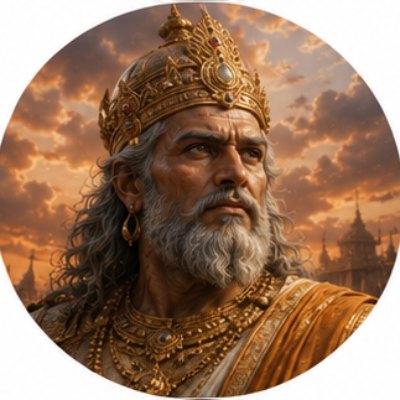
About
Prishadasva — Succession King of the Solar Dynasty
Prishadasva · Prishadashva · Prsadasva · Trasadasva · Tradashva
Prishadasva is a king of the Solar Dynasty, the Surya Vansha, who ruled from the capital of Ayodhya as part of the early Ikshvaku lineage. He is the son of King Anaranya — a monarch of Ayodhya who was slain in single combat by the demon king Ravana during the latter's campaign of world conquest — and the father of King Haryashva, who continued the dynastic succession after him. His place in the Puranic genealogical record is confirmed principally by the Vishnu Purana and the Bhagavata Purana, both of which anchor him as a generational link in the long chain of Solar kings that eventually descends to Trishanku and, many generations further, to the hero Rama, son of Dasharatha. Prishadasva's biographical significance lies less in any independently narrated episode than in his role as the king who secured the continuity of the Ayodhya throne at a moment when the dynasty had been struck by the violent loss of his father.
✦ The Name
The name Prishadasva is a compound of two Sanskrit elements: Prshat, meaning a spotted deer or a drop of liquid, and Ashva, meaning a horse. The compound has been interpreted as meaning one whose horses are as swift as spotted deer, or one who rides upon rain-bearing steeds, the latter reading connecting the image of rain-drops to the speed and force of a cavalry charge. In early Vedic literature, the compound Prshadashva functions independently as a poetic epithet applied to the Maruts, the storm wind deities who form the retinue of Indra, the king of the gods. In this Vedic usage the term evokes horses of the stormcloud or dappled steeds of the atmospheric host. The application of the same compound as a personal royal name in the Puranic genealogies is a separate usage, though the resonance with the Vedic epithet lends the name a martial and elemental quality appropriate to a Kshatriya king. The variant spellings Trasadasva and Tradashva found in certain manuscript traditions of the Bhagavata Purana represent copyist variations rather than distinct names; commentators consistently assign these forms to the same generational position in the dynastic list.
✦ Lineage
- Great-grandfather: Trasadasyu — a celebrated Vedic king of the Solar line, remembered in Rigvedic hymns as a powerful monarch and a favourite of Indra and Varuna, whose patronage enabled him to rule with great prosperity.
- Grandfather: Sambhuta — son of Trasadasyu and a generational link in the Ikshvaku succession between the celebrated Vedic king and the later Puranic lineage.
- Father: Anaranya — king of Ayodhya, son of Sambhuta, who met his death in a direct confrontation with Ravana, the demon king of Lanka, during Ravana's campaign of world conquest. As Anaranya lay dying he is recorded in the Valmiki Ramayana as having pronounced a prophecy that a descendant born in his line would one day be the instrument of Ravana's destruction.
- Son and successor: Haryashva — also rendered Haryyaswa in some manuscripts — who continued the Ayodhya succession after Prishadasva and through whom the dynastic line proceeded toward the later Solar kings.
No wife or wives of Prishadasva are named in any of the primary Puranic sources consulted. The texts record only the patrilineal succession.
✦ The Martyrdom of Anaranya and the Ascent of Prishadasva
The political context for Prishadasva's accession is provided by the episode of Ravana's Digvijaya — his campaign of conquest across the known world — as narrated in the Uttara Kanda of the Valmiki Ramayana. During this campaign, Ravana arrived at Ayodhya and demanded that its reigning king, Anaranya, submit to him and acknowledge his supremacy. Anaranya refused and chose to meet Ravana in battle rather than yield the sovereignty of Ayodhya. The duel ended with Anaranya's defeat and death at Ravana's hands. Before dying, Anaranya delivered a curse and prophecy directed at Ravana: that a descendant of his own royal line would eventually cause Ravana's destruction. This prophecy is understood within the broader Ramayana tradition as an anticipation of Rama, born many generations later in the same Solar lineage.
Following his father's death, Prishadasva succeeded to the throne of Ayodhya. The Puranic texts do not narrate any specific military campaigns, administrative measures, or personal episodes associated with his reign. His significance in the genealogical record is that of a stabilising successor — the king who held the dynasty intact across the generation immediately following a catastrophic royal death and ensured that the line continued to his son Haryashva.
✦ Textual Variants and Inconsistencies
The Vishnu Purana, at Book 4, Chapter 3, provides the clearest and most direct statement of the succession, recording that the son of Anaranya was Prishadasva and the son of Prishadasva was Haryashva. The Bhagavata Purana at Canto 9, Chapter 7 corroborates this placement in the dynastic sequence, confirming Prishadasva as a king of the Ikshvaku line who reigned in the period well before the events of the Treta Yuga's culminating episodes. In certain regional manuscript traditions of the Bhagavata Purana, the name appears in the variant forms Trasadasva or Tradashva. These are generally treated by commentators as scribal corruptions rather than as evidence of a separate figure, since the genealogical position — son of Anaranya, father of Haryashva — is consistently maintained across the variant readings.
The episode of Anaranya's death at Ravana's hands is narrated in the Valmiki Ramayana's Uttara Kanda and functions as the primary context for understanding why Prishadasva's accession mattered dynastically, but the Ramayana itself does not narrate Prishadasva's reign in any detail. The genealogical texts and the epic thus complement rather than contradict one another, the Puranas supplying the king-list and the Ramayana supplying the narrative background.
✦ Connection to the Wider Genealogy
Prishadasva stands within the long descent from Ikshvaku — eldest son of Vaivasvata Manu, the seventh Manu and progenitor of the current human race — who founded the royal house of Ayodhya and initiated the Solar Dynasty's principal ruling line. Through his son Haryashva, the line passes forward through successive generations to reach Trishanku, the king whose desire to ascend bodily to heaven while alive became one of the Puranic tradition's most celebrated episodes of conflict between royal ambition and brahminical authority. Further down the same descent, many generations after Trishanku, the line produces Dasharatha, king of Ayodhya, and Dasharatha's son Rama — the hero of the Valmiki Ramayana and the seventh avatar of Vishnu in the Vaishnava theological tradition. The dying prophecy of Prishadasva's father Anaranya, that a descendant of his line would destroy Ravana, is thus fulfilled, within the narrative logic of the tradition, by Rama — Prishadasva's own lineal descendant.
✦ References
Primary Sources
- Vishnu Purana, Book 4, Chapter 3, verse 18: The foundational genealogical text for this profile, explicitly recording the father-son-grandson succession of Anaranya, Prishadasva, and Haryashva in the Ikshvaku line.
- Bhagavata Purana, Canto 9, Chapter 7, verse 4: Corroborates Prishadasva's position in the dynastic sequence and provides the broader chronological context of the early Ikshvaku kings reigning before the Treta Yuga's principal events.
- Valmiki Ramayana, Uttara Kanda: Narrates the episode of Ravana's world conquest, the duel between Ravana and Anaranya, Anaranya's death, and the dying prophecy that a descendant of his line would destroy Ravana — providing the narrative context for Prishadasva's accession.
Secondary and Reference Sources
- Wisdomlib — definition entries for Prishadashva and Anaranya: Aggregates cross-references to both figures across multiple Puranic texts and identifies the relevant primary passages; useful for confirming the range of sources in which the names appear.
- Ancientvoice (ancientvoice.wikidot.com) — entry for Prishadaswa: Provides a compiled genealogical summary drawing on the Vishnu Purana and Bhagavata Purana king-lists, useful for cross-checking generational placement.
- Sanskritsahitya.org — Vishnu Purana 4.3.18: Provides the Sanskrit text of the relevant verse, enabling direct verification of the genealogical statement naming Prishadasva as son of Anaranya and father of Haryashva.
- Sanskrit Dictionary (sanskritdictionary.com) — entry for Prsadasva: Provides etymological analysis of the compound name and its Vedic usage as an epithet of the Maruts, supporting the name-meaning section of this profile.