
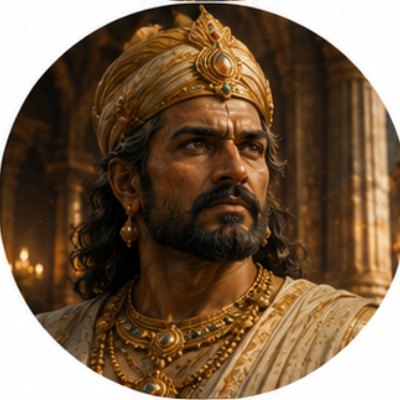
About
Tridhanvan — King of Ayodhya, Son of Vasumanas, Father of Trayyaruna
Tridhanvan · Tridhanva · Tridhanvaa
Tridhanvan was a king of the Ikshvaku dynasty of Ayodhya, belonging to the Solar lineage, the Suryavamsha, and is placed in the Treta Yuga by the genealogical traditions of the Puranas. He is the son of King Vasumanas and the father of King Trayyaruna, who would in turn father the celebrated and controversial Satyavrata — the prince who became Trishanku. Through this line, Tridhanvan stands as the great-grandfather of King Harishchandra, the legendary exemplar of absolute truth-telling, and a more distant ancestor in the Solar dynastic succession that ultimately produced Rama, the seventh avatar of Vishnu. Tridhanvan's presence in the tradition is almost entirely genealogical: he appears consistently in the dynastic vamsha lists of the major Mahapuranas and the Harivamsa as a link in the Solar succession, but no independent narrative episode is devoted to him in any primary text. His profile accordingly reflects the limited textual base available.
✦ The Name
The name Tridhanvan is a Sanskrit compound of tri, meaning three, and dhanvan, meaning bow or wielder of a bow. The compound thus signifies one who wields three bows or who is possessed of three bows, a formulation that in the epic and Puranic naming tradition typically connotes exceptional martial prowess. The variant spelling Tridhanva represents a common scribal contraction of the same name across different Puranic manuscript traditions and carries no distinct meaning apart from the full form. No etymological gloss or explanation of the name's significance is provided by any primary Puranic source, and the name is attested solely in genealogical list contexts rather than in narrative passages that might illuminate its significance.
✦ Lineage
- Dynasty: Ikshvaku dynasty, Suryavamsha (Solar lineage), ruling from Ayodhya
- Father: King Vasumanas, a king of Ayodhya in the Solar line, recorded in the Puranic dynastic lists as Tridhanvan's immediate predecessor on the throne; his name also appears in some manuscript traditions as Sumana or Vasuman
- Son: King Trayyaruna, the strictly dharmic king of Ayodhya who banished his own heir, Prince Satyavrata, for the forcible abduction of a Brahmin's bride, and who died during the period of his son's exile
- Grandson: King Satyavrata, later known as Trishanku — the king cursed to the form of a Chandala who, through the intervention of the sage Vishvamitra, was elevated to a specially created heaven where he remains suspended inverted for eternity
- Great-grandson: King Harishchandra, celebrated throughout the Puranic and epic traditions as the supreme exemplar of truth-keeping under suffering, who inherited the throne of Ayodhya after Trishanku's ascent and suspension
✦ Textual Attestation and the Limits of the Record
Tridhanvan's presence in the tradition is confined to the vamshanuchrita — dynastic succession lists — found in the major Mahapuranas and the Harivamsa. The Harivamsa, in its Harivamsa Parva, records the generational sequence explicitly, naming Tridhanvan as the son of Vasumanas and identifying Trayyaruna as the son of Tridhanvan. The Vishnu Purana, in its fourth book, includes the same genealogical sequence, placing Tridhanvan in the line of Solar kings between Vasumanas and Trayyaruna. The Bhagavata Purana's ninth book similarly records this dynastic position. The Brahma Purana's genealogical sections are consistent with these accounts.
None of these texts devotes a narrative passage to Tridhanvan himself. He is not the subject of any major episode in the Valmiki Ramayana, which mentions the Solar dynastic lineage in its Bala Kanda in the context of the Trishanku and Vishvamitra narrative but does not pause at Tridhanvan's generation. No act, judgment, war, sacrifice, or interaction with sages is attributed to Tridhanvan in any primary source text consulted.
The claim that the sage Vishvamitra served as Tridhanvan's chief minister or advisor during his reign is not corroborated in any primary Puranic or epic source and is accordingly omitted from this profile. Vishvamitra's narrative interactions in the primary texts are with Trishanku and with later figures in the Solar line, not with Tridhanvan.
✦ Textual Variants
The name of Tridhanvan's father varies across manuscript traditions. The Harivamsa gives Vasumanas or Vasuman as the father's name. Some Puranic genealogical lists record the same figure under the names Sumana or Sudhanva, and in certain manuscript variants the name Paarjitar also appears in this generational slot. These variations appear to reflect scribal and regional recension differences across the Puranic textual tradition rather than genuinely independent genealogical accounts. The core sequence — that Tridhanvan stood between Vasumanas and Trayyaruna in the Solar succession — is stable across all major sources.
No contradictions between primary texts concerning Tridhanvan's son or grandson have been identified; the identification of Trayyaruna as his son and Satyavrata-Trishanku as his grandson is consistent across the Harivamsa, the Vishnu Purana, the Bhagavata Purana, and the Brahma Purana.
✦ Connection to the Wider Genealogy
Tridhanvan stands in the long dynastic succession of the Solar line descending from Ikshvaku — son of Manu Vaivasvata, himself the son of the sun-god Vivasvat and the progenitor of humanity in the present cosmic age. The line passes through many generations of Ayodhya kings before reaching Vasumanas, then Tridhanvan, then Trayyaruna, and then Satyavrata-Trishanku, whose son Harishchandra continued the line. From Harishchandra the succession proceeds through Rohitasva and a further sequence of kings to Bhagiratha — the monarch who, through extraordinary austerities, succeeded in bringing the sacred river Ganga from the heavens to earth — and thence through Raghu and Dasharatha to Rama. Tridhanvan's significance within this genealogy is structural: he is the generational link who carried the Solar dynasty forward from Vasumanas to the period of dramatic events — the transgressions of Satyavrata, the rivalry between Vasishtha and Vishvamitra, and the creation of Trishanku's suspended heaven — that would define the generations immediately following his own.
✦ References
Primary Sources
- Harivamsa, Harivamsa Parva, Chapter 12: The most explicit primary source for Tridhanvan's genealogical position; names him directly as the son of Vasumanas and the father of Trayyaruna in the Solar dynastic succession.
- Vishnu Purana, Book 4, Chapter 3: Records the Solar dynastic sequence and places Tridhanvan between Vasumanas and Trayyaruna, identifying him as the grandfather of Satyavrata-Trishanku.
- Bhagavata Purana, Skandha 9: Includes Tridhanvan in the Solar vamsha list in a position consistent with the Harivamsa and Vishnu Purana accounts.
- Brahma Purana, dynastic genealogy sections: Records the same generational sequence, consistent with the other major Puranic sources.
- Valmiki Ramayana, Bala Kanda: Narrates the Solar dynastic lineage as background to the Trishanku episode; does not devote independent narrative content to Tridhanvan but situates him within the generational context.
Secondary and Reference Sources
- Vettam Mani, Puranic Encyclopaedia (1975): Synthesises genealogical data on Tridhanvan from across the major Puranic sources and cross-references his position in the Solar dynastic succession.
- Robert P. Goldman (trans.), The Ramayana of Valmiki, Vol. 1: Balakanda (Princeton University Press, 1984): Critical translation and annotation providing genealogical context for the Solar dynasty within which Tridhanvan is situated.