
About
Jwalamalini — Goddess of the Garland of Flames, Builder of the Fire Wall, and Fourteenth Nitya Devi
Jwalamalini · Jvalamalini · Jvalamalini Devi · Srijwalamalini · Vahni Devi (Jain tradition)
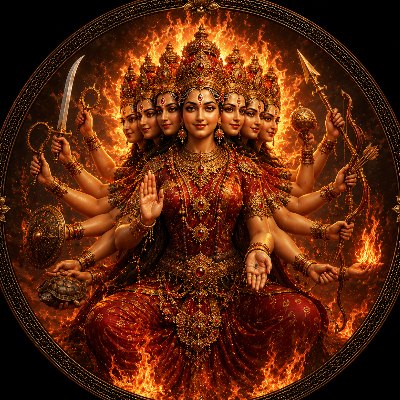
Jwalamalini is a goddess of fire and one of the fifteen Nitya Devis — the eternal lunar goddesses of the Sri Vidya tradition. She is the fourteenth among the Nityas, governing the Chaturdashi tithi — the fourteenth lunar day — in both the waxing and waning phases of the moon. In the Lalitopakhyana of the Brahmanda Purana she performs two distinct and pivotal acts during the war against Bhandasura: first, she glows with self-illuminating radiance alongside the fifth Nitya Vahnivasini, making invisible demons visible in the darkness and thereby enabling the full assembly of sixteen Nitya Devis to destroy Vishanga's night-attacking army; second, at Lalita's direct instruction following the night attack, she constructs a vast compound wall of fire around the entire Shakti Sena — one hundred yojanas wide and thirty yojanas tall — that protected the divine army for the remainder of the war. She is named in the seventy-first name of the Lalita Sahasranama, Jvalamalinikakshipta-vahniprakara-madhyaga — she who is in the middle of the fort of fire created by Jwalamalini. She is described as bright as flaming fire with a ruby crown, six faces, twelve arms, and weapons spanning the full range of cosmic instruments. She appears in the Brahmanda Purana, the Vayu Purana, the Matsya Purana, the Tantraraja Tantra, the Nityashodashikarnava, and in the Jain Tantric tradition as a Yakshi of great power.
✦ The Name
The name Jwalamalini is a Sanskrit compound formed from jwala — flame, blaze, or burning fire — and malini — one who wears a garland, the garland-bearer. Jwalamalini thus means the one who wears a garland of flames, or the one adorned with blazing fire. The name encodes her identity at the most immediate level of appearance — fire not merely as a weapon she deploys but as her permanent ornament, as intrinsic to her as a garland of flowers to a devotional deity. In the Jain tradition she is known as Vahni Devi — the fire goddess — where vahni means fire or the carrier of fire, making the fire-identification equally explicit in that tradition. The Srijwalamalini reference in some texts adds the honorific Sri, acknowledging her as the auspicious and supreme form of this fire-principle.
✦ Identity as the Fourteenth Nitya Devi
The fifteen Nitya Devis are the eternal lunar goddesses of the Sri Vidya tradition, each governing one of the fifteen visible tithis or lunar days. They are understood as the fifteen rays or kalas of the moon, emanating from the supreme consciousness of Lalita Tripura Sundari herself — who constitutes the invisible sixteenth kala, the unchanging essence behind all lunar phases. Jwalamalini governs the Chaturdashi — the fourteenth tithi — in both the waxing phase (Shukla Chaturdashi) and the waning phase (Krishna Chaturdashi). The Chaturdashi is the tithi immediately preceding the full moon in the waxing phase and immediately preceding the new moon in the waning phase — the penultimate tithi in each cycle, placed at the threshold of completion and dissolution respectively. Jwalamalini as the fire-garland goddess governs this threshold position with the transformative energy of fire, which simultaneously purifies and destroys, illuminates and consumes. She is the fourth Nitya in some orderings, and the fourteenth in others; the shodash nitya sadhana and arunraj.org sources both confirm her as the fourteenth of the fifteen visible Nityas. The srividya-sadhana.com source places her as the fourth Nitya — this reflects a different counting sequence used in some traditions.
✦ The Lunar Kalas She Rules
The tantra.press source records that Jwalamalini rules over the kalas of the sun — twelve solar kalas, the moon — sixteen lunar kalas, and fire — ten fire kalas. These thirty-eight kalas are each attended by a pair of divine beings, making her full retinue seventy-six attendants. This governance over the solar, lunar, and fire kalas simultaneously gives Jwalamalini a cosmological scope that extends beyond the single tithi she governs in the lunar cycle and identifies her as a deity of the full spectrum of luminous time — the light of the sun, the reflected light of the moon, and the produced light of fire all falling under her domain.
✦ Role in the War: The Night Illumination
The Lalitopakhyana (sections 280–286) narrates the crisis that required Jwalamalini's first intervention. Vishanga, informed by spies that the Shakti Sena had insufficient protection on its rear flank, organised a treacherous night attack. In the darkness, his forces approached from behind while Kutilaksha simultaneously attacked from the front. The combined assault from two directions in the dark stupefied the entire Shakti Sena — a crisis distinct from the Jaya-Vighna-Yantra episode and comparable to it in its disruption of the divine army's effectiveness.
The Tithidevatas — the presiding deities of the lunar days — requested Lalita to permit Vahnivasini and Jwalamalini, both Nitya Devis with the capacity of self-illumination, to glow. Lalita agreed. The two fire-goddesses blazed with the radiance of fireballs, instantly illuminating the darkness and making all the demons who had been concealed in it fully visible. With the concealment broken, the full assembly of sixteen Nitya Devis attacked Vishanga's army. All the commanders of the demonic army were killed. Vishanga himself, wounded over his entire body, fled in shame. Kutilaksha also retreated. The Lalita Sahasranama records Lalita's response: nityaparakrama-topa-nirikshana-samutsuka — seeing the valour of the Nitya Devatas, the goddess was extremely pleased.
✦ Role in the War: The Construction of the Fire Wall
Following the night attack, both Mantrini and Dandanatha went to Lalita and expressed their distress at the failure of their protective arrangements. Lalita instructed Jwalamalini to build a compound wall of fire around the entire Shakti Sena. The Lalitopakhyana specifies the dimensions with precision: the fire wall was one hundred yojanas wide and thirty yojanas tall. On the southern end — which faced Shunyapuram, Bhandasura's capital — there was an entry passage one yojana in length through which the Shakti Sena could emerge to fight, so that the defensive perimeter did not immobilise the army. This entry point was placed under the guard of Stambhini Devi, a member of Dandanatha's family retinue who functioned as the pilot of the fire wall's opening.
The seventy-first name of the Lalita Sahasranama — Jvalamalinikakshipta-vahniprakara-madhyaga — encodes this act permanently: Lalita is she who is in the middle of the fort of fire hurled or created by Jwalamalini. The name positions Lalita within the fire compound as its most sacred inner content, protected by the fire wall at its periphery — a theological statement that the supreme consciousness is forever within a protective boundary of transformative fire that no demonic force can cross.
✦ Textual Variant: The Number of Nitya Devis
The Lalitopakhyana synopsis (section 285) states that sixteen Nitya Devis attacked Vishanga's army, while the Nivniks.wordpress.com (Part 9) account states there are sixteen Nitya Devatas in total. The formal count in the Sri Vidya tradition is fifteen visible Nitya Devis plus Lalita herself as the sixteenth — making the total sixteen when Lalita is included in the count. The Lalitopakhyana appears to use the inclusive count of sixteen in the battle context. This is not a contradiction but a different mode of counting: the fifteen Nityas plus their sovereign.
✦ Iconography
The Lalita Sahasranama commentary on Name 71 and the Tantric sources provide a precise description of Jwalamalini's form. She is lustrous as flaming fire, resplendent with a ruby crown. She has six faces, each with three eyes, illumined by a sweet smile — an unusual combination of fierce fire-form and gentle expression that encodes the paradox of fire as simultaneously destructive and benevolent. She has twelve arms. She holds in her twelve hands the noose (pasha), goad (ankusha), sword (khadga), shield (khetaka), bow (dhanus), arrows (bana), mace (musala), tortoise (kurma), spear (shula), and fire (vahni), and displays the gestures of vara (boon-granting) and abhaya (fearlessness) with the remaining two hands. This arsenal of ten held objects plus two gestures gives her the most elaborate weapon-description of any of the six Shakti Sena commanders profiled in this series. She is adorned with all forms of ornament and wears a crown with burning flames in some depictions. The Jain iconographic tradition depicts her with flames issuing from her head.
The Jain Tantric tradition describes Jwalamalini as a Yakshi — a class of divine beings — and associates her with mantras and yantras of considerable power. She carries a chakra, trishul, pennant with a fish ensign, bow and arrow, pasha, fruit, and vara mudra in that tradition. The Jvalinikalpa, a text in the Jain tradition, was composed by Helacharya, a Jain Tantric teacher, who reportedly received her instruction to systematise the occult rites sacred to her. Inscriptions record that exorcising rites were performed in her honour in the Rashtrakuta period. Her association across both the Hindu Shakta and Jain traditions — each recognising her fire-nature and her mantra-power — makes her one of the more extensively attested figures across tradition-boundaries in the Lalitopakhyana's cast.
✦ The Mantra and Yantra
The mantra of Jwalamalini as given in the srilalithatripurasundari.wordpress.com source is: Om sarvamangalayai vidmahe chandratmikayai dhimahi tanno nitya prachodayat. This is a Gayatri-format mantra in which she is identified with the all-auspicious and with the essence of the moon — an integration of fire and lunar consciousness that encodes her position as the fire-kala governing the fourteenth tithi. The Jain tradition employs a distinct mantra. Both traditions prescribe her worship as a powerful means of removing obstacles from the spiritual path, noting that her sadhana has historically been imparted only to deserving disciples due to the intensity of her form and the scope of her powers. The tradition states that even the gods fear her form, while great yogis crave her sadhana precisely in order to remove all obstacles from the path of spiritual development.
✦ References
Primary Sources
- Brahmanda Purana, Lalitopakhyana, sections 284–291 — The primary source for both of Jwalamalini's acts in the war: the self-illumination alongside Vahnivasini to expose the night attackers (section 284), the full Nitya Devi attack on Vishanga's army (section 285), and the construction of the hundred-yojana fire wall with its one-yojana southern entry guarded by Stambhini Devi (sections 288–291).
- Lalita Sahasranama, Name 71: Jvalamalinikakshipta-vahniprakara-madhyaga — The primary scriptural encoding of Jwalamalini's fire wall and Lalita's position within it; Name 72 (Nityaparakrama-topa-nirikshana-samutsuka) encodes Lalita's pleasure at the Nitya Devis' collective valour including Jwalamalini's illumination act.
- Nityashodashikarnava (Vamakeshvara Tantra) — The principal Tantric text of the Sri Vidya tradition enumerating the fifteen Nitya Devis including Jwalamalini as the fourteenth, their mantras, yantras, and cosmic functions.
- Tantraraja Tantra — Describes Jwalamalini's iconography and her cosmic governance of solar, lunar, and fire kalas with her seventy-six attendants.
- Vayu Purana — Associates Jwalamalini with Shiva in the Hindu Puranic tradition; one of the earliest Puranic attestations of the goddess.
- Matsya Purana — Associates Jwalamalini with Shakti in the Puranic tradition.
- Jvalinikalpa — The Jain Tantric text composed by Helacharya systematising the occult rites of Jwalamalini (Vahni Devi) in the Jain tradition; the foundational source for her presence in the Jain Tantric tradition.
Modern and Secondary Reference Works
- Srilalithatripurasundari.wordpress.com — Commentary on Name 71: Jvalamalinikakshipta-vahniprakara-madhyaga — The most detailed secondary source for Jwalamalini's role and iconography; provides the complete twelve-arm weapon list (noose, goad, sword, shield, bow, arrows, mace, tortoise, spear, fire, vara, abhaya), the six-faced three-eyed sweet-smiling description, the ruby crown, the mantra, and the theological significance as a Nitya Devi; states that the goddess can be invoked in a boy or girl for oracular answers about past, present, and future.
- Lalitopakhyana Synopsis (srilalithatripurasundari.wordpress.com) — Sections 284–291 provide the precise narrative sequence of the night illumination, the Nitya Devi assault, and the fire wall construction with exact dimensions; confirms the Lalita Sahasranama encoding of Lalita's pleasure at Nitya Devi valour.
- Nivniks.wordpress.com — Sri Lalitopakhyana Part 9 — Provides the most detailed narrative of the night attack crisis, the Tithidevatas' request, the dual illumination of Vahnivasini and Jwalamalini, the Nitya Devis' assault, and the fire wall instruction with dimensions of one hundred yojanas wide and thirty yojanas tall.
- Wikipedia — Jwalamalini article (en.wikipedia.org/wiki/Jwalamalini) — Confirms her presence in the Brahmanda Purana, Vayu Purana, and Matsya Purana; records the Jain tradition's association of her with Helacharya and the Jvalinikalpa; confirms the Rashtrakuta-period inscriptions of exorcising rites performed in her honour.
- Tantra.press — The Fifteen Nityas in the Crescent Moon — Confirms Jwalamalini's governance of the solar kalas (12), lunar kalas (16), and fire kalas (10); records her seventy-six attendants in pairs; gives her mantra for destroying poison from the Tantraraja.
- Arunraj.org — Nitya Devi — Confirms the complete list of fifteen Nitya Devis with Jwalamalini as the fourteenth, and Lalita as the sixteenth; explains the lunar-tithi correspondence and the waxing-waning departure-return cycle of the Nityas.
- Shivashakti.com — The Fifteen Nityas — Provides additional iconographic and mantra details for the Nitya Devis including the cross-reference between Vahnivasini (the fifth Nitya) and Jwalamalini in the fire-element context.