
About
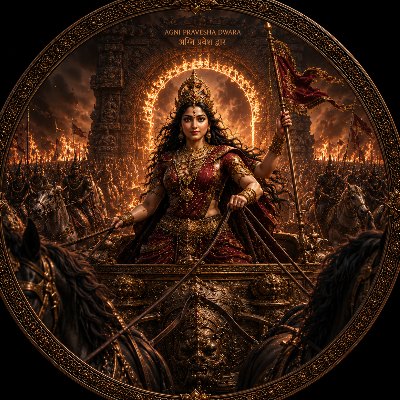
Stambhini — Charioteer of Maha Varahi, Guardian of the Fire Wall Entry, and Rear Commander of the Shakti Sena
Stambhini · Sthambhini · Vighna Devi · Stambhini Devi · Dandanatha Parivara
Stambhini is a goddess of the Shakti Sena — the divine army of Lalita Tripura Sundari — who performed three distinct and documented functions in the Lalitopakhyana of the Brahmanda Purana. She served as the personal charioteer of Maha Varahi, piloting the Kiri Chakra Ratha — the boar-wheeled chariot of the supreme military commander — throughout the war. She guarded the one-yojana entry passage on the southern face of the fire wall built by Jwalamalini, commanding a force of twenty akshauhinis in that defensive role. And she served as the rear commander of the entire Shakti Sena's marching formation, with the narrator Hayagriva recording that he was placed in the vanguard of the army and that Stambhini with the rest of the forces followed behind him. She is described in the Lalitopakhyana as a member of Dandanatha Devi's family — that is, of Varahi's retinue — and is also called Vighna Devi in the primary text, a name whose significance connects her to the domain of obstacle-power that Varahi herself governs. She is attested in the Brahmanda Purana's Lalitopakhyana and in the Scribd compilations of the Lalitopakhyana through the Lalita Sahasranama.
✦ The Names
The name Stambhini — also spelled Sthambhini — derives from the Sanskrit root stambha, meaning a pillar, a post, a support, or the act of fixing in place, making immobile, or paralysing. The suffix ini creates a feminine agent-noun, making Stambhini she who immobilises, she who fixes in place, or she who is the pillar. The stambhana power — the capacity to paralyse or arrest movement — is one of the six principal supernatural powers (Shat Karmas) in the Tantric tradition and is directly associated with Varahi herself, who is described in the Sri Varahi Devasthanam source as the deity of stambhana. That Stambhini — named for this power — serves as Varahi's personal charioteer is thus not incidental: the charioteer of the goddess of paralysis is herself named for the paralysing function, making the pairing a deliberate theological correspondence in the Lalitopakhyana's architecture.
The second name Vighna Devi — the goddess of obstacles or impediments — is applied to her in the primary text in connection with her role guarding the fire wall entry. Vighna means obstacle, impediment, or that which obstructs passage. As the guardian of the one-yojana passage through the fire wall, Stambhini was literally the vighna — the obstacle — placed at the threshold, controlling who could pass and who could not. This name places her in a deliberate structural parallel with Mahaganesha — Vighnanayaka, the lord of obstacles — whose own function in the war was the removal of the Jaya-Vighna-Yantra. Stambhini as Vighna Devi is the constructive counterpart: she creates the obstacle at the threshold rather than removing it.
✦ Lineage and Position
- Affiliation: A member of Dandanatha Devi's family — that is, of the retinue and household of Maha Varahi, the supreme commander of the Shakti Sena. The Lalitopakhyana (section 291 in multiple sources) specifically identifies her as belonging to Dandanatha Devi's family, establishing her subordinate position within Varahi's command structure.
- Sovereign: Maha Varahi (Dandanatha Devi) — for whom Stambhini served as personal charioteer of the Kiri Chakra Ratha.
- Supreme sovereign: Lalita Tripura Sundari — the supreme goddess of the Shakti Sena, at whose indirect command the fire wall was built and its entry guarded.
- Directional superior for the fire wall assignment: Dandanatha Devi personally posted Stambhini at the entrance of the vahni prakara — the fire wall — as confirmed in the Vedadhara (Ramaswamy Sastry) source.
✦ Role as Varahi's Charioteer
The Scribd table compiled from the Lalitopakhyana through the Lalita Sahasranama identifies Stambhini explicitly as the charioteer of the Kiri Chakra Ratha — Maha Varahi's divine chariot. The Amritananda Natha Saraswati source confirms this: the Kiri Chakra chariot was pulled by one thousand boars, and Stambhini Devi served as its charioteer. The Kiri Chakra Ratha was the military vehicle through which Varahi directed the supreme command of the Shakti Sena across all four days of the war, moving in step with the Sri Chakra Raja Ratha of Lalita and the Geya Chakra Ratha of Mantrini. As charioteer, Stambhini was present at every engagement Varahi participated in — including the Madyasamudra episode, the confrontations with Vishukra and Vishanga, and the final phases of the battle. She was not a passive driver but an active commander of the vehicle of the war's supreme military mind.
The role of charioteer in the Sanskrit military tradition carried a significance well beyond mere vehicle operation. The charioteer was the strategist who positioned the warrior, protected the vehicle, maintained situational awareness across the entire battlefield, and whose judgment in placement directly determined the warrior's effectiveness. In the Mahabharata, Krishna's role as Arjuna's charioteer is the most celebrated instance of this principle — the divine intelligence that guides, positions, and protects the divine warrior. Stambhini's role as Varahi's charioteer places her in a structurally analogous position within the Lalitopakhyana's own internal hierarchy: the guiding intelligence behind the army's supreme commander.
✦ Role as Guardian of the Fire Wall Entry
Following the night attack by Vishanga and Kutilaksha and the subsequent construction of the hundred-yojana fire wall by the Nitya Devi Jwalamalini, the fire wall required a controlled entry point through which the Shakti Sena could emerge to fight — since Shunyaka, Bhandasura's capital, lay to the south of the divine army's position. A one-yojana passage was left on the southern face. Dandanatha Devi personally assigned Stambhini to guard this entry with a force of twenty akshauhinis. This assignment made Stambhini the threshold-keeper of the entire divine army's defensive perimeter — the single point of controlled access through the fire barrier that Jwalamalini had erected.
The theological significance of this role is encoded in her secondary name Vighna Devi. The fire wall was an impenetrable barrier; its single entry was the one point of vulnerability — and simultaneously the one point of controlled power, the threshold through which the Shakti Sena could move freely while nothing from outside could enter without Stambhini's assent. Her twenty-akshauhini force was the largest single protective deployment recorded at one position in the war, indicating the strategic importance the divine command placed on that entry point.
✦ Role as Rear Commander of the Shakti Sena
The Scribd Glimpses source preserves an important detail from the Lalitopakhyana's narration: Hayagriva — the horse-faced avatar of Vishnu who serves as the narrator of the Lalitopakhyana to the sage Agastya — reports that he was placed in the forefront of the Shakti Sena's formation, and that Stambhini with the rest of the army followed behind him. This places Stambhini in the rear-command position of the entire marching formation — controlling the rearguard, the most vulnerable position in any advancing army and the position most critical for maintaining the formation's integrity against flanking or encirclement. The night attack by Vishanga and Kutilaksha — which targeted the rear of the divine army — confirms why the rear position was strategically significant. The subsequent posting of Stambhini to guard the fire wall entry on the southern face was thus a natural extension of her existing rearward responsibility.
✦ Theological Significance
Stambhini's three roles — charioteer of the supreme commander, guardian of the defensive threshold, and rear commander of the entire army — together encode a specific theological principle within the Lalitopakhyana's symbolic architecture. The stambhana power she embodies is the capacity to fix, to hold, to make unmovable — and her functions across the war express this principle at every level. As charioteer, she fixes the commander's vehicle in precisely the right position for maximum effectiveness. As threshold guardian, she fixes the entry — making it immovable for the enemy while keeping it open for the Shakti Sena. As rear commander, she anchors the army's formation — preventing it from being destabilised from behind. She is, in the deepest sense, the Shakti Sena's principle of structural stability — the force that holds the divine formation together against all attempts to disrupt it.
Her membership in Varahi's family — not merely her service to Varahi — connects her to the broader domain of Varahi's stambhana power in the Sri Vidya tradition. Varahi is the deity who silences enemies, paralyses evil forces, and dissolves the root of enmity; Stambhini is the member of her household who manifests the stambhana principle at the operational level of the war — at the chariot, at the wall's entry, and at the army's rear.
✦ Textual Note on Stambhini's Limited Attestation
Stambhini is a figure of limited but precise textual attestation. She does not receive an independent narrative episode beyond the three functions recorded above, and the sources do not supply her individual iconographic description, her mantra, or her yantra. Her profile in the tradition is entirely constituted by her roles within the war and her relationship to Varahi. The user's system presents her under the category of Pilot — a modern rendering of the charioteer function — which is confirmed by the primary text's table and narrative. This profile draws on every available primary and secondary source reference to her name and functions, and proportionally represents the scope of her textual presence: precise in what she does, silent on what the tradition does not record about her.
✦ References
Primary Sources
- Brahmanda Purana, Lalitopakhyana, section 291 — The principal primary source for Stambhini as a member of Dandanatha Devi's family, her guardianship of the fire wall entry with twenty akshauhinis, and her designation as Vighna Devi.
- Brahmanda Purana, Lalitopakhyana (chariot table section) — The section from which the Scribd Glimpses table is drawn, confirming Stambhini as the charioteer of Maha Varahi's Kiri Chakra Ratha.
Modern and Secondary Reference Works
- Omshivashakti.wordpress.com — Lalitopakhyana: The Story of the Goddess Lalita, section 291 — Records Stambhini as a member of Dandanatha Devi's family, guarding the fire wall entry with twenty akshauhinis, called Vighna Devi.
- Srilalithatripurasundari.wordpress.com — Lalitopakhyana Synopsis, section 291 — Corroborates the Omshivashakti account word for word: Stambhini Devi, member of Dandanatha Devi's family, with twenty akshauhini senas, protecting the fire wall entry point, called Vighna Devi.
- India-guide.blogspot.com — Lalitopakhyanam: Story of Lalita Tripura Sundari Devi — Confirms the same section 291 details; also records the broader narrative sequence of the fire wall's construction and the Jaya-Vighna-Yantra's discovery by Mahaganesha inside the fire wall after its construction.
- Nivniks.wordpress.com — Sri Lalitopakhyana Part 9 — Confirms Stambhini Devi is referred to as Vighna Devi and as a member of Dandanatha Devi's army; confirms the fire wall dimensions and the southern entry guardianship assignment.
- Vedadhara / Ramaswamy Sastry — Sree Lalitopakhyanam (ramaswamysastry.blogspot.com) — Confirms that Dandanatha personally posted Stambhini to guard the entrance to the vahni prakara; provides the detail of the internal army arrangement: Chakraraja Ratha at the centre, Mantrini and Dandanatha on either side, Sampatkari behind, Ashvarudha in front.
- Amritananda Natha Saraswati — Sri Maha Varahi Meditation Guide (amritananda-natha-saraswati.blogspot.com) — Confirms that the Kiri Chakra chariot was pulled by one thousand boars and that the charioteer was Stambhini Devi; the most direct confirmation of her charioteer role from a secondary source.
- Scribd — Glimpses of LalitOpakhyana Through Lalitha Sahasranama (all three editions) — The chariot table drawn from the primary Lalitopakhyana confirms Stambhini as the charioteer of Maha Varahi's Kiri Chakra Ratha; also records that Hayagriva was placed in the forefront of the army and Stambhini with the rest of the army followed behind him, establishing her rear-commander role; the same source records this placement as relevant to the narrator-reliability analysis of the Vishukra-Vishanga killing attribution.
- Spiritualmasala.blogspot.com — Legends of the Goddess-7 — Confirms that Stambhini Devi, who was a part of the army of Sri Varahi, along with twenty akshauhini sena protected the fire wall entry point; calls her Vighna Devi; records that this was dawn after the night attack.